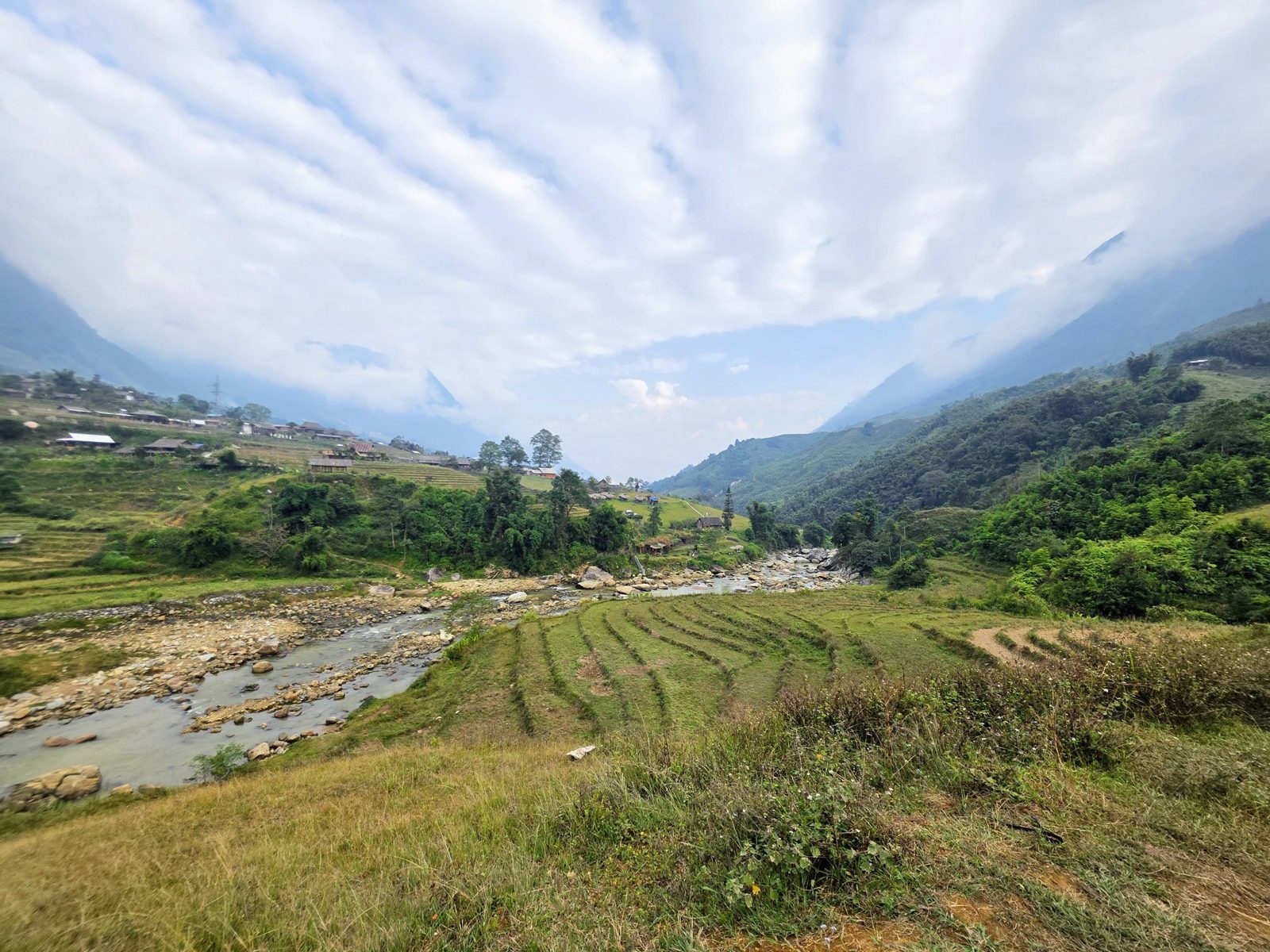
Back from the bay in the late afternoon, and no question of unpacking: tonight, we're sleeping on a train. Destination Lào Cai, in the far north, a stone's throw from China, then the Mường Hoa valley and the village of Tả Van, at the foot of Sapa's rice terraces. The mountains were waiting for us. So was the mist.
October 26 · 6 pm
Around the world in three plates
Before the train, an early dinner. After four days of phở, spring rolls and summer rolls, we fancy something different. We head up to Cultra, a rooftop on Hàng Da Street in the Old Quarter. The menu travels the world, and we follow it: a crispy herb and scallion pancake with an Asian dipping sauce; seafood spaghetti in coconut milk; and a beef quesadilla with pico de gallo and lime.
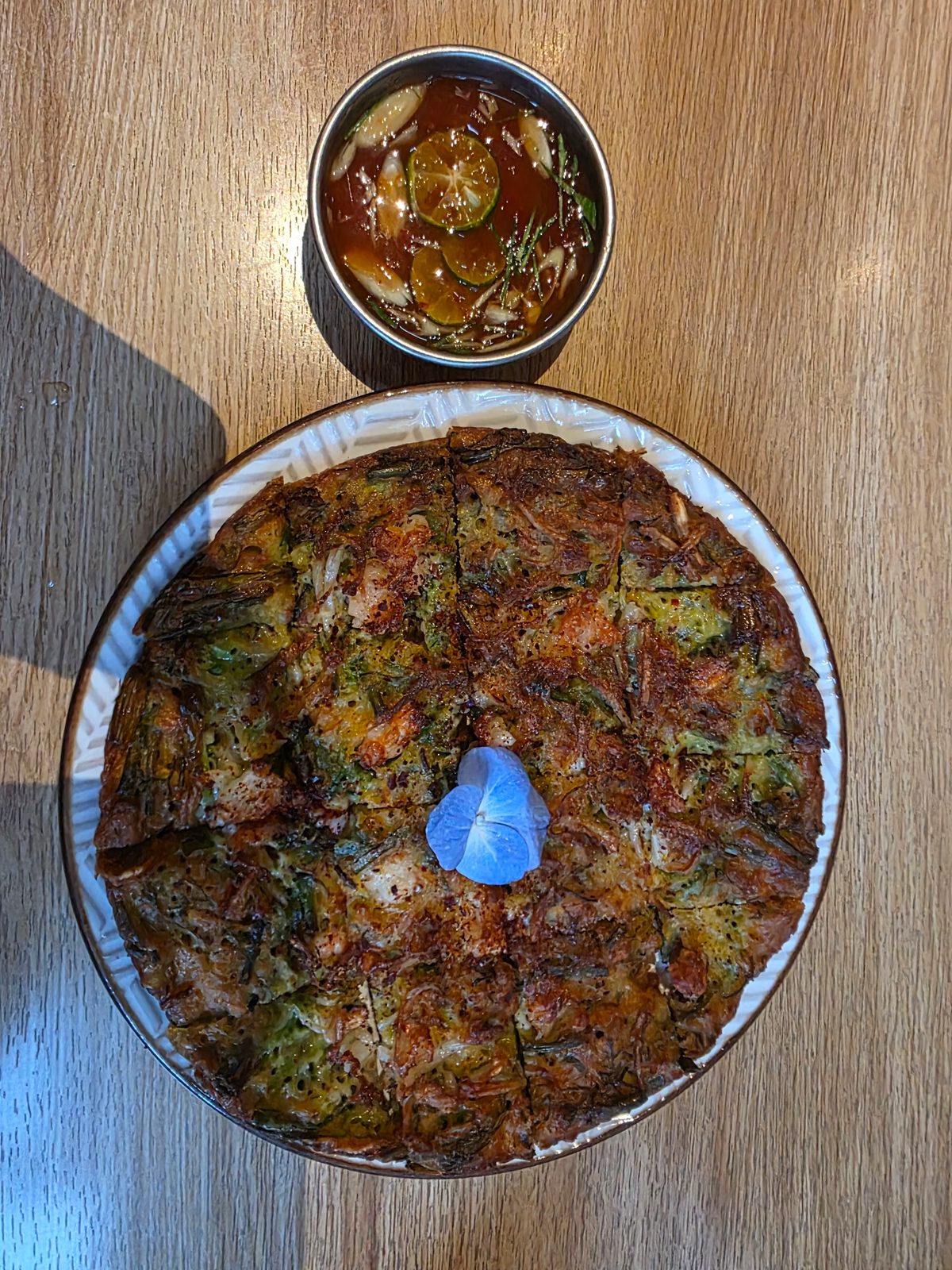
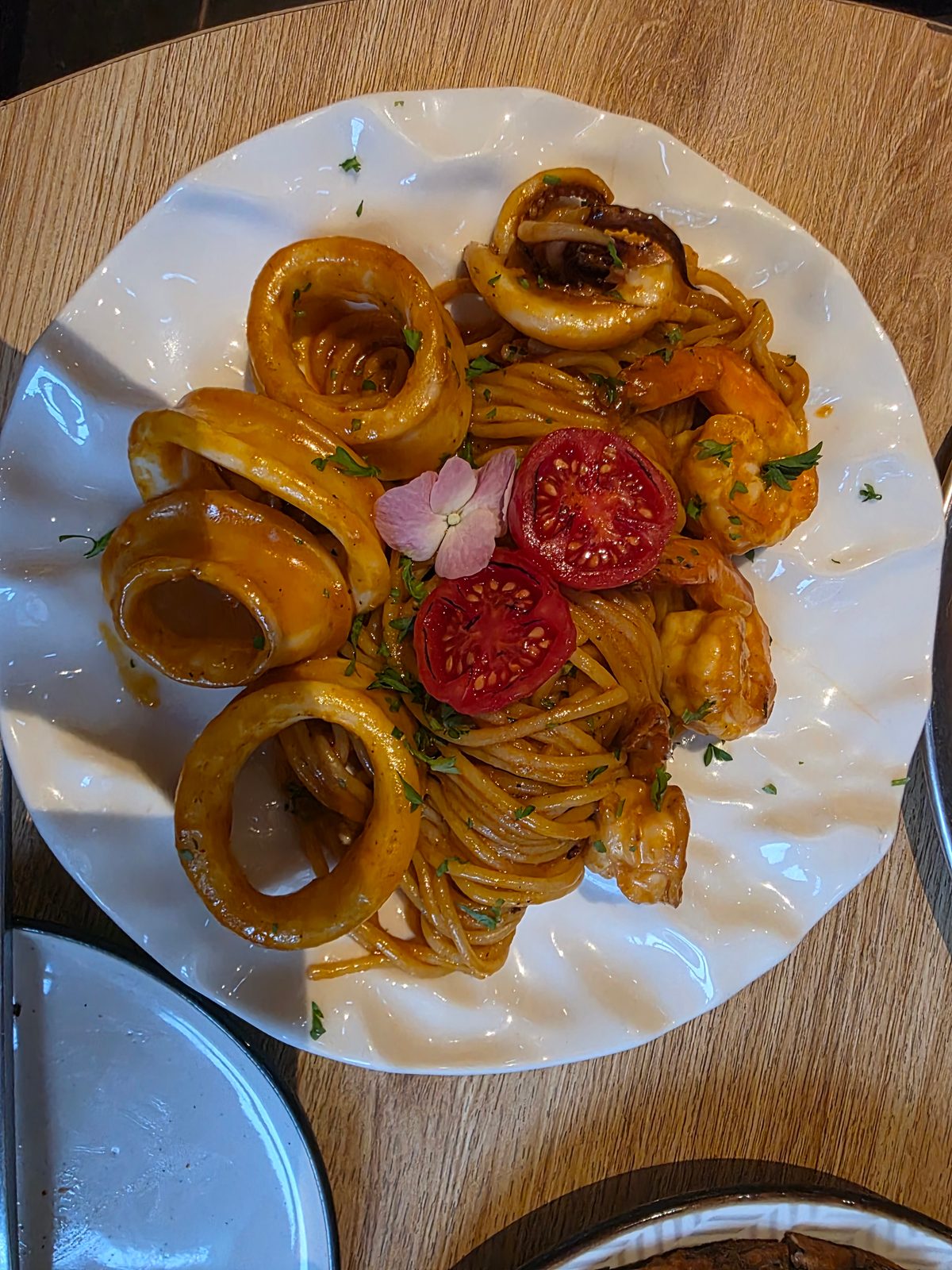
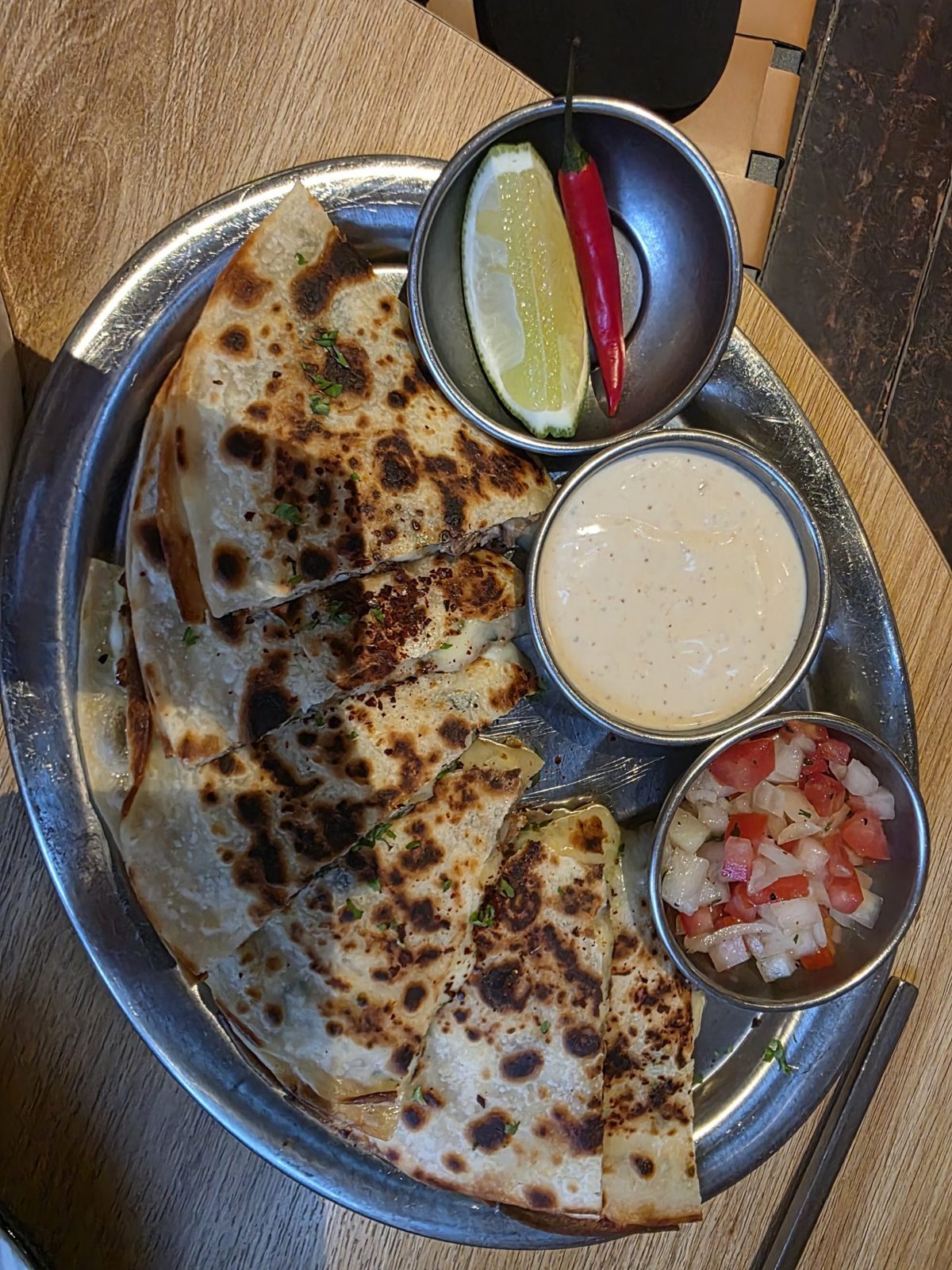
An herb pancake, spaghetti from Italy, a quesadilla from Mexico. And a hydrangea petal on every plate.
Cultra Taproom & Rooftop Bar, Hanoi
Hàng Da Street, Old Quarter · Rooftop · International menu
A break from phởVerdict: very good. And one detail made me smile. On every plate, a hydrangea petal, blue or pink. Readers of my Azores journal will understand: I get the feeling hydrangeas are following me from one trip to the next.
October 26 · evening
A hotel on rails
Back at the hotel: we empty the cruise bags and refill them for the mountains, sweaters included. Then Hanoi station, an hour early. Upstairs, a lounge where you swap your booking voucher for tickets, with a complimentary drink. Despite our head start, the lounge is already pretty full. As departure time approaches, the train hostesses come to collect the passengers and walk them to the platform.
I was expecting seats, maybe rows of bunks. Surprise: there are only cabins. The car, cream and brown with gold trim, bears the name Tonkin Heritage Express. Inside, a woven wicker ceiling, black curtains, a shaded lamp, an octagonal mirror, an all-white bed, and a basket of bananas for the road. This isn't a train, it's a little hotel on wheels. As for price, with Chapa Express (train SP15 at 9:45 pm), expect from $43 per person in a shared four-berth cabin, and over $300 for a private cabin. A small luxury, but it also saves you a night in a hotel.

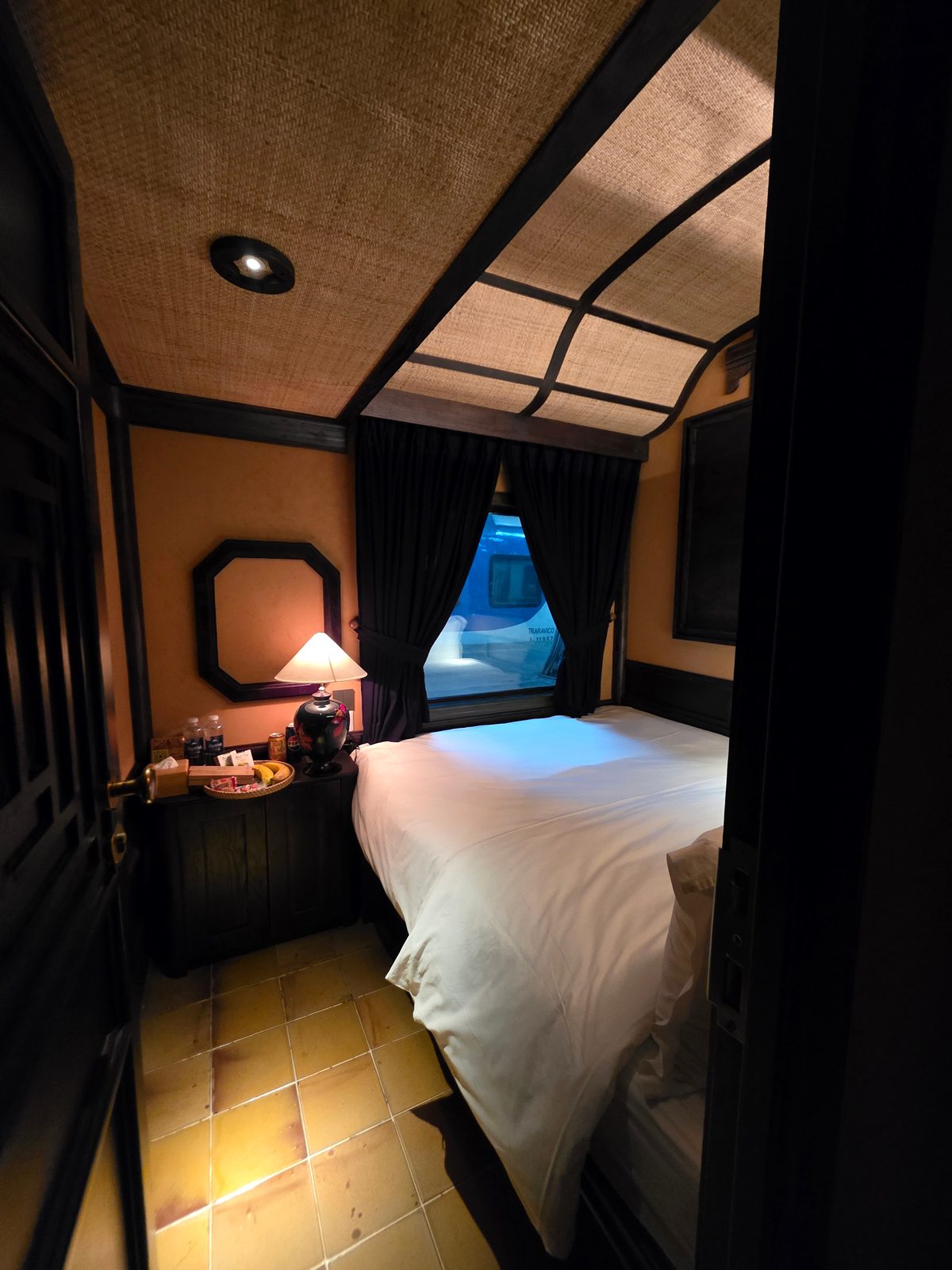
The platform, then the bedroom. Sorry: the cabin.
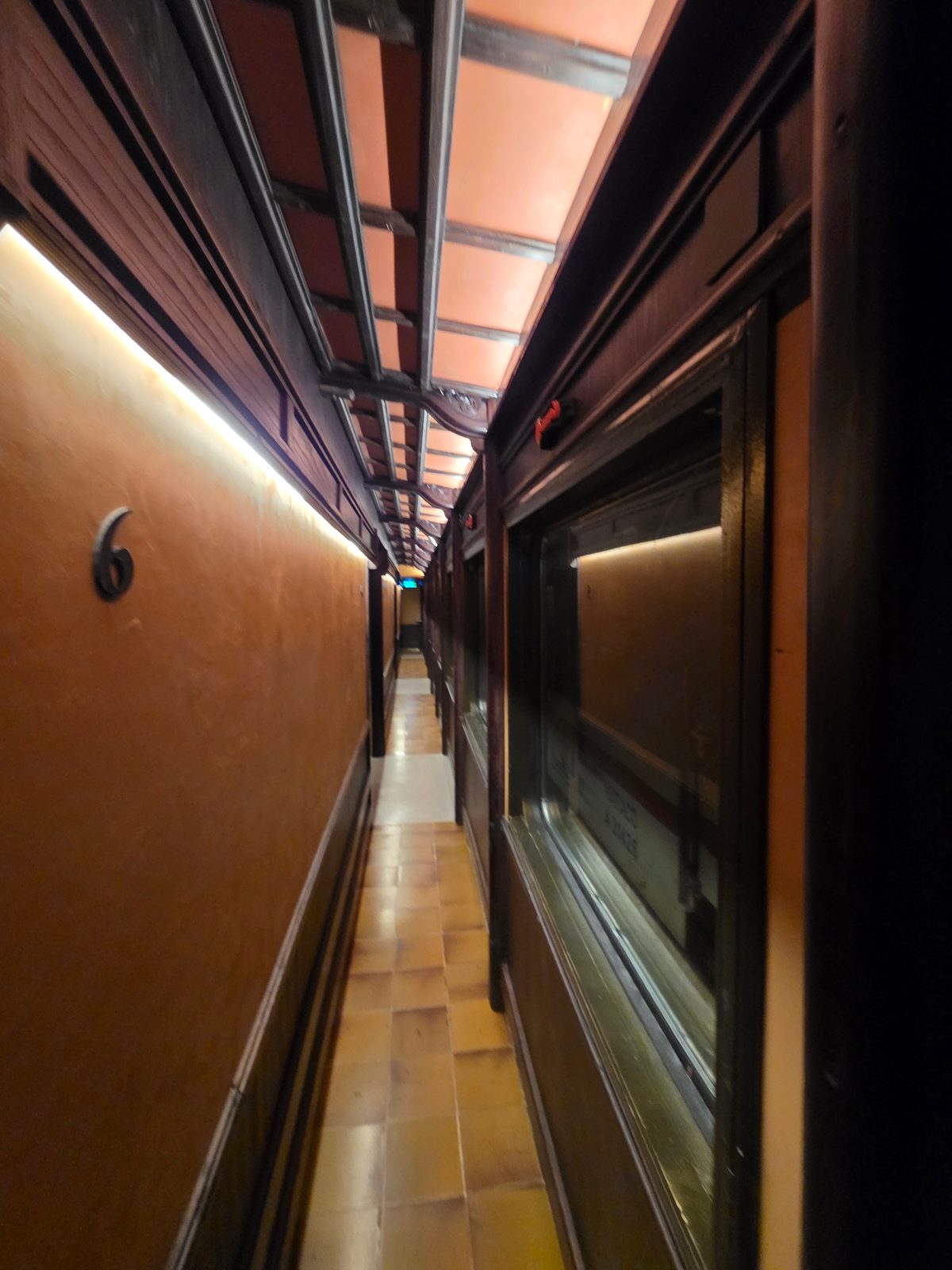
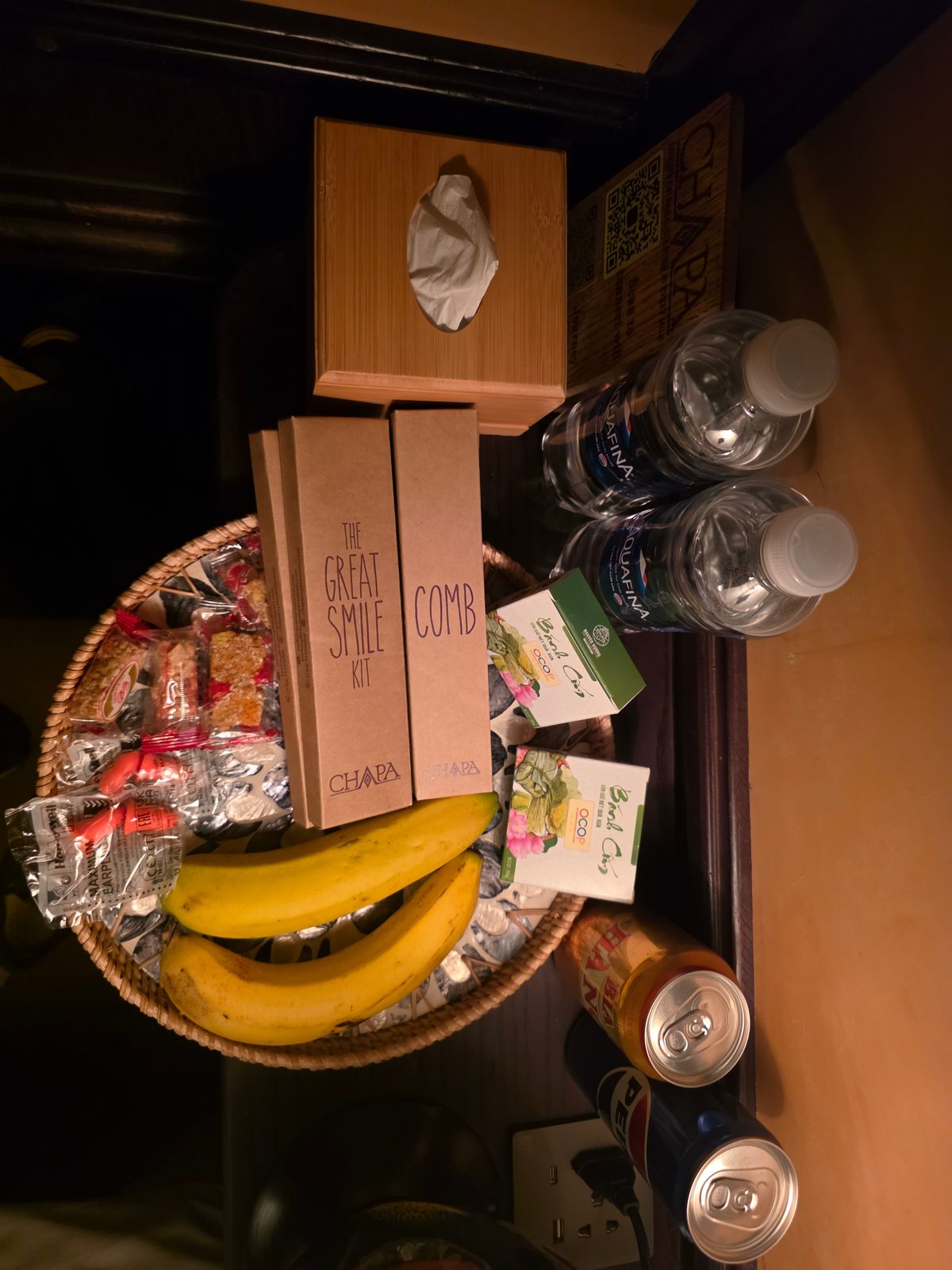
The corridor, then the welcome basket. The bananas survived the night.
Chapa Express, train SP15
Hanoi 9:45 pm → Lào Cai 5:50 am · Shared four-berth or private cabins · Waiting lounge at the station
From $43 per personPrivate cabin: $300 and upPrice noted in October 2026; varies with the cabin, the season and the booking site.
The Hanoi → Lào Cai night train. Arrive at least an hour early: the lounge fills up fast and swapping the tickets takes a little while. The toilets aren't in the cabin but at the end of the corridor, shared; it works out fine. Bring a sweater for arriving in the mountains, and expect an early start: you get in before 6 am.
We're the stars now
The train jolts into motion, crosses the city and turns into Train Street. Along the tracks, people are waiting, phones raised, taking pictures of us. Exactly what we were doing three days earlier, sitting with our drinks. We've come full circle. I wave like mad from the window. For a few seconds, we feel like movie stars.
Then the city fades out. Lying on the bed, I gaze out the window, framed by its midnight-blue curtains like a movie screen. A high-definition screen, with just one channel: the real landscape, rolling by in the night.
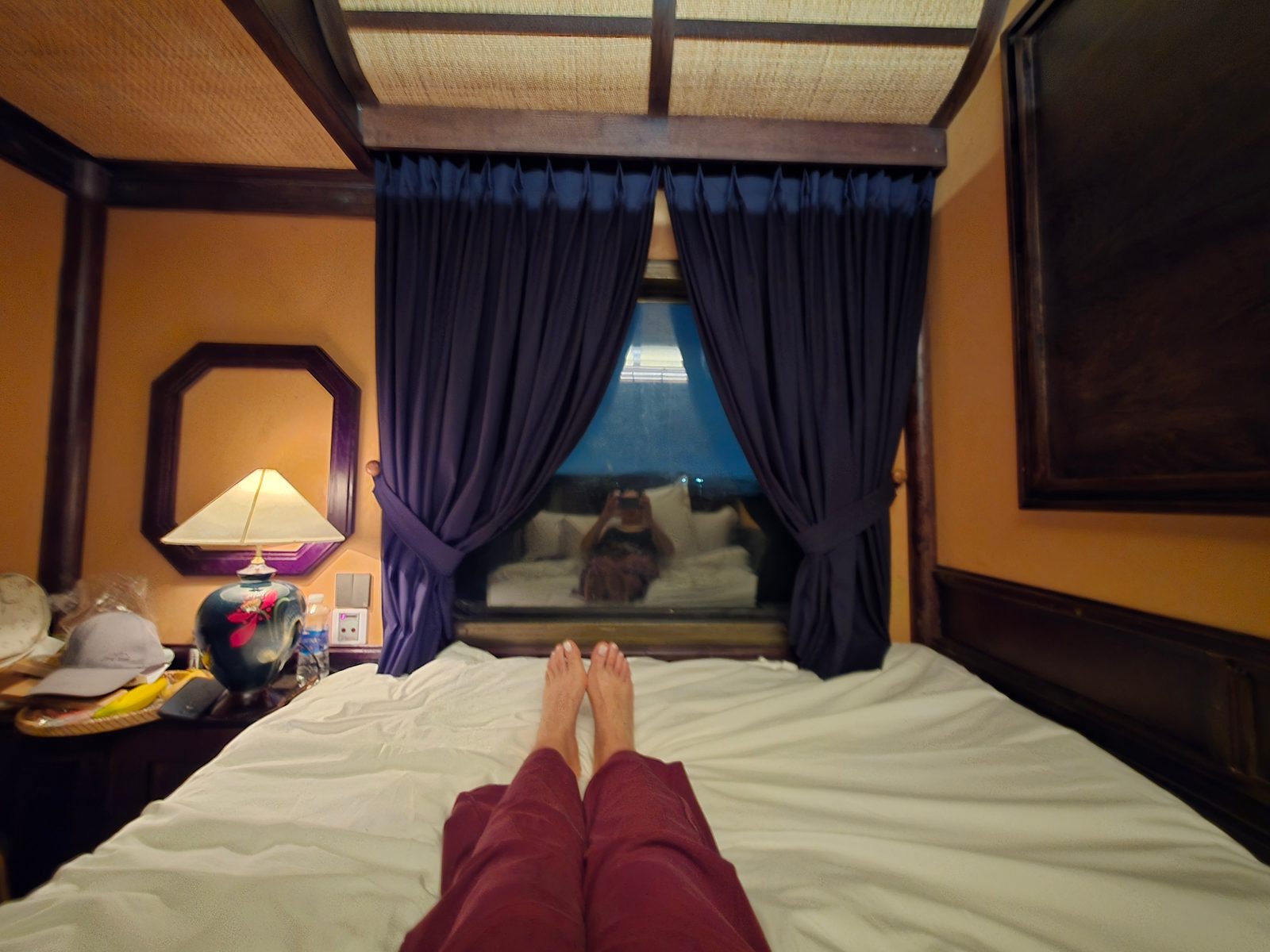
Netflix, Tonkin edition.
October 27 · 5:22 am
A wake-up call with a full brass band
No gentle alarm. Very loud music over the speakers, and the train pulls into Lào Cai station at 5:22, almost half an hour early. Outside, it's still dark, the surroundings are rusty, and we're hurried off the train. So much for the sunrise photo from bed.
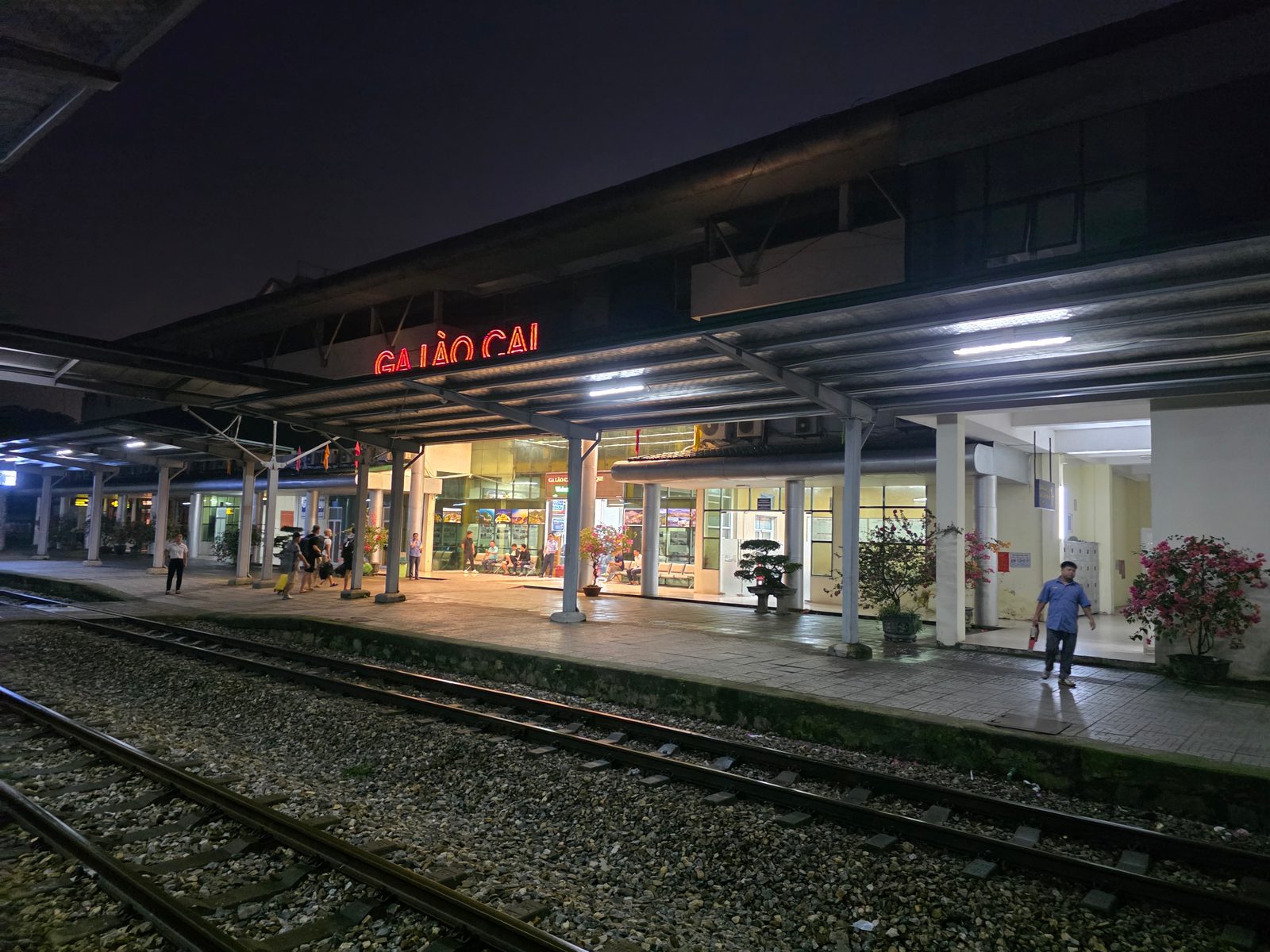

Lào Cai, 5:22 am. Pitch dark, and the train is early.
On the platform, a driver is waiting with a sign bearing my name: a car booked by our guesthouse, for about 700,000 VND (just over €20). An hour and a half's drive to Tả Van. Around 6, the rain shows up, and the mist with it. We climb through the hairpin bends without seeing a thing of the valley.
October 27 · 8 am
Hmong House, with a view of white
Our home for two nights: Hmong House, a guesthouse run by two sisters, clinging to the slope above Tả Van. A stepped path, ocher earth houses with thatched roofs, bushes of red flowers. In the room, bamboo walls, a mosquito net, wicker pendant lamps, towels folded into flowers, and a big glass door opening onto a balcony. Rooms, bungalows or suites: expect about €12 to €35 a night depending on the category.
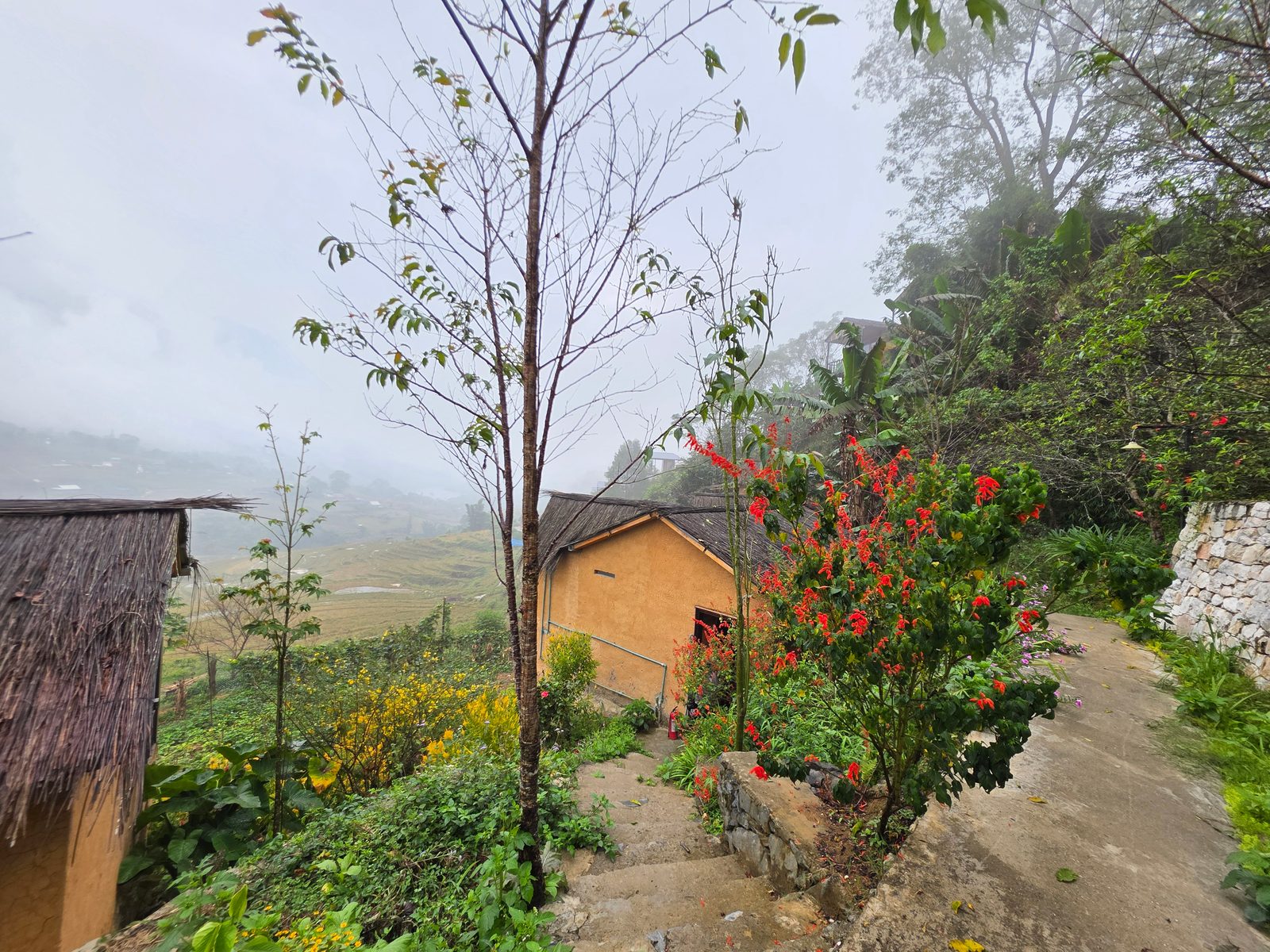
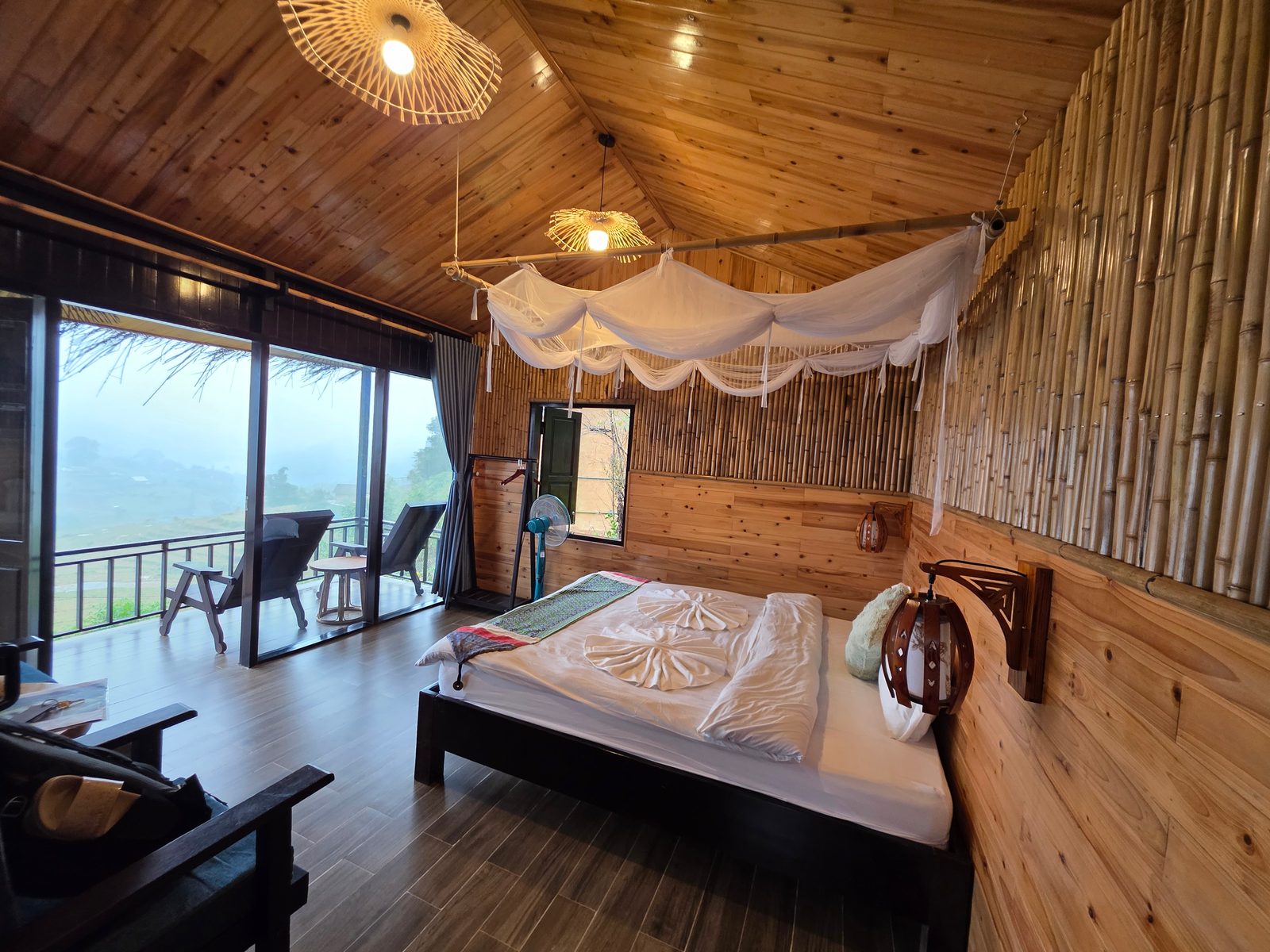
The path to the house, and the room that goes with it.
Hmong House, Tả Van
Above the village, valley views · Guesthouse run by two sisters · Rooms, bungalows and suites
~€12 to €35 a nightCar from Lào Cai: 700,000 VNDPrice noted in October 2026; varies with the room, the season and the booking site.
I lie down, just like on the train, and look at the screen. Behind the glass: white. The valley is out there somewhere, completely drowned in clouds.
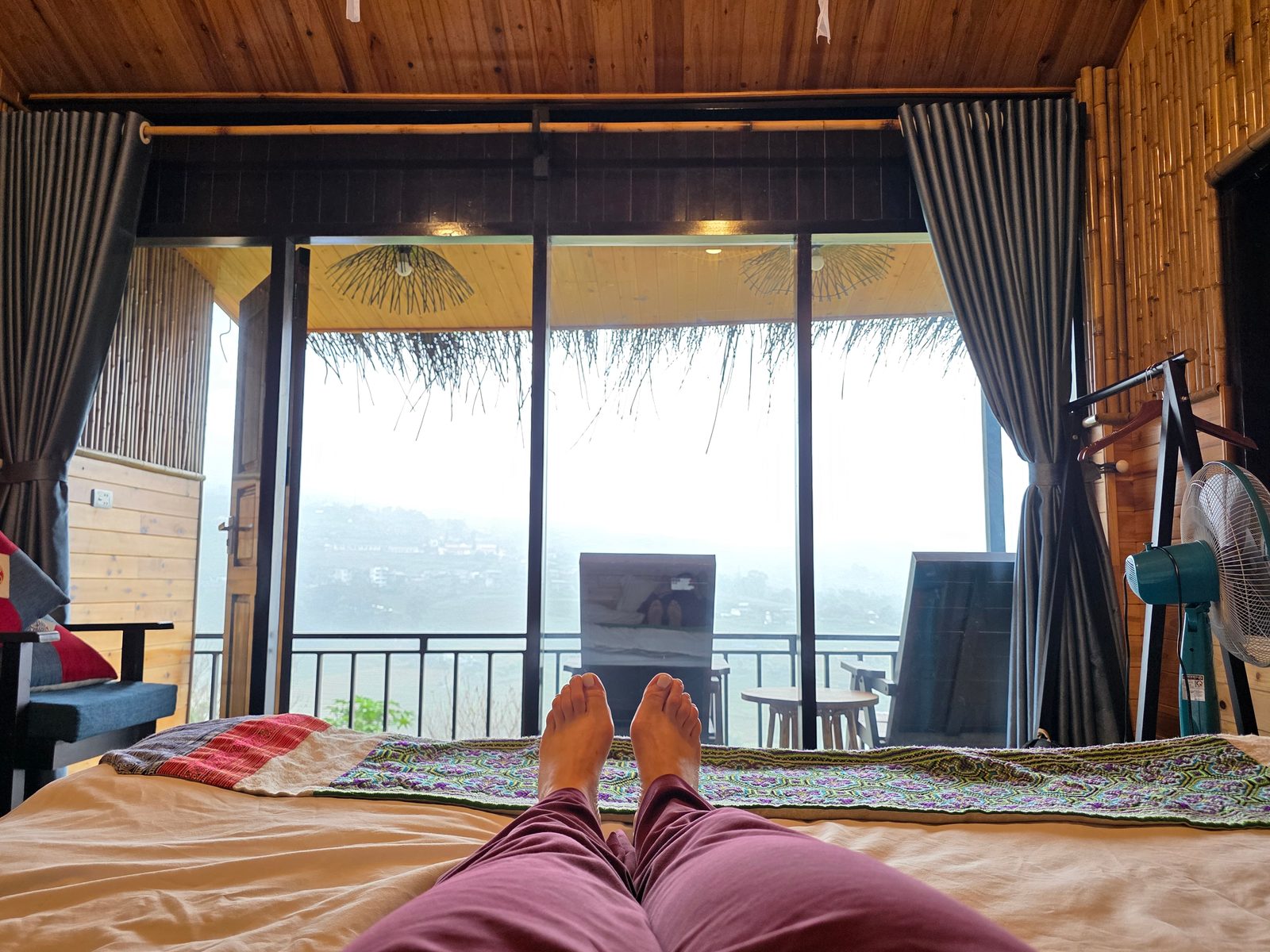
Same bed, same pose, different screen. Today's program: fog.
A shower, then a homemade breakfast on the terrace, facing the mountain: an herb omelet, rice vermicelli stir-fried with vegetables and mushrooms, a lightly sweet sweet-potato fritter, mango and a cup of tea. Below the table, the valley starts to take shape between two clouds.
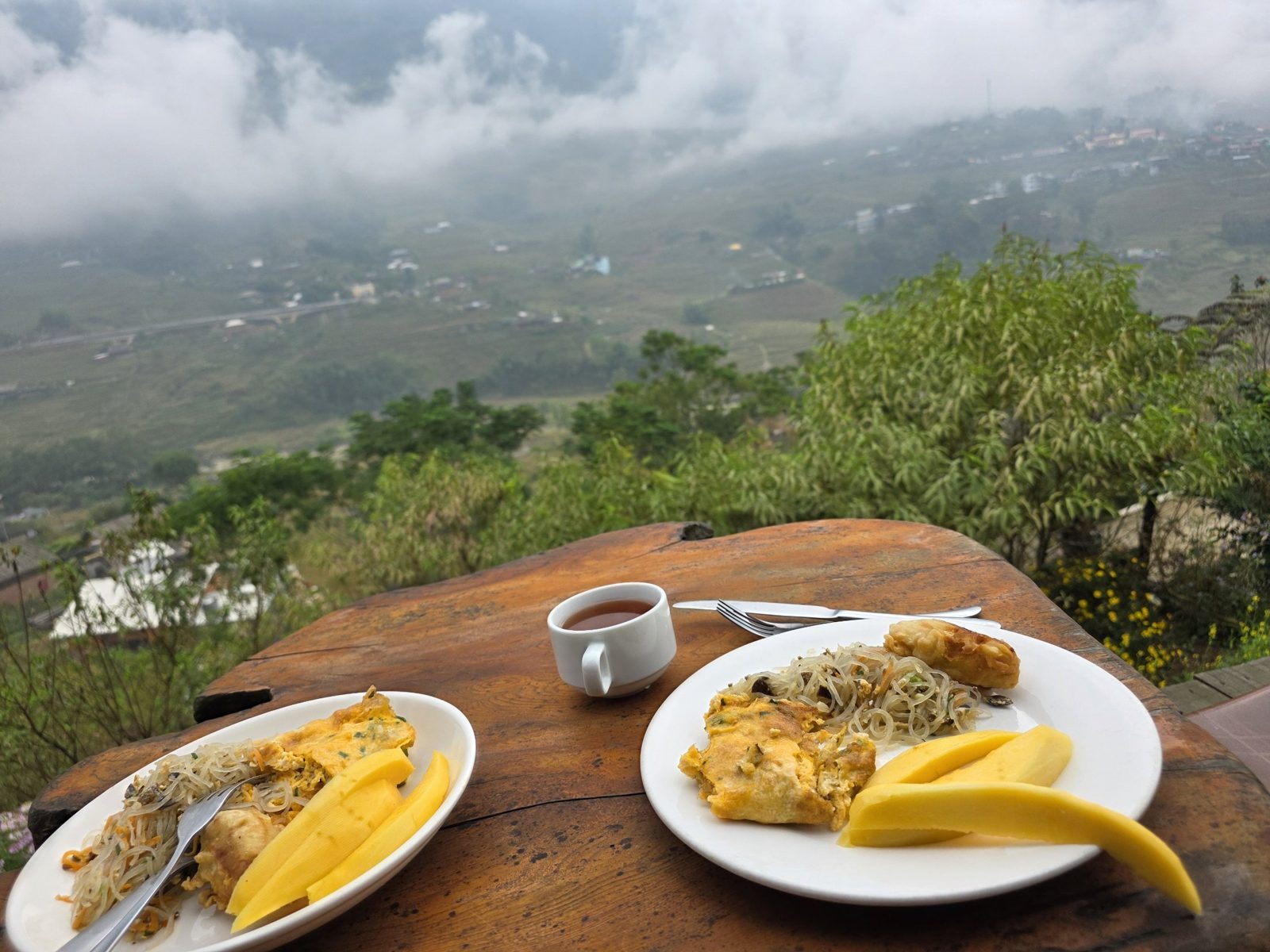
A breakfast suspended above the valley.
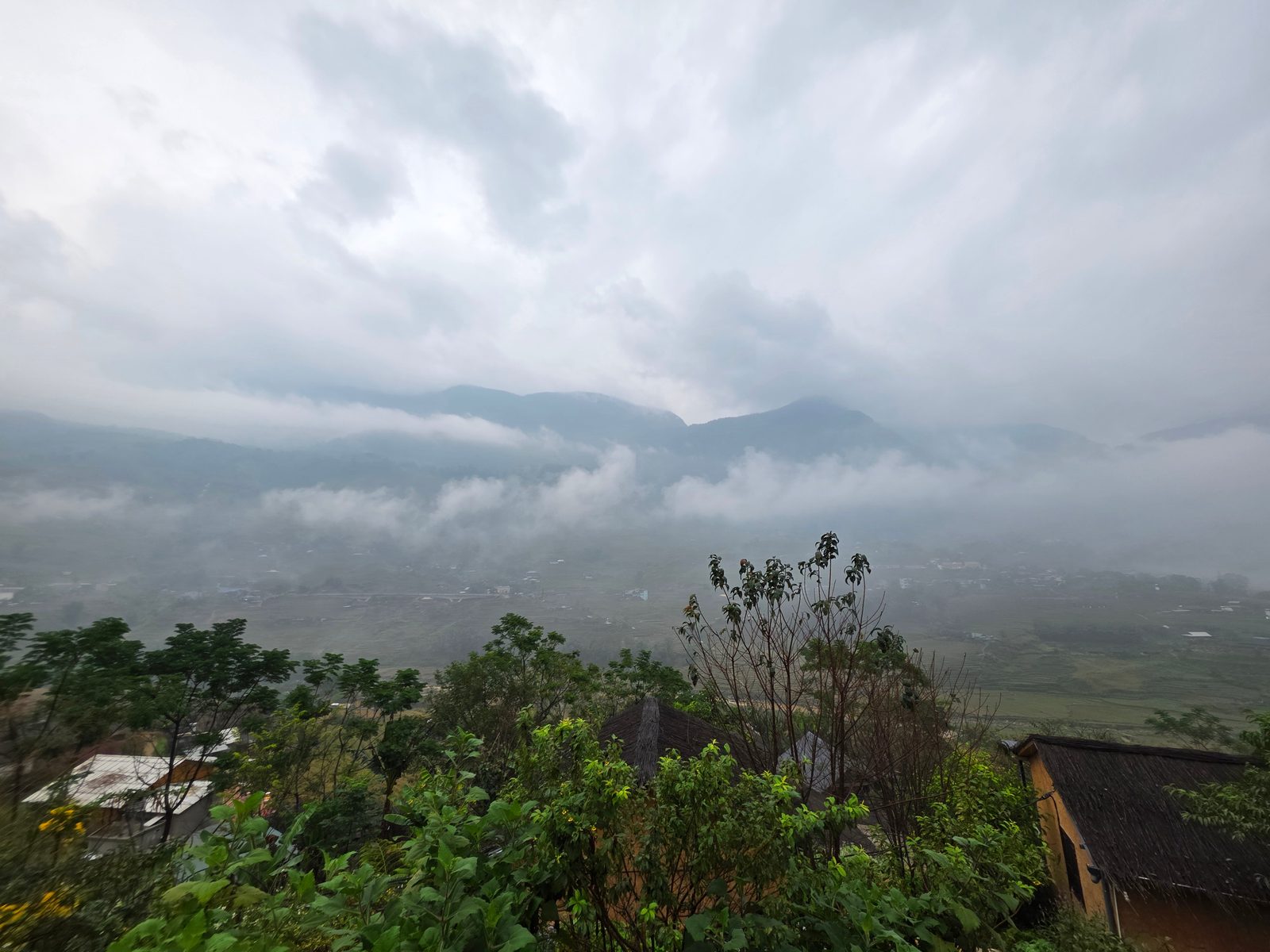
The Mường Hoa valley, sea-of-clouds edition.
After two or three nights of little sleep (the boat, the train), the body wants what it's owed. Nap time. Two and a half hours, very, very, very restful.
October 27 · 2:30 pm
The mist lifts
When I wake up, the curtain has risen. Not all the way, but enough: golden rice terraces tumble down the slope, a little lake shines at the bottom, and the mountain keeps a few clouds draped over its shoulders. The same path as this morning, but with the scenery this time.
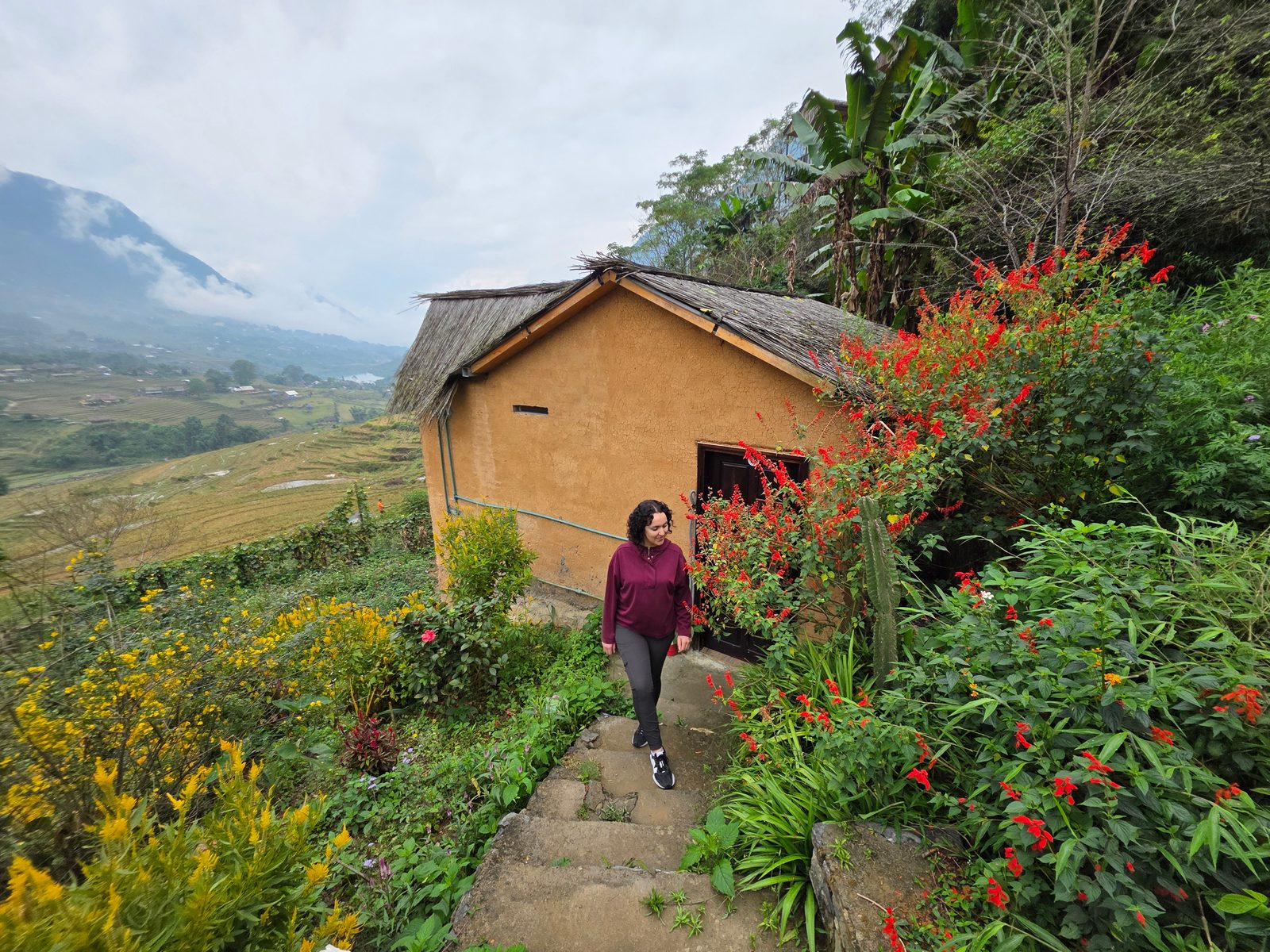
The same path as this morning. This time, with the valley thrown in.
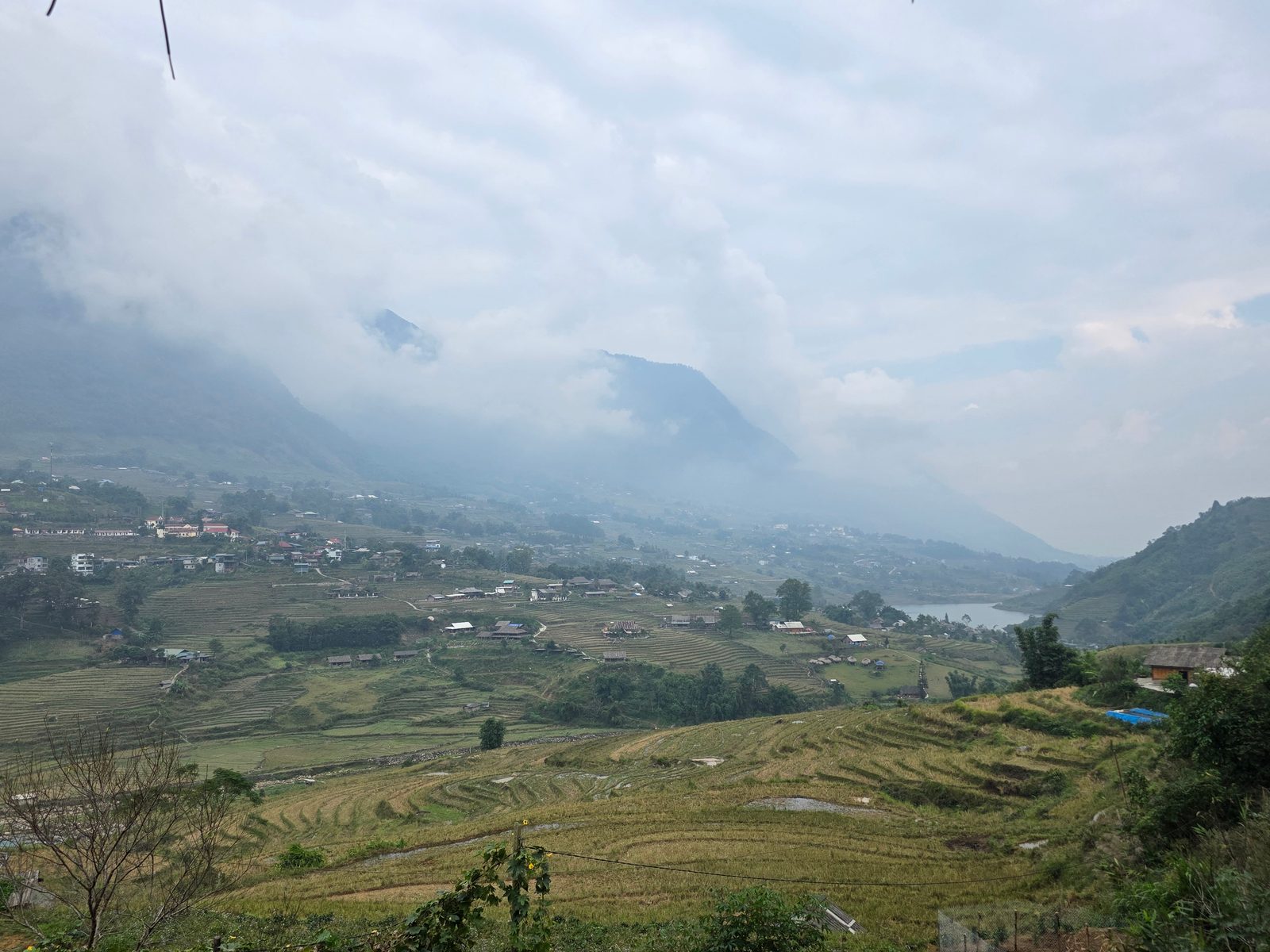
From the balcony. In the distance, the little lake that will serve as our compass.
October 27 · 3 pm
A walk without a guide
The guesthouse offers guided hikes. We choose the opposite: setting off on our own, with no map and no plan. We head down, follow the road, then the trail, and we'll see. Vague goal: the little lake we spotted from the balcony.
The path plunges between bougainvillea and pink hibiscus. The flooded terraces mirror the sky, and the mountain has kept its hat of clouds on.
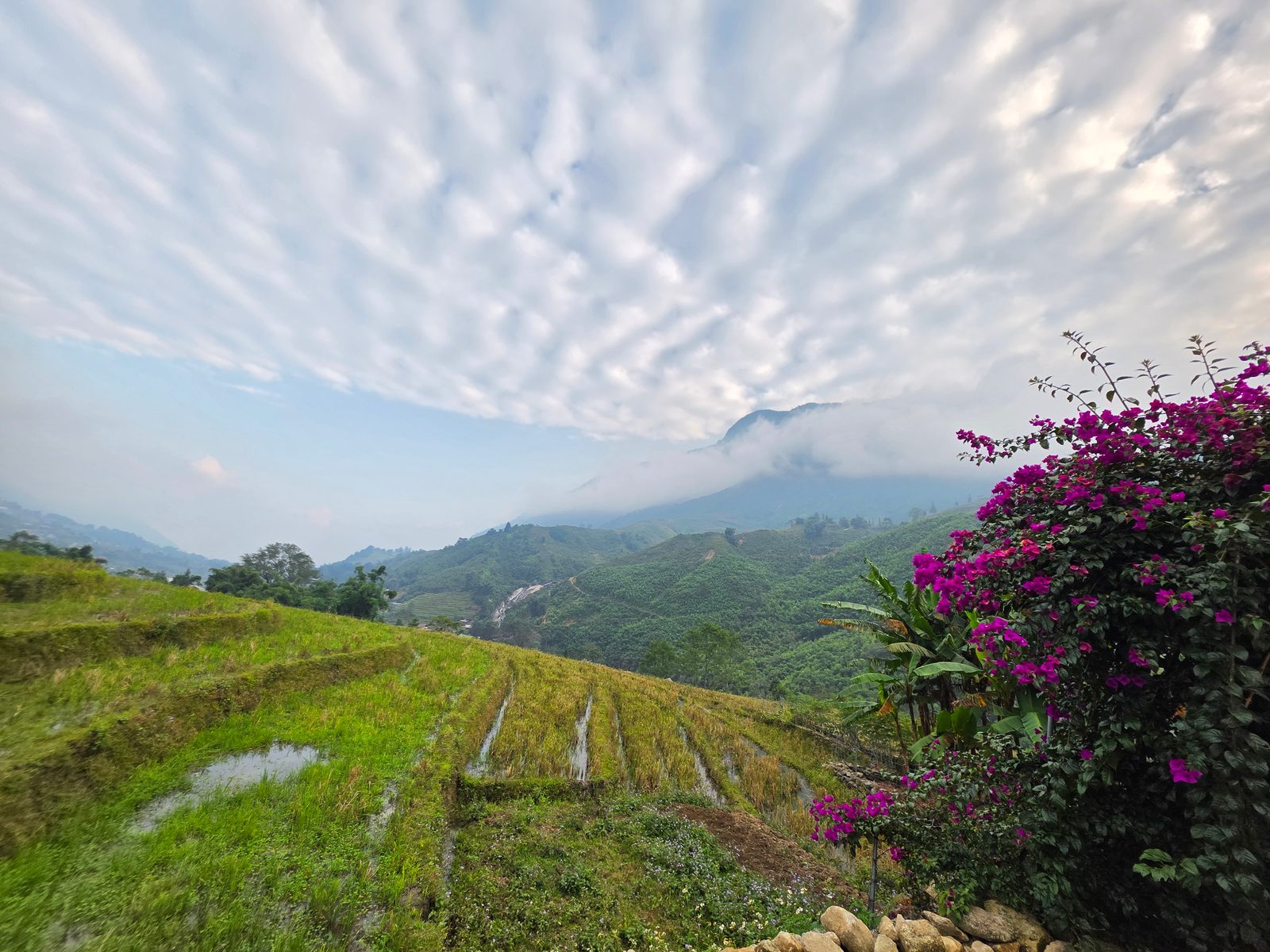
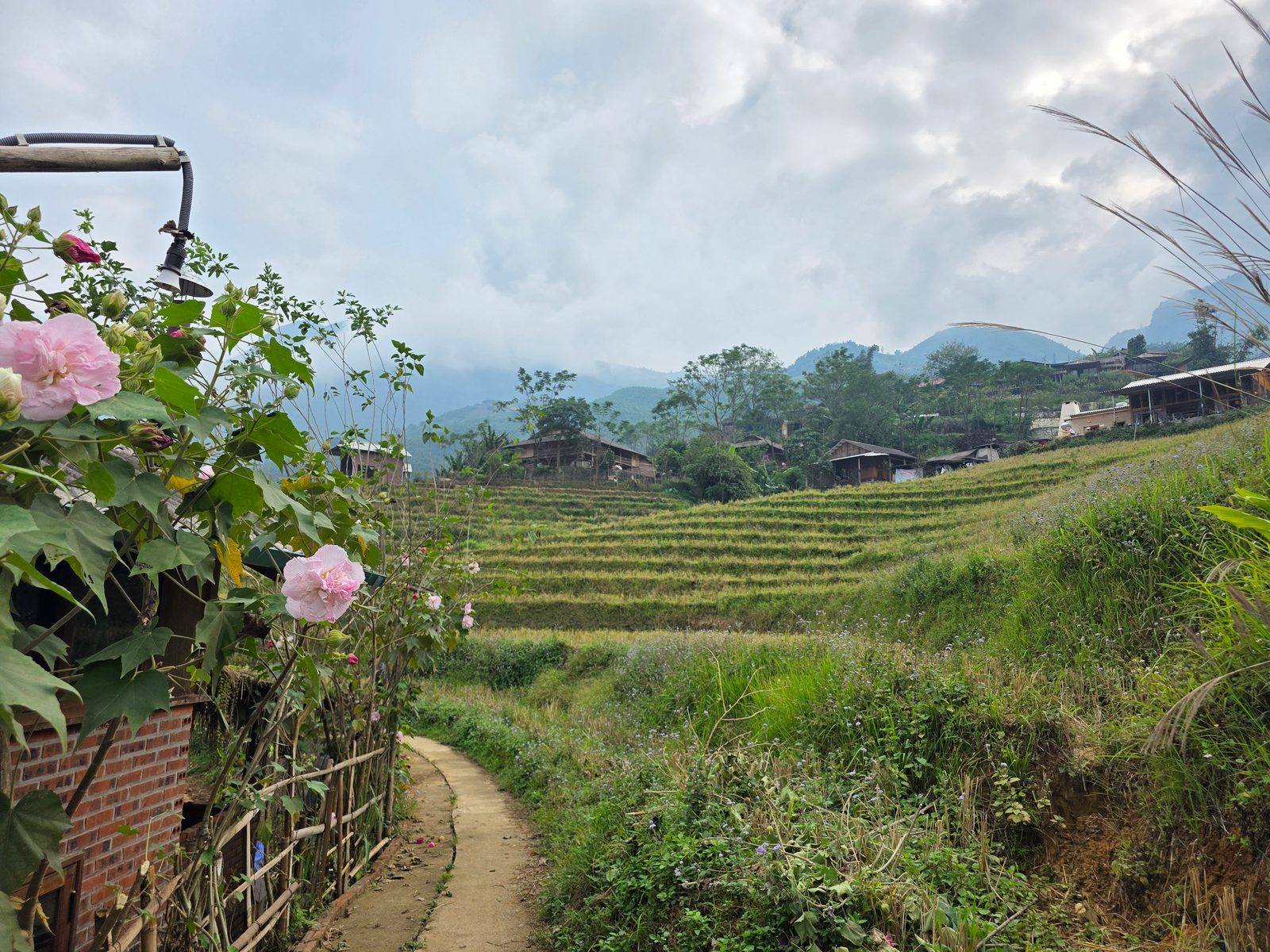
The way down, garden edition.
Very soon, the road leads nowhere: there's no way across the river from there. So we cut across the rice fields. I think we've wandered into people's fields; we walk along the little dikes, trying not to damage anything.
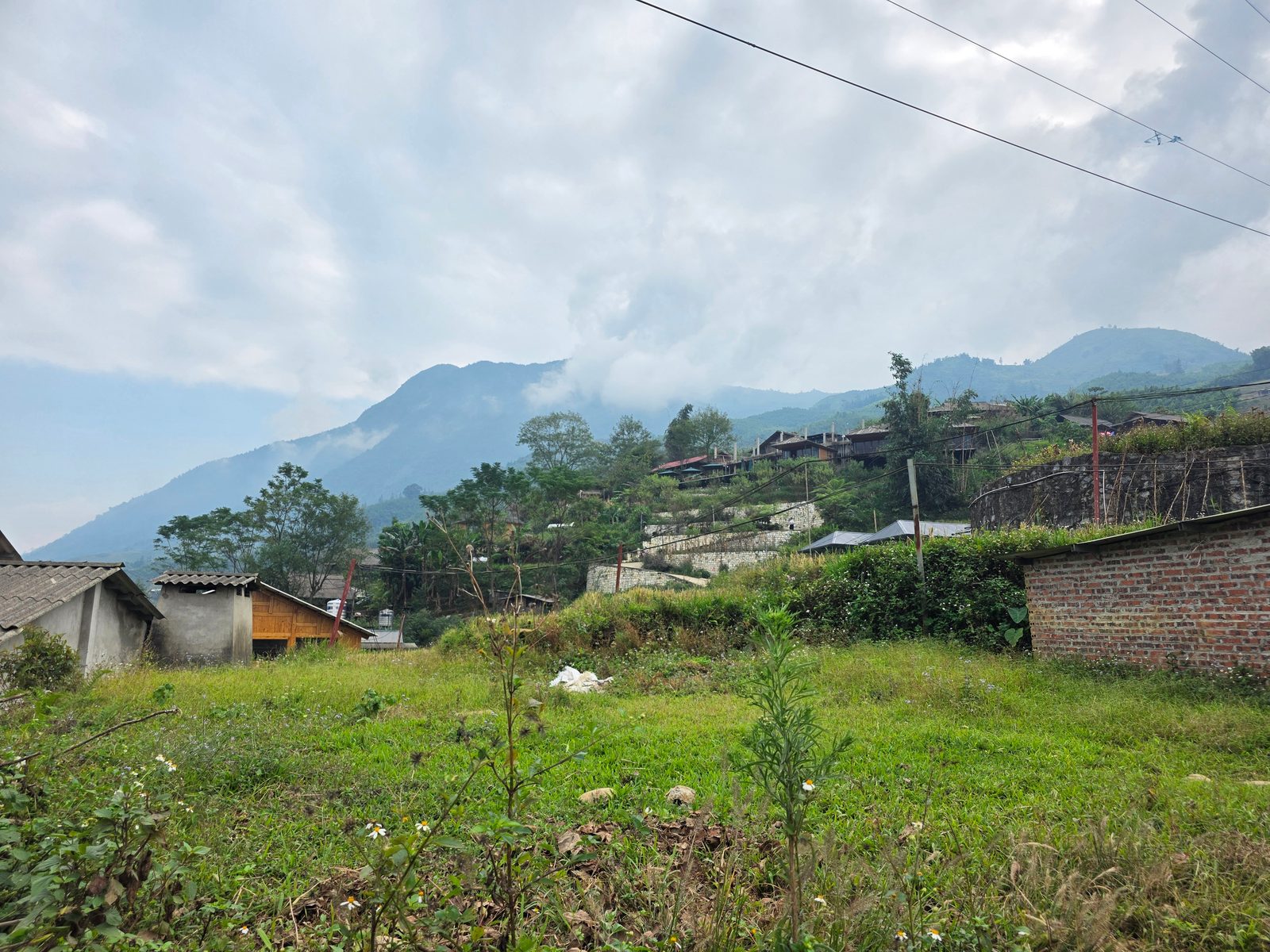
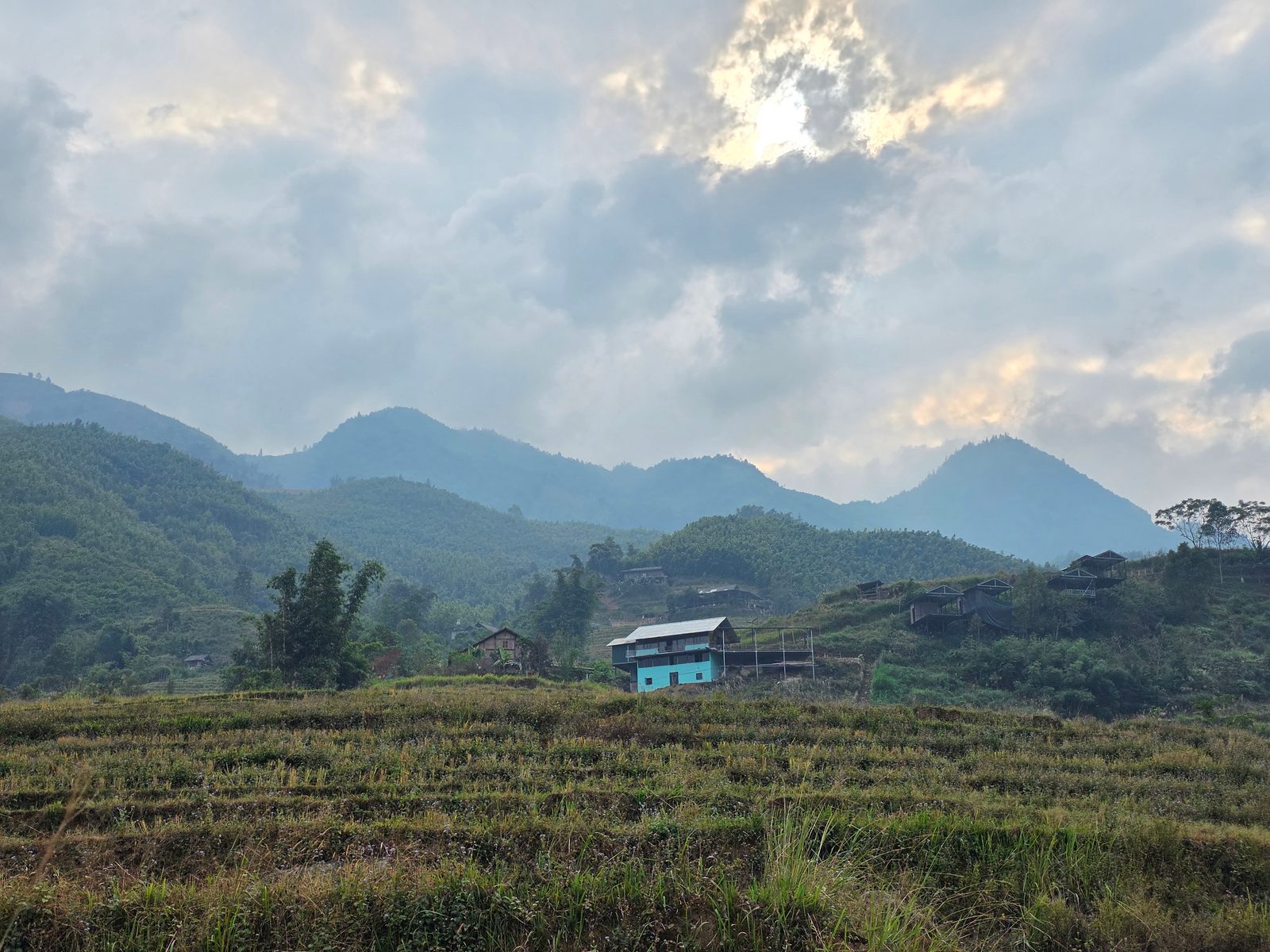
A hamlet, and rice fields that wait for no one.
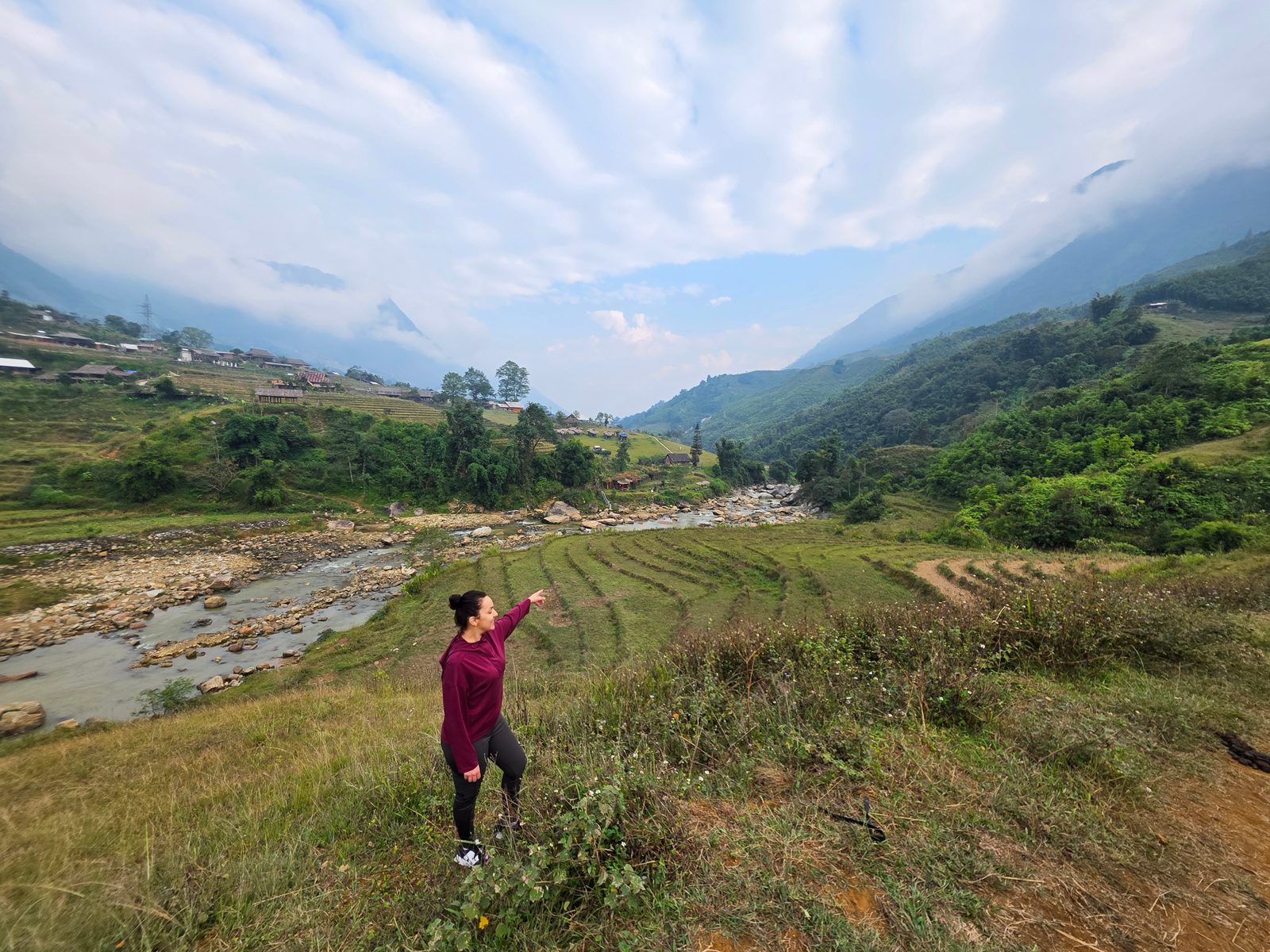
“It's this way.” Well, we think so.
At the bottom, the river. No bridge in sight. Shoes off, pants rolled up, and we wade across, from stone to stone, with the cold water pushing against our ankles. A slightly hairy crossing, but a successful one. On the other side, a rock was required to celebrate.
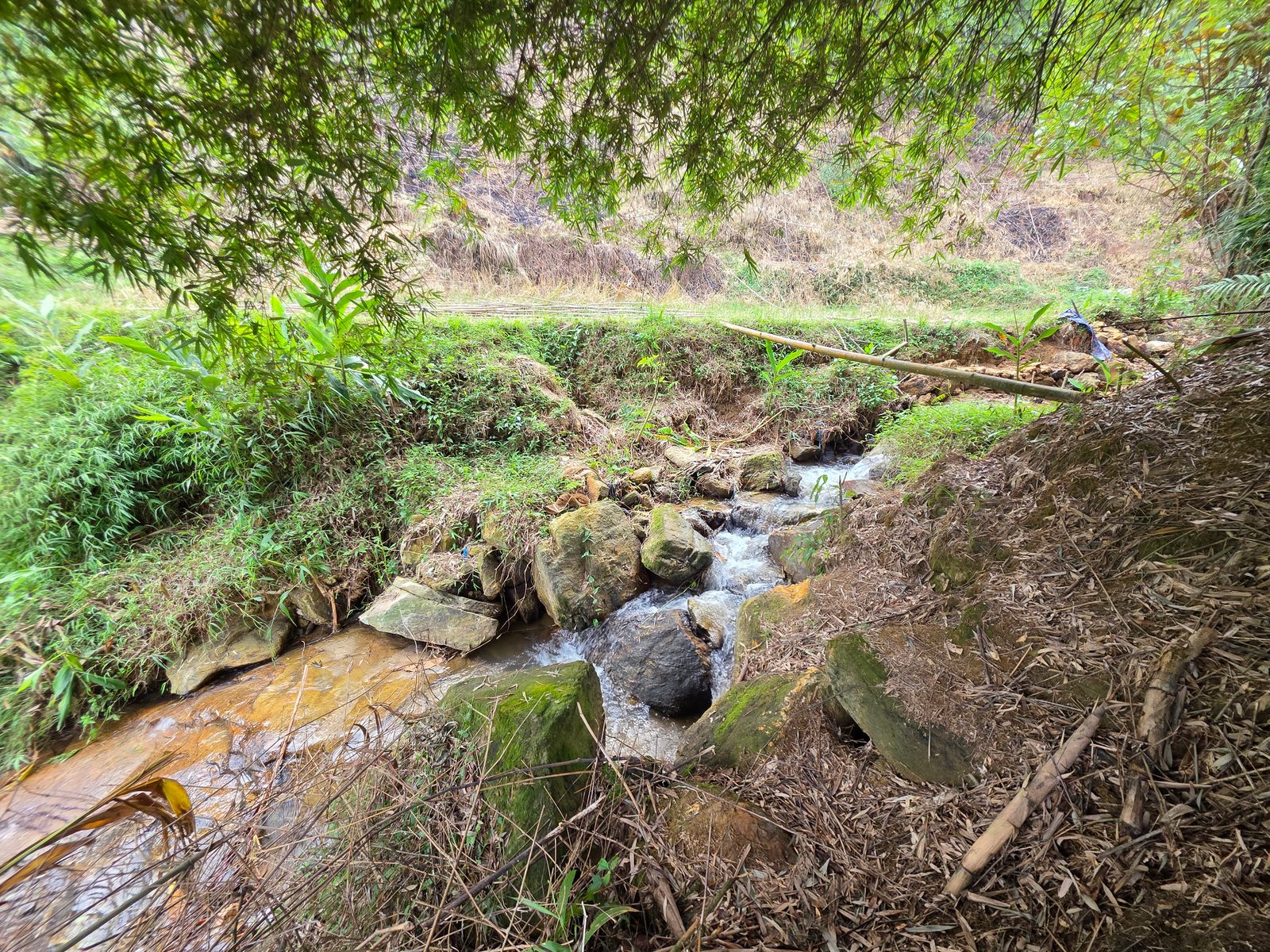
The stream, before the big river.
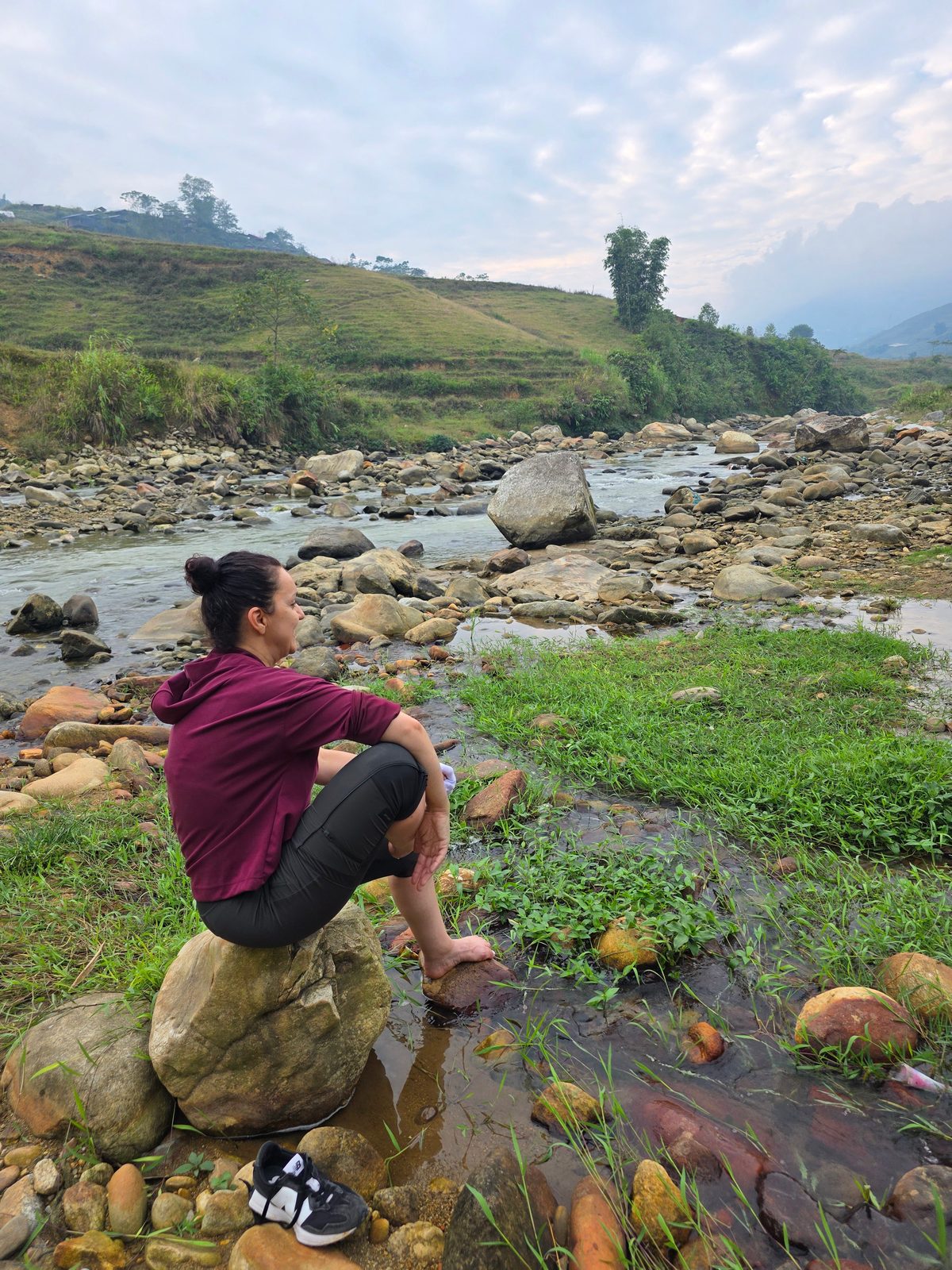
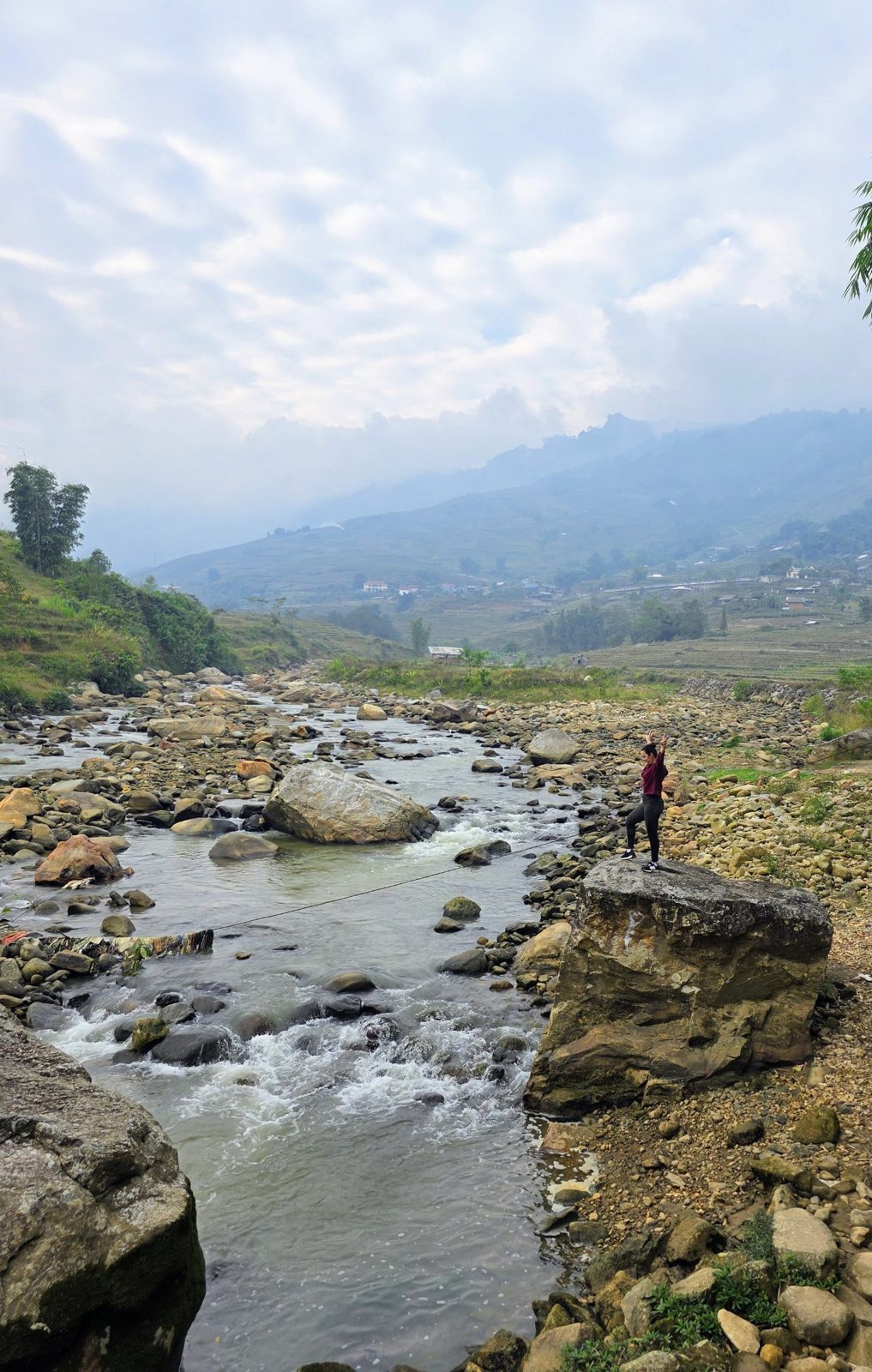
Shoes back on. But first, the victory pose.
A path found more or less by chance climbs back up toward a village. On the way, we pass a “photo café”, where young women in beautiful dresses pose in front of the valley. We don't stop: we have another café in mind.
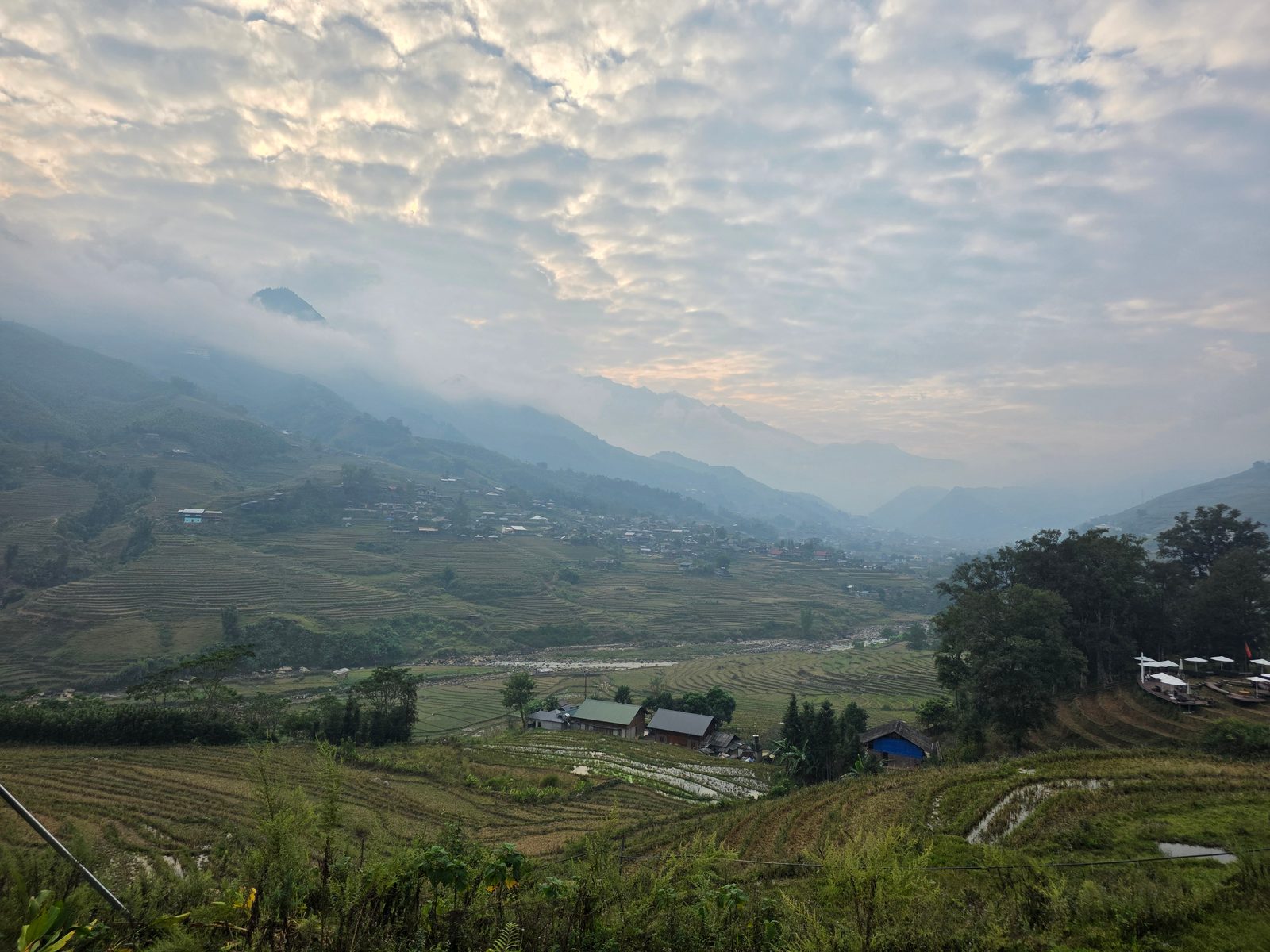
The Mường Hoa valley, under a fleecy sky.
Coconut coffee and a jaw harp
By the side of the road, the Village Pub & Cafe: a terrace hanging over the edge, the valley below, 17 °C (63 °F) on the thermometer. We've barely sat down when a Hmong grandmother comes over, her grandson on her back, to offer us her colorful “little trinkets”. We buy a small instrument from her: a thin brass reed slipped into a case covered in blue and white woven fabric, with an embroidered tassel.
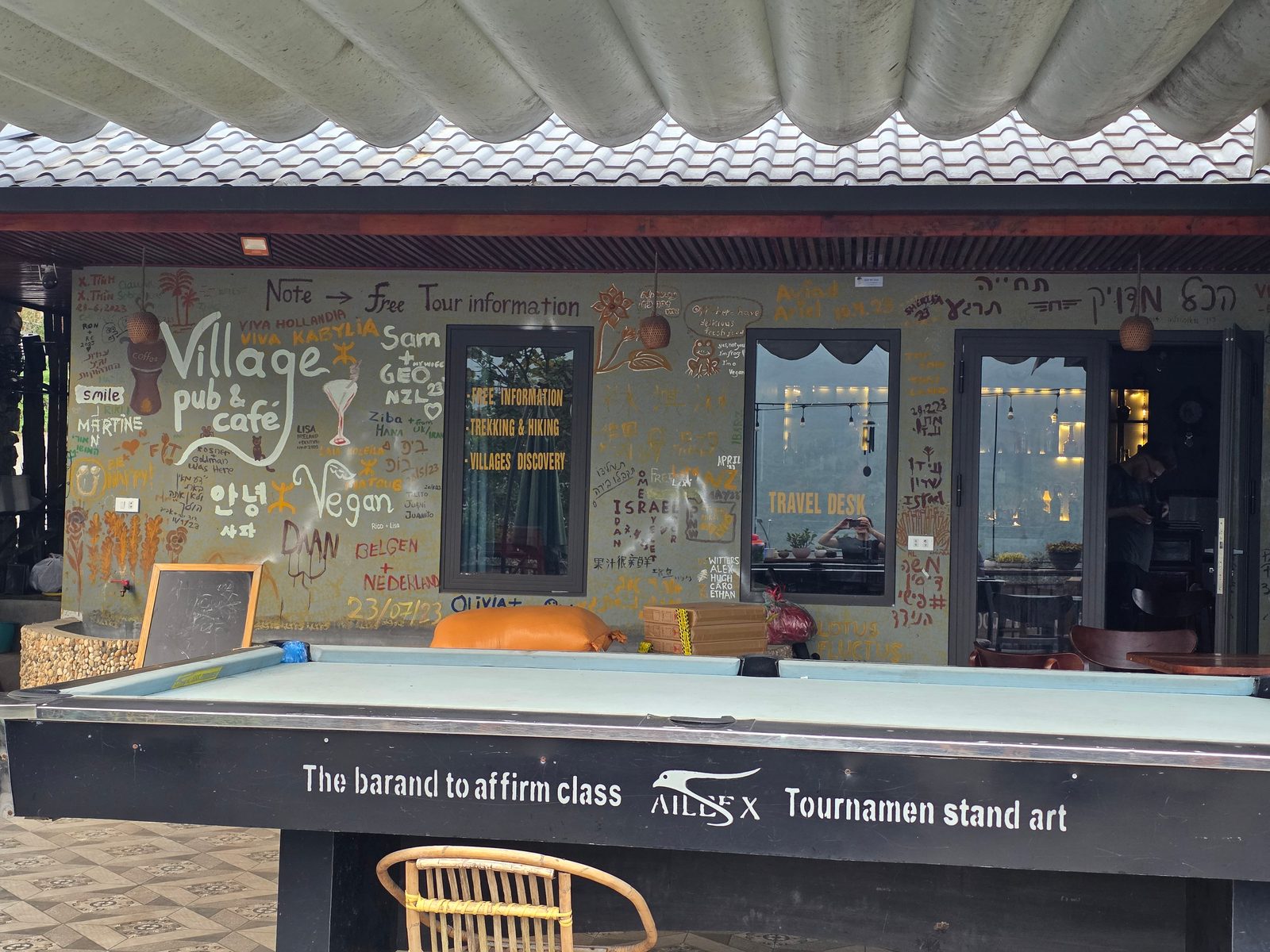
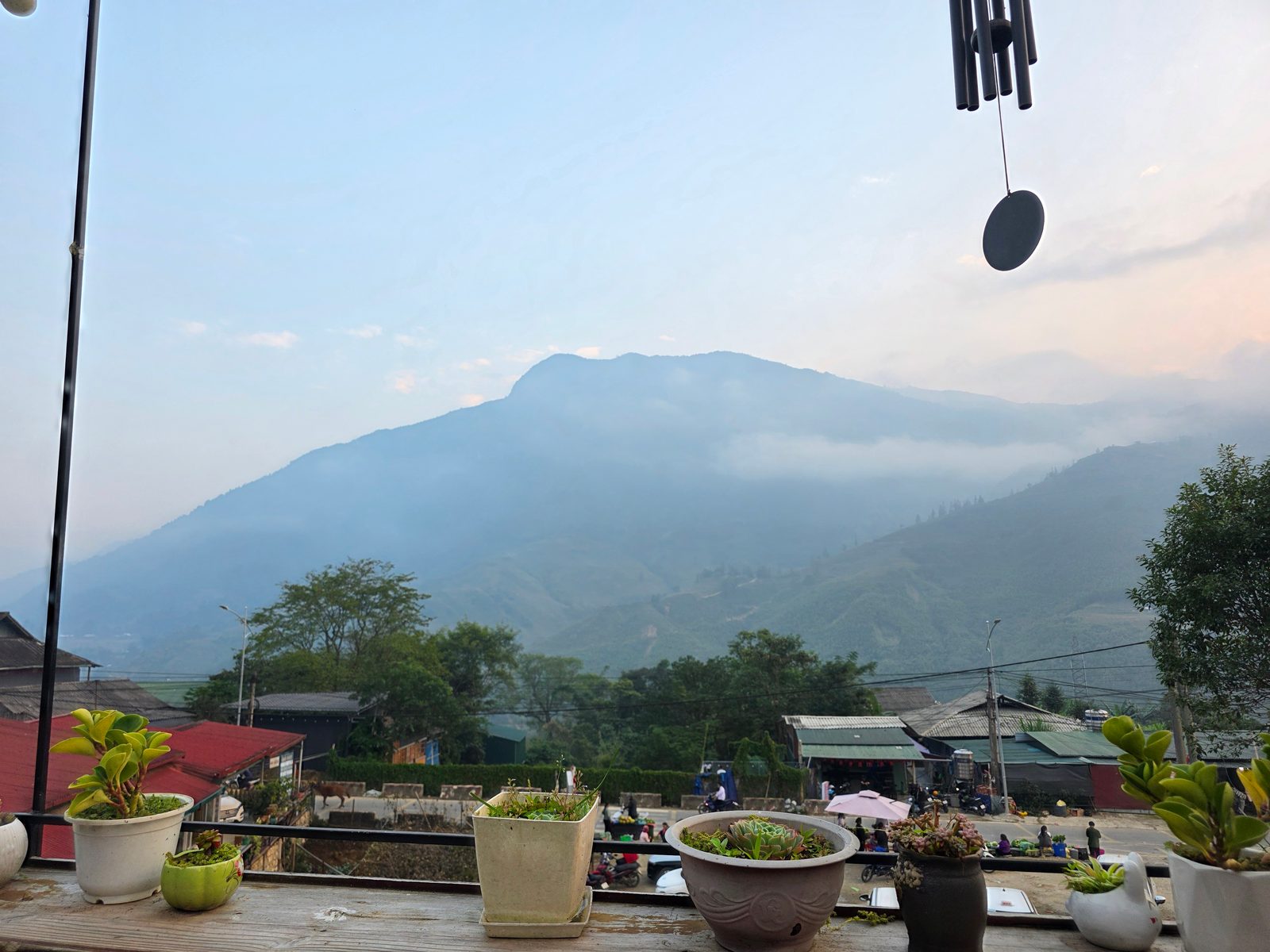
The Village Pub, and its terrace over the valley.
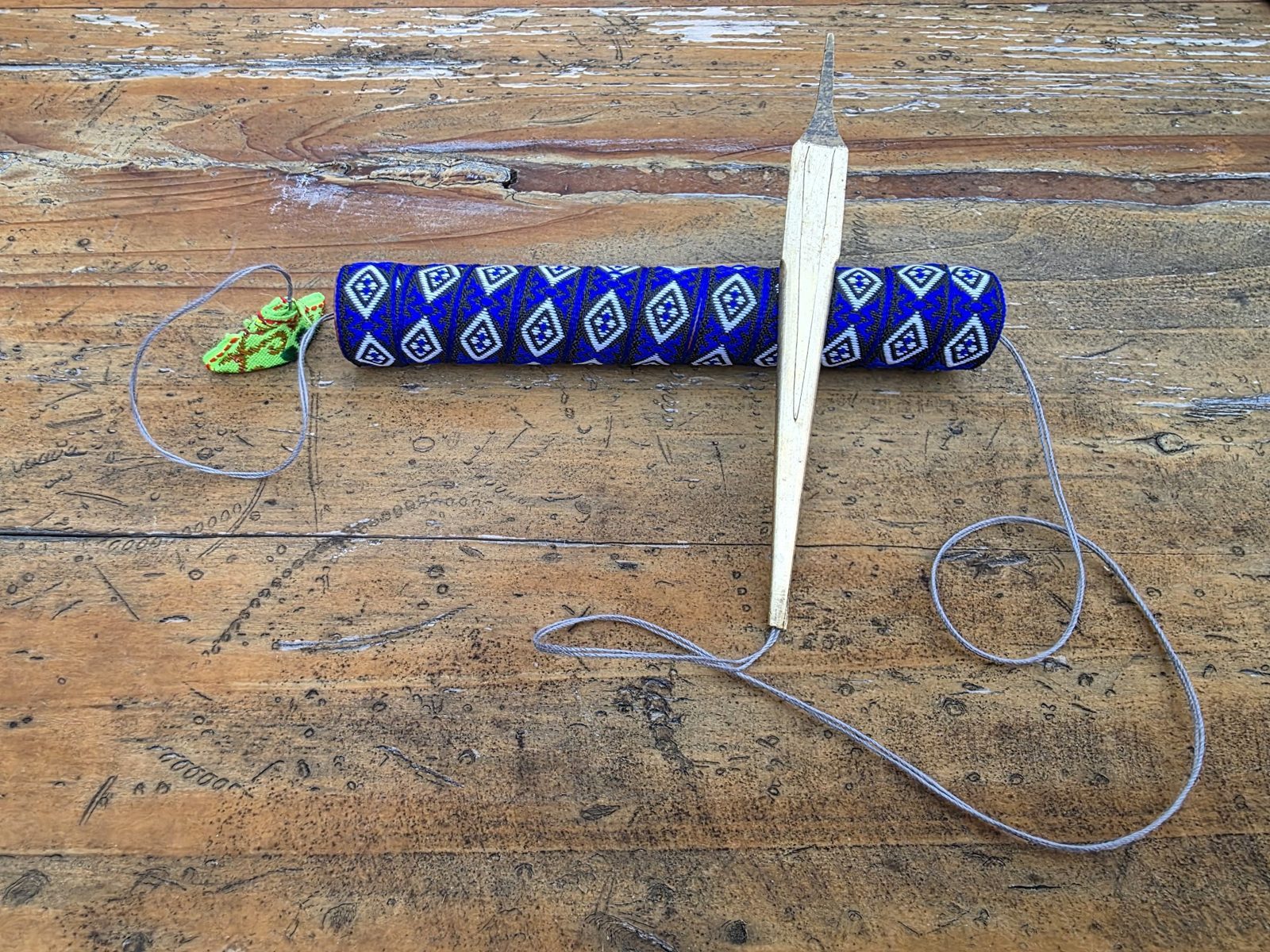
Our souvenir of Tả Van. It fits in a pocket.
Village Pub & Cafe, Tả Van
By the road, terrace over the valley · Coconut coffee, crêpes
Don't miss the coconut coffeeThis little instrument is a Hmong jaw harp (ncas in Hmong, đàn môi in Vietnamese). You hold it against your lips and make the reed vibrate: your mouth acts as the sound box. Among the Hmong, it's the instrument of courtship. Players are even said to reproduce the sounds and tones of their language, which would let them talk to each other, or declare their love, discreetly.
Then I ask the grandmother if I may take her picture. She agrees, for herself and for the little one. They're adorable, in their clothes embroidered with blue, purple and green.
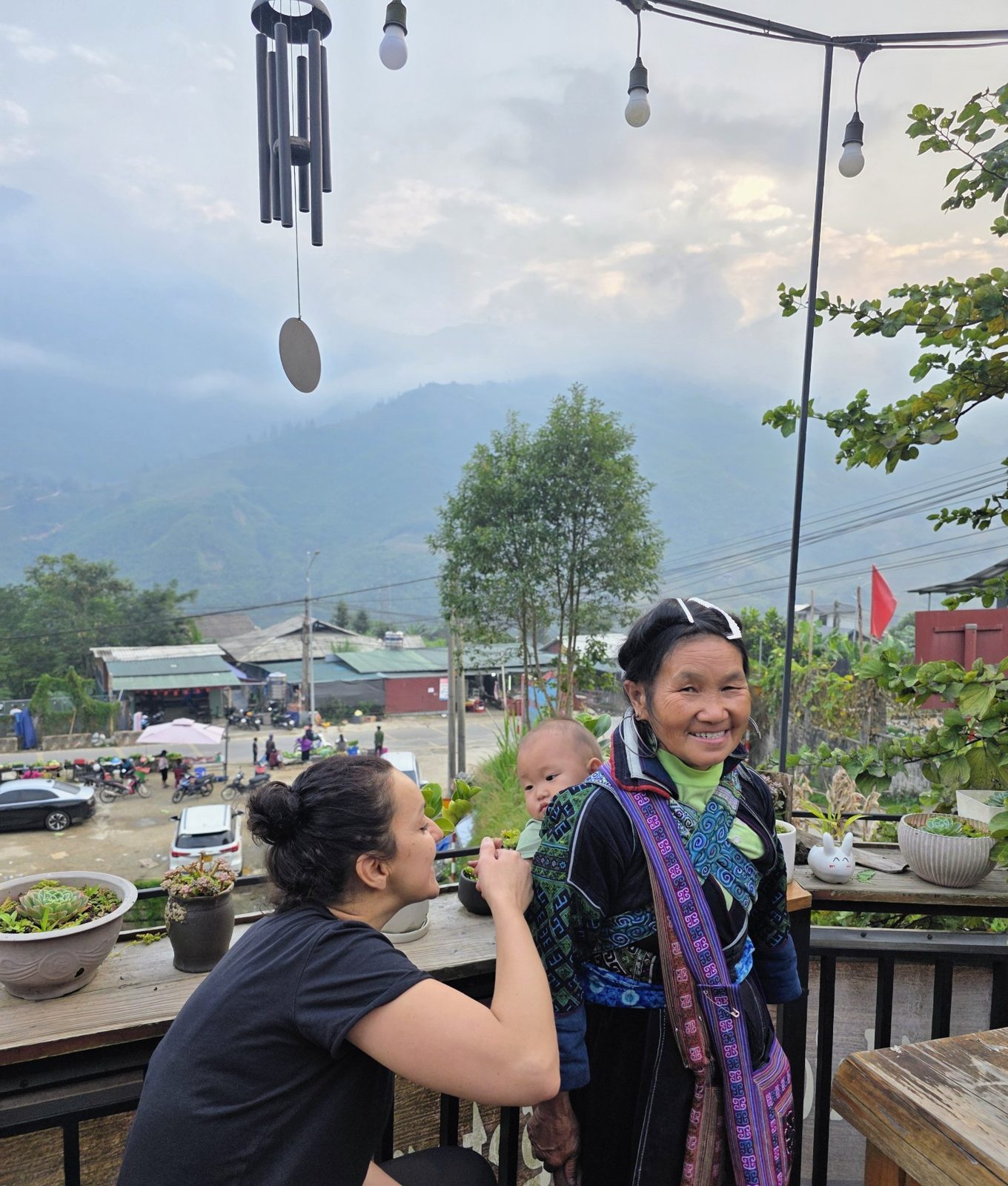
With their permission, and their best smiles.
Only then do we order: a coconut coffee, very, very good, served in layers, the coffee sitting on top of the coconut cream. And crêpes. Not very original on paper, but not European either: they taste of this place. We stay a long time, watching the valley change its light.
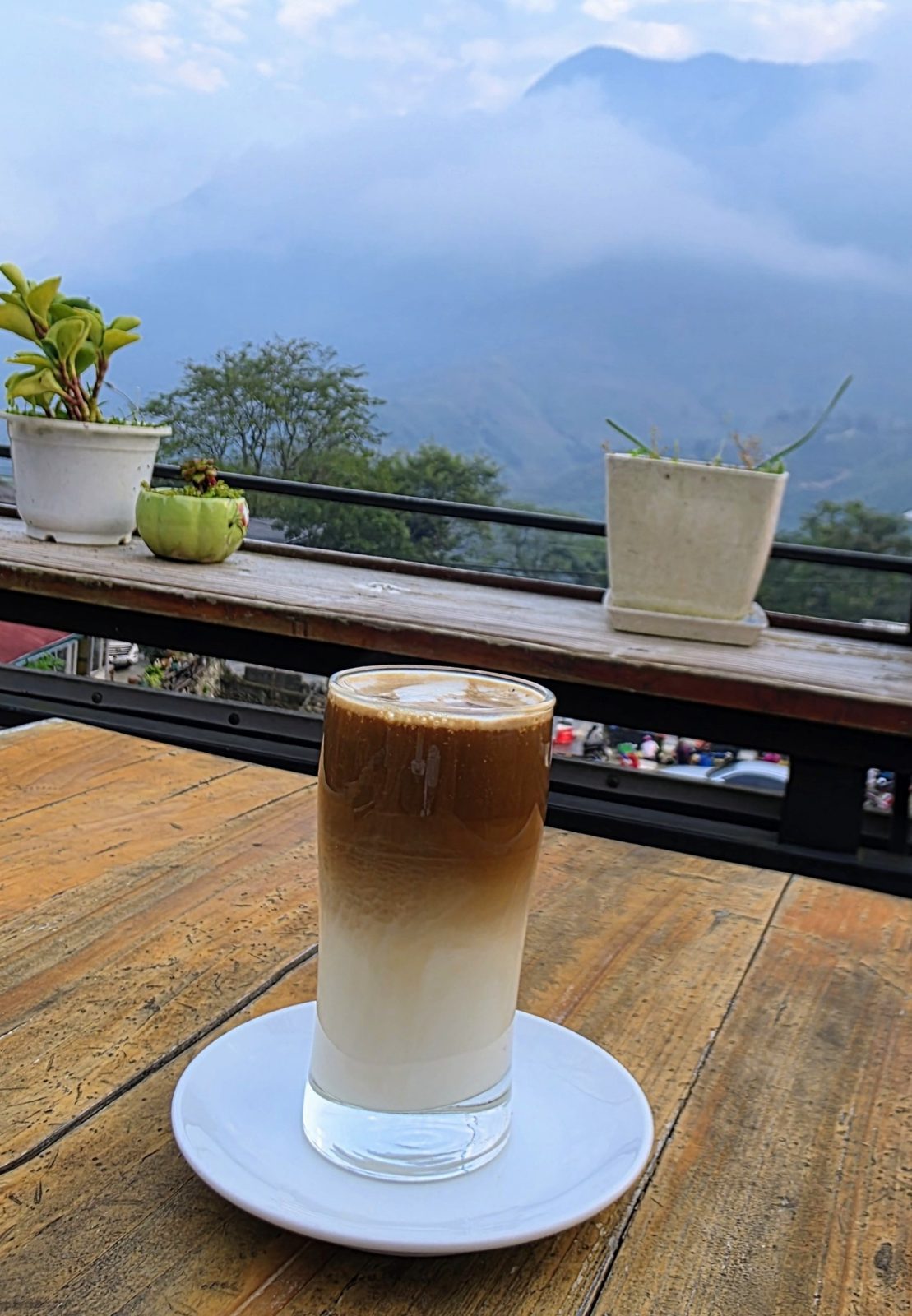
The coconut coffee, and the view that comes with it.
Walking around Tả Van without a guide is perfectly doable, as long as you're happy to get a little lost. The trails often cross private rice fields: stay on the dikes and don't trample anything. And if the river blocks your way, check the current before you take your shoes off. For the way back, a Grab will pick you up with no trouble.
October 27 · evening
Egg fried rice, and a story
Back to Hmong House by Grab. It's 8:30 pm, and dinner is usually served around 7: we're late. No problem, they make us egg fried rice anyway. A very simple gesture, and a very touching one.
That evening, one of the two sisters who run the house takes the time to sit with us and tell us her life story. She agreed to let me share it here.
Portrait
Sú, the woman who dared
Her name is Sú. So is her sister's, but not quite: in Hmong, the same syllable changes meaning depending on the tone. Sú with a rising voice, Sú with a falling voice. Two sisters, one name, and only the melody of the voice tells them apart. Together, they run Hmong House, and they make one heck of a team. The younger sister was lucky enough to go to primary school for a few years. She's the one who handles the bookings and answers the messages. Our Sú, the elder, didn't have that luck.
If you meet Sú, you'll take her for the happiest woman in the valley. She laughs all the time, talks to everyone, keeps the conversation going from one end of the table to the other, and she's the one who makes the toast at dinner. No need to ask who's the boss. And that smile, from morning till night. Which is exactly what makes her story so striking.
Sú was married at 14. The two families chose for her; her husband, two years older, was someone she had never seen before her wedding day. At 16, she had her first child. Two more followed. The husband drank heavily and didn't look after the children. She was not happy.
To feed them, she takes one odd job after another. She guides tourists through the valley for next to nothing, and sometimes for nothing at all: there are times she doesn't get paid. Sú never went to school. She neither speaks nor reads Vietnamese, only Hmong, her mother tongue. And to this day, she can't write.
But she speaks English, fluently, and that may be what changed everything. She taught herself, hike after hike, listening to travelers from Europe and beyond. As she told them her story, it was they, and above all the women travelers, who planted an idea she didn't even dare put into words: divorce.
In her community, it's almost unthinkable. She did it anyway. Her father was against it. Nobody would speak to her anymore, not in the family, not in the village. For three years, she lived as a divorced woman, shunned, at her parents' home, with her children, whom she insisted on keeping with her, and embroidery to earn a living.
Then life finally smiled on her. Sú remarried, and a little one came along: he's eleven months old today. He still wakes her around 2 or 3 in the morning, and the guests' breakfast is served at 8:30. She admits she's tired sometimes. But at breakfast, the smile is already there.
Around the table, when she finished speaking, no one said a word. Many of us had tears in our eyes, and I was the first. I find Sú immensely brave. She went against her culture, her traditions, her family, for something very simple: the right to be happy. If you're passing through Tả Van, go and stay with her. And listen to her.
After a story like that, we needed a little lightness.
That's when the village children take the stage: songs and dances, in pleated skirts and bare feet.
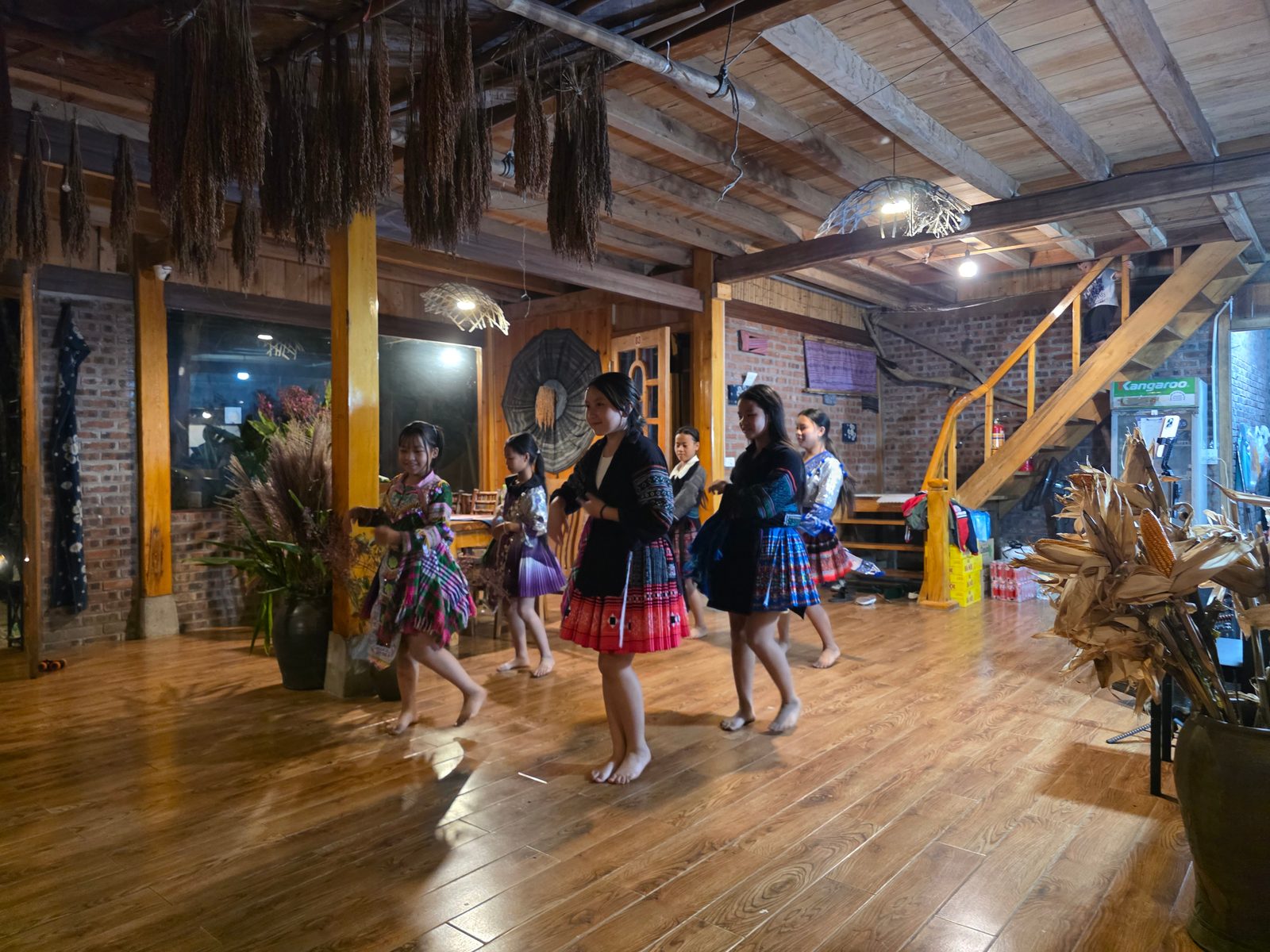
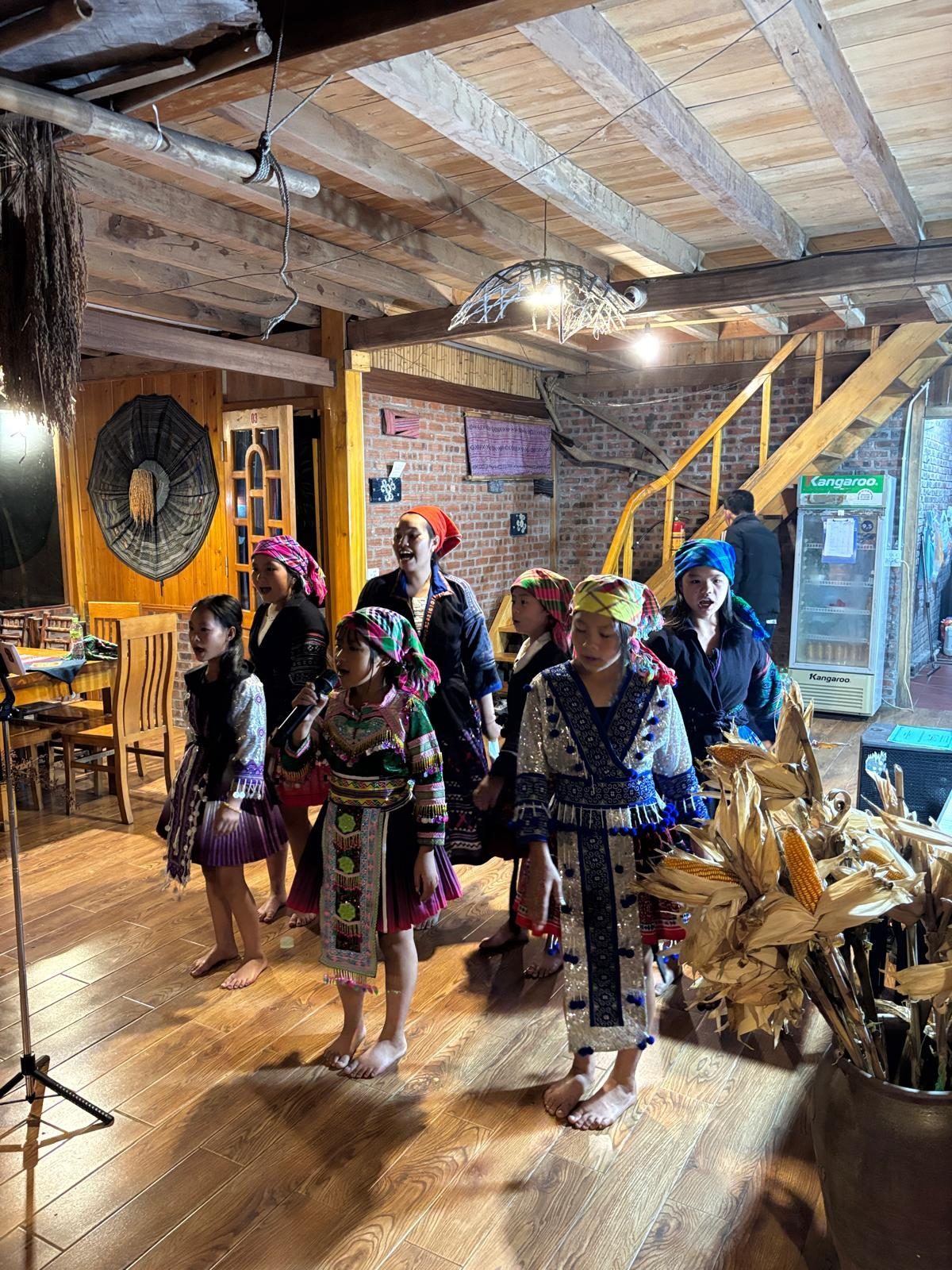
Pleated skirts twirling, then the song, mic in hand. Tonight, we're the audience.
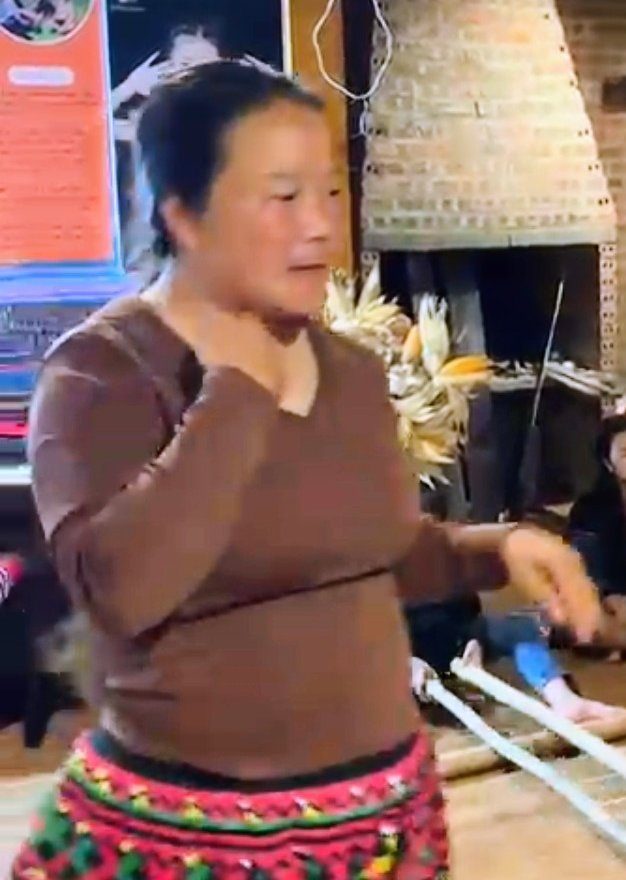
But the audience doesn't stay seated for long. Out come long bamboo poles, laid on the floor in pairs. At each end, someone holds them and claps them together in rhythm: open, closed, open, closed. And we, travelers from every country, jump in the middle, trying to keep our ankles in one piece. It starts slowly, then the rhythm speeds up, and so do the fits of laughter. I didn't take a single photo: I was too busy jumping. Luckily, someone was filming. And who's leading the dance, in an embroidered skirt? Sú, of course.
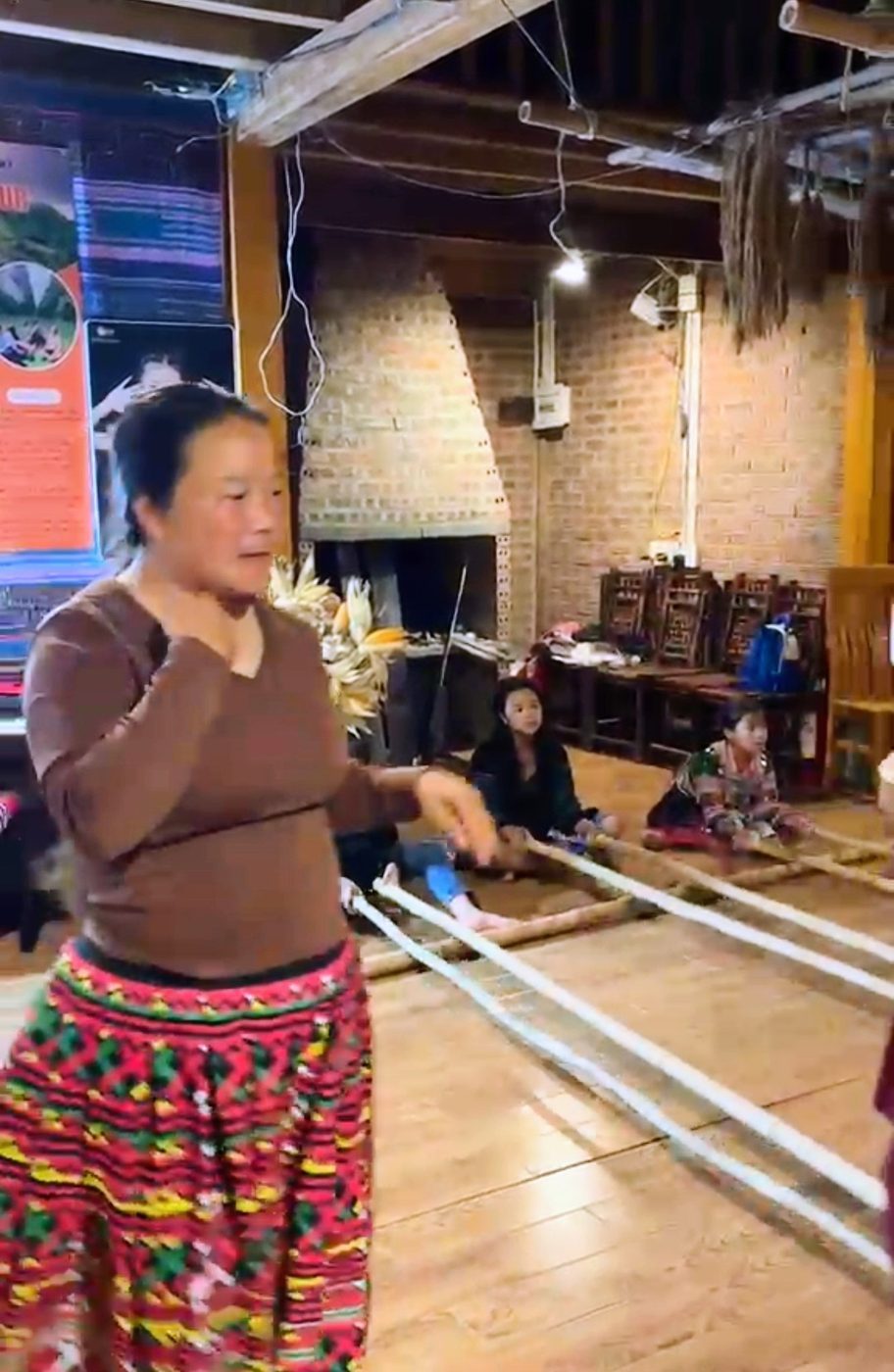
Sú leads the dance. The poles show no mercy.
This bamboo dance is called múa sạp. It's mostly associated with the Thái people (Vietnam's Thái ethnic group, not the people of Thailand), and more broadly with the peoples of the mountainous Northwest. The clapping poles set the rhythm, faster and faster, and the dancers have to keep their feet clear of the bamboo. It's danced at village festivals, and it symbolizes solidarity and the joy of shared work.
To wrap up, a little improvised disco where everyone dances together. Lights out around 10 pm. Tomorrow, we're going up to the roof of Indochina. In theory.