Twenty-three days, two countries. This journal starts where all great journeys start: at Paris Charles de Gaulle, with a flight to Hanoi taking off at 2 pm. It carries on in Hanoi, where within twenty-four hours you learn to count in hundreds of thousands, to buy a hotel night in slices, and to sip a fruit juice with a train in your line of sight.
October 22 · departure
Ten hours in the air, one hot towel
Thursday, 2 pm, Paris Charles de Gaulle: our Vietnam Airlines flight to Hanoi takes off. Over ten hours of flying on the ticket, and a five-hour time difference to swallow. We've barely sat down when a flight attendant comes by with damp towels to freshen our hands. The crew smiles, takes its time, and you can already feel something different from the scrum of a low-cost flight. Vietnamese hospitality starts in the aisle of the plane, before take-off even.
October 23 · arrival
Millionaires by the first taxi
Touchdown at 6:30 am, ten minutes early. A Grab (the local Uber) drives us to the Old Quarter for 350,000 dong, about twelve euros. In Hanoi, you become a millionaire at the first ATM, and you quickly lose count of the zeros.
In my morning notes, I had written “taxi: 350 dong”. That's roughly one euro cent. Even in Hanoi, the driver might have found that a little on the stingy side. Three zeros missing, and it won't be the last time.
One hotel night, sold by the quarter
8:30 am, reception at the San Palace Hotel & Rooftop, on Hàng Bông Street in the Old Quarter. Expect around €55 to €60 a night, breakfast included, with a small pool on the roof. But the room isn't ready, of course: check-in is in the afternoon. They offer us breakfast while we wait, and explain the house rule. Take a room before 9 am and you pay a full night. Between 9 and noon, half a night. Rather than carve up the night, we go and eat first.
Somewhere between the eggs and the coffee, the receptionist comes to find us: a room has just been freed up, and he'll let us have it at the “quarter-night” rate. 400,000 dong, around 13 euros. Sold. A shower, then a two- or three-hour nap, the kind you wake up from not knowing what day it is.
San Palace Hotel & Rooftop, Hanoi
187 Hàng Bông Street, Old Quarter · Breakfast included · Small rooftop pool · Booked on Booking.com
~€55 to €60 a nightQuarter night: 400,000 VND (~€13)Price noted in October 2026; varies with the room, the season and the booking site.
After a night flight, ask for early check-in by the hour. Many Old Quarter hotels charge the room according to what time you turn up. And if you're in no hurry, have breakfast while you wait: sometimes the price drops while you eat.
Early in the afternoon, we head up to see the rooftop. The pool is the size of a postage stamp, the Old Quarter roofs spread out behind the glass, and the air is hot, thick, humid. The kind of heat that reminds me of Singapore: you sweat just sitting still.
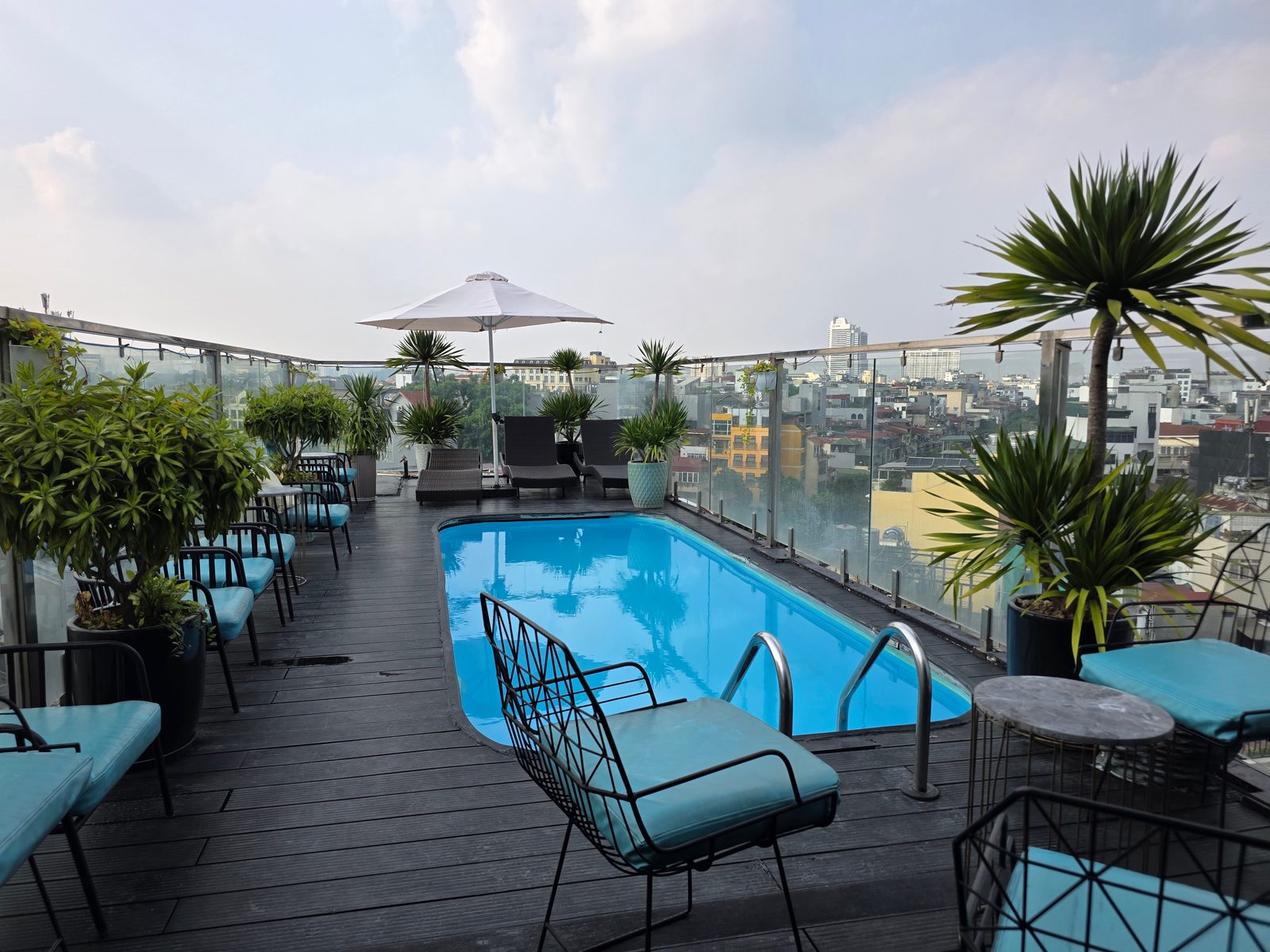
The rooftop pool. Not one for laps. For the view, though, it'll do.
October 23 · 3 pm
Train Street, in four acts
Picture an Old Quarter alley barely wider than a railroad car. Houses squeezed together on both sides, laundry in the windows, garlands, plastic stools. And down the middle, a real railroad track, used by a real passenger train a few times a day. The locals have opened little cafés right by the tracks, and the whole world comes to sit there and watch the train go by a few centimeters away.
As we leave the hotel, we hear a train is due in ten minutes. Perfect timing.
Before
We settle into a small café on a corner. There are cafés all around, all packed. Passion fruit mocktails, and we wait with everyone else, practically sitting on the rails. Vendors come past again and again, pushy, almost aggressive. I ended up caving and buying a new screen protector for my phone, the equivalent of 3 euros. At least it's still doing its job.
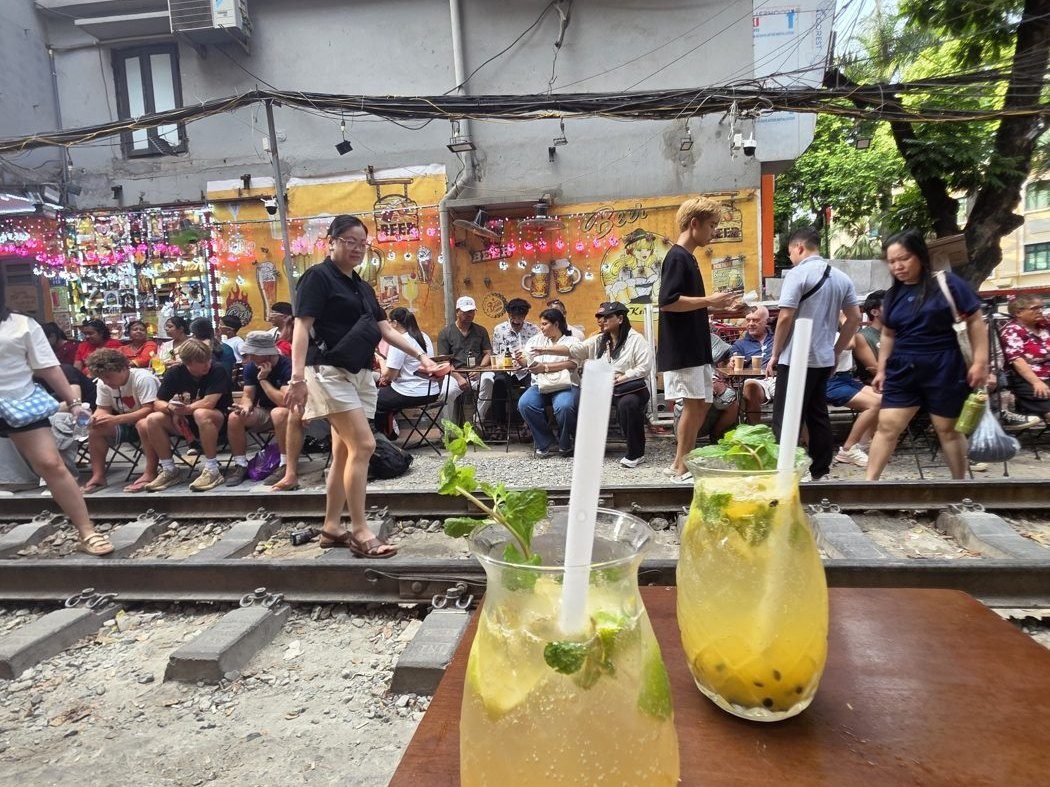
The wait. Glasses full, rails empty. For now.
During
A siren, then everyone stands up. The owners pull the tables in, we flatten ourselves against the wall, and the train bursts out at the end of the alley, blue and red, slowly, with an incredible racket. Up go the phones, the whole street is filming. It passes so close you could put your hand on the car.
And our mocktails? They stay right there on the table, a few centimeters from the cars rolling past.
Right after
The train heads for the intersection, and we watch it leave on the other side in a completely different livery: blue, purple and yellow. One train, two faces. Behind the barriers, the crowd films it to the very end.
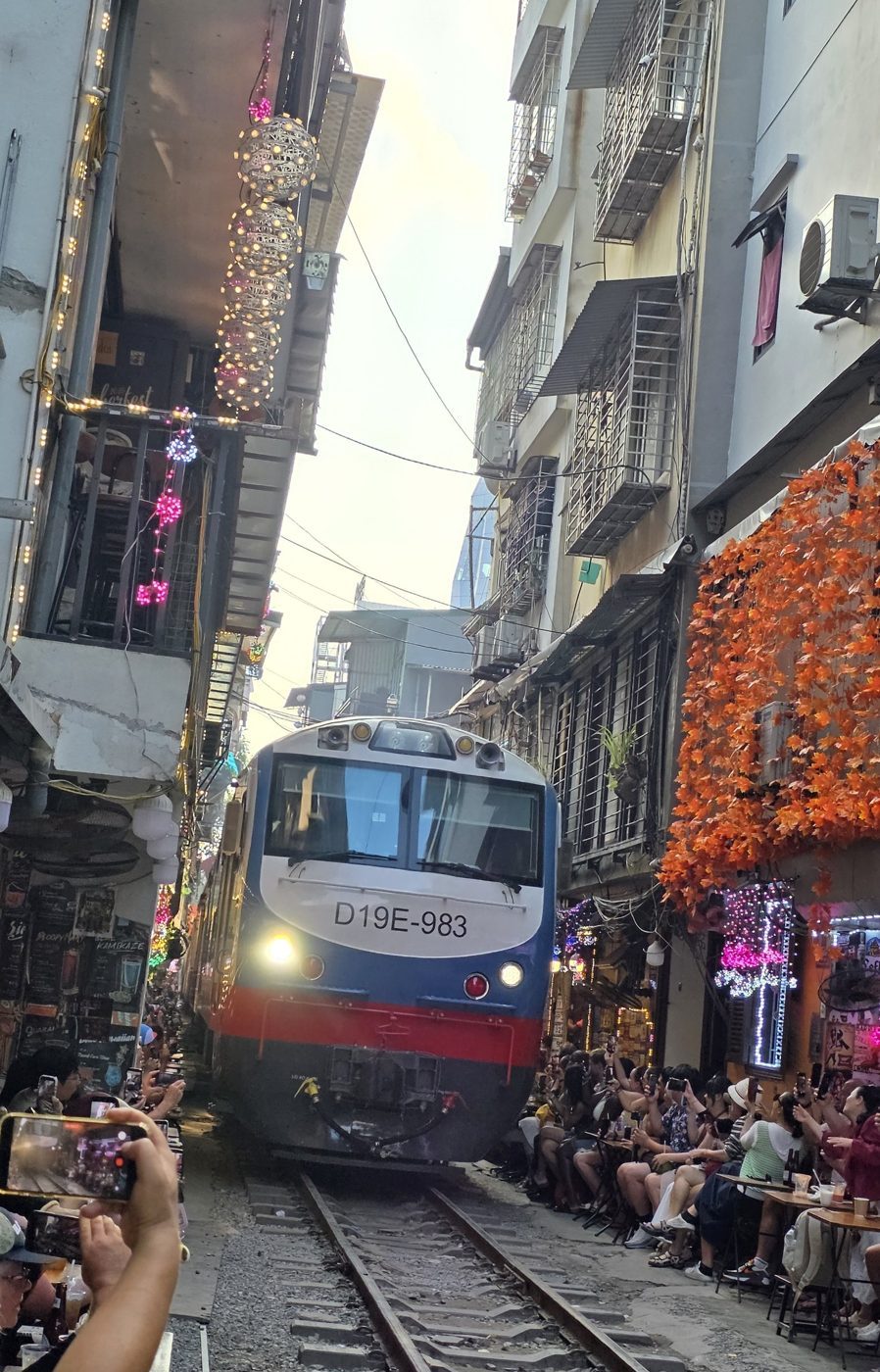
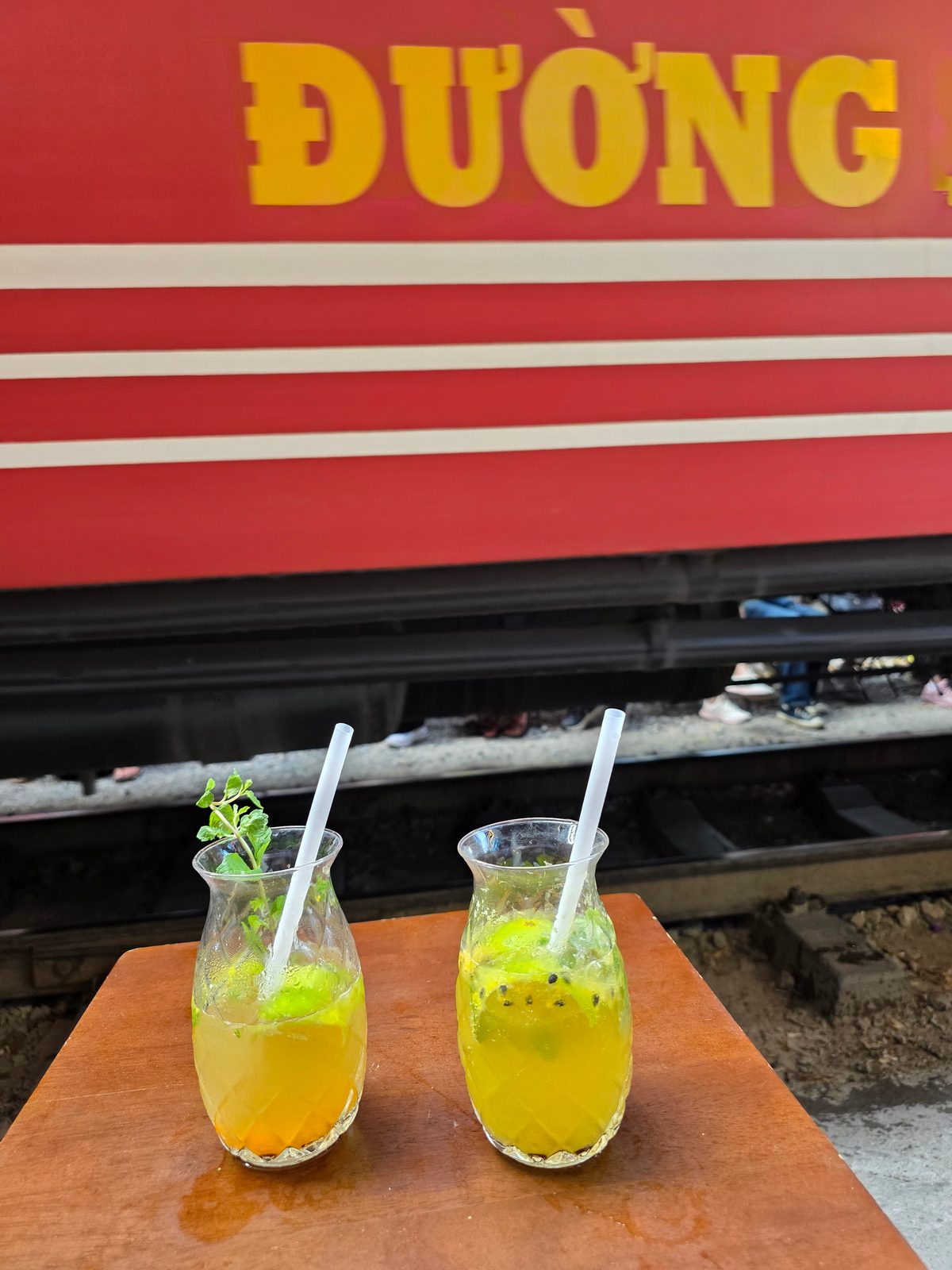
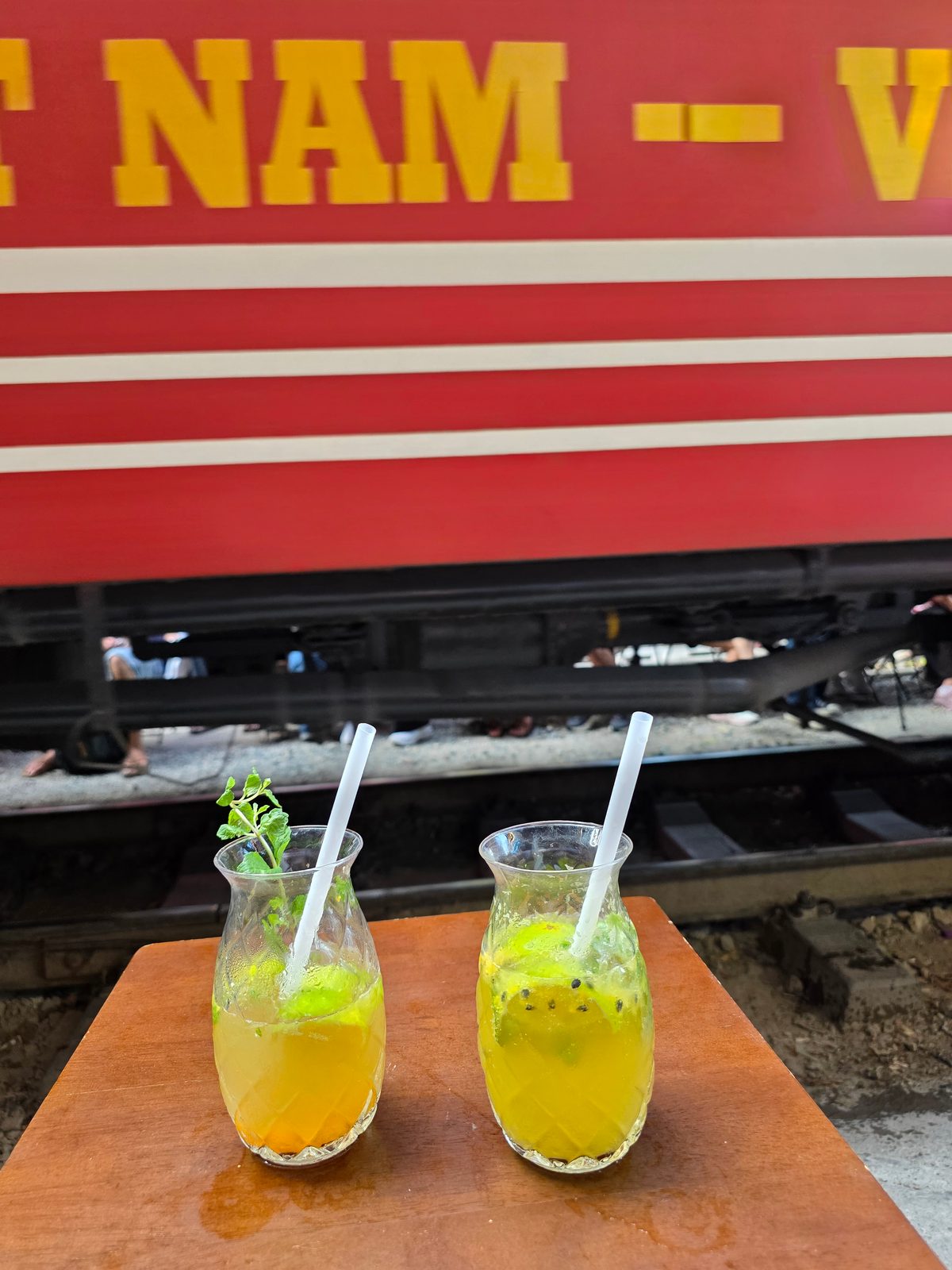
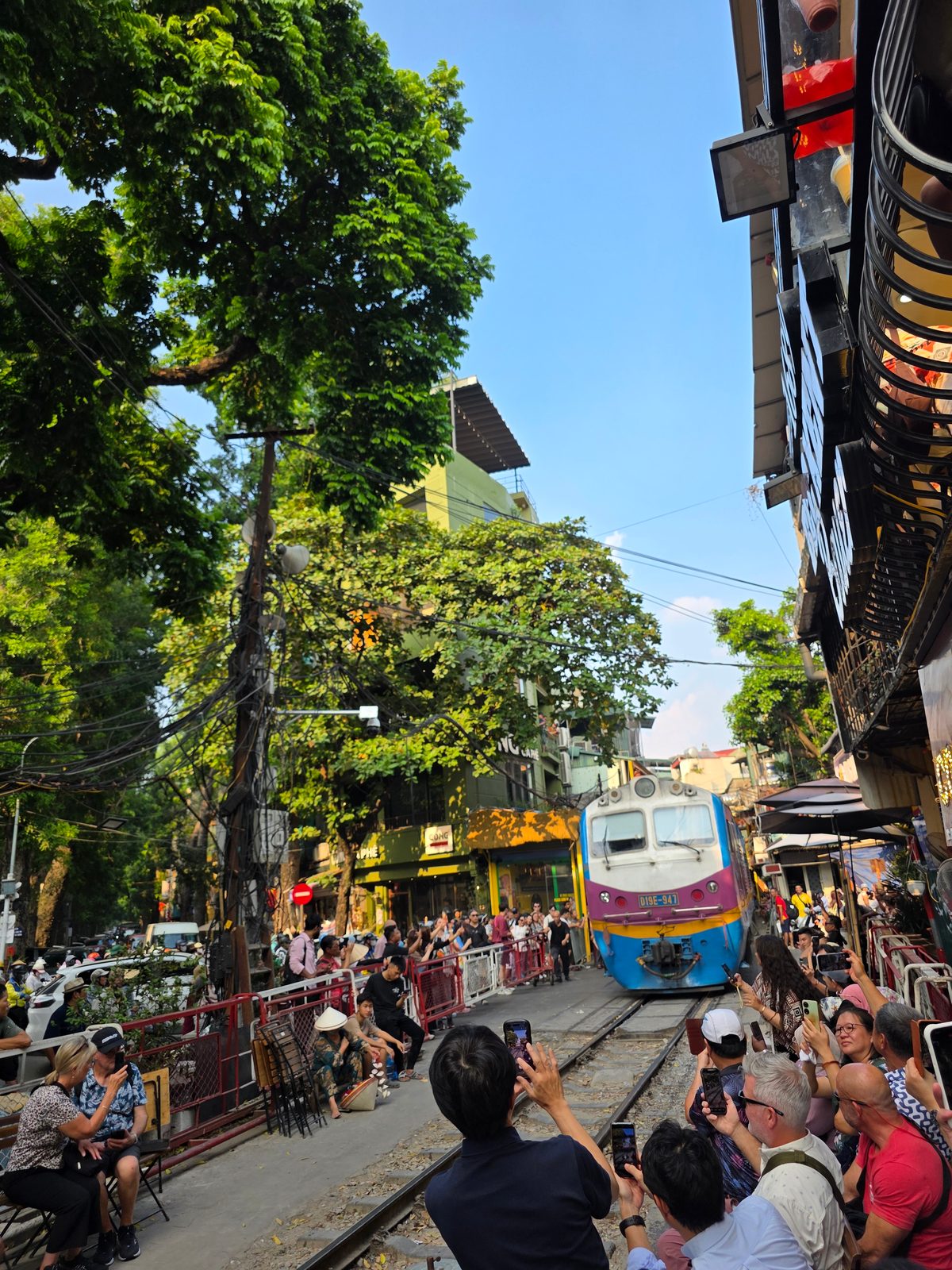
The train bursts into the alley, “Đường sắt Việt Nam” (Vietnam Railways) on the car, then leaves on the other side in a whole new livery.
A few minutes later
And then nothing. Within five minutes, the street empties. The tables go back on the rails, the vendors leave with their conical hats, and we walk the whole alley back along the track, between the orange garlands and the colorful façades. Dead calm. Without the photos, we'd wonder if we'd dreamed it.
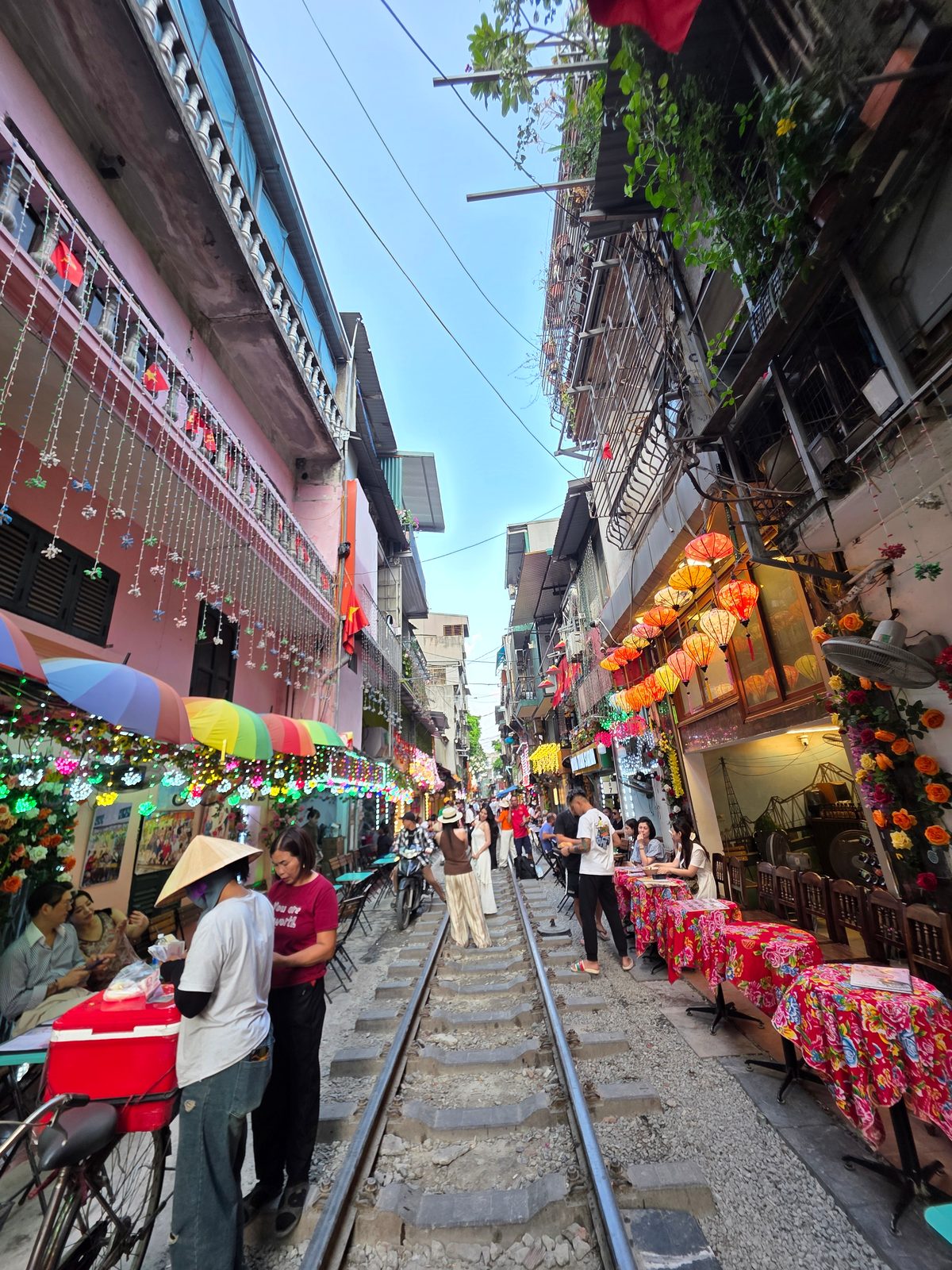
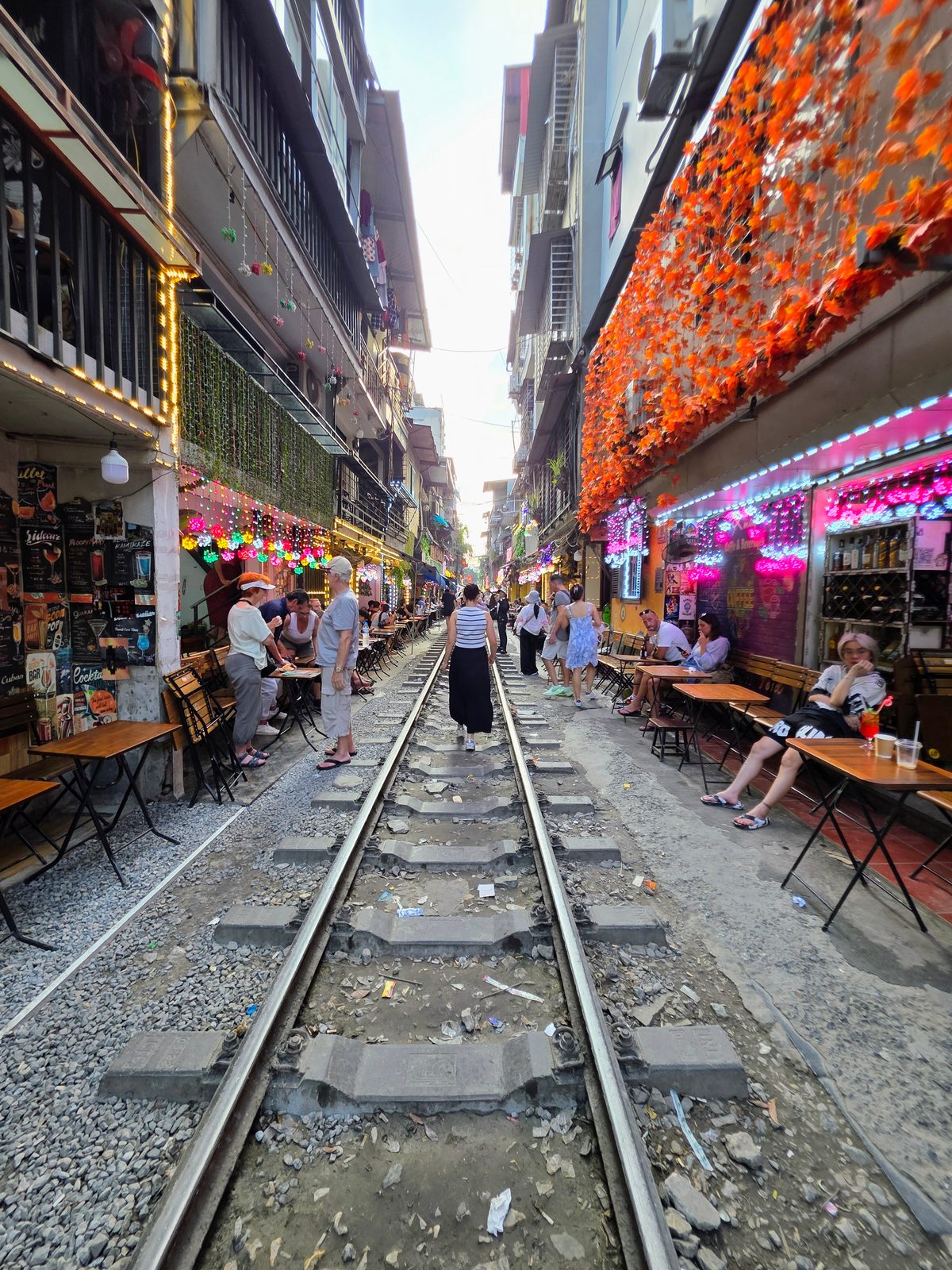
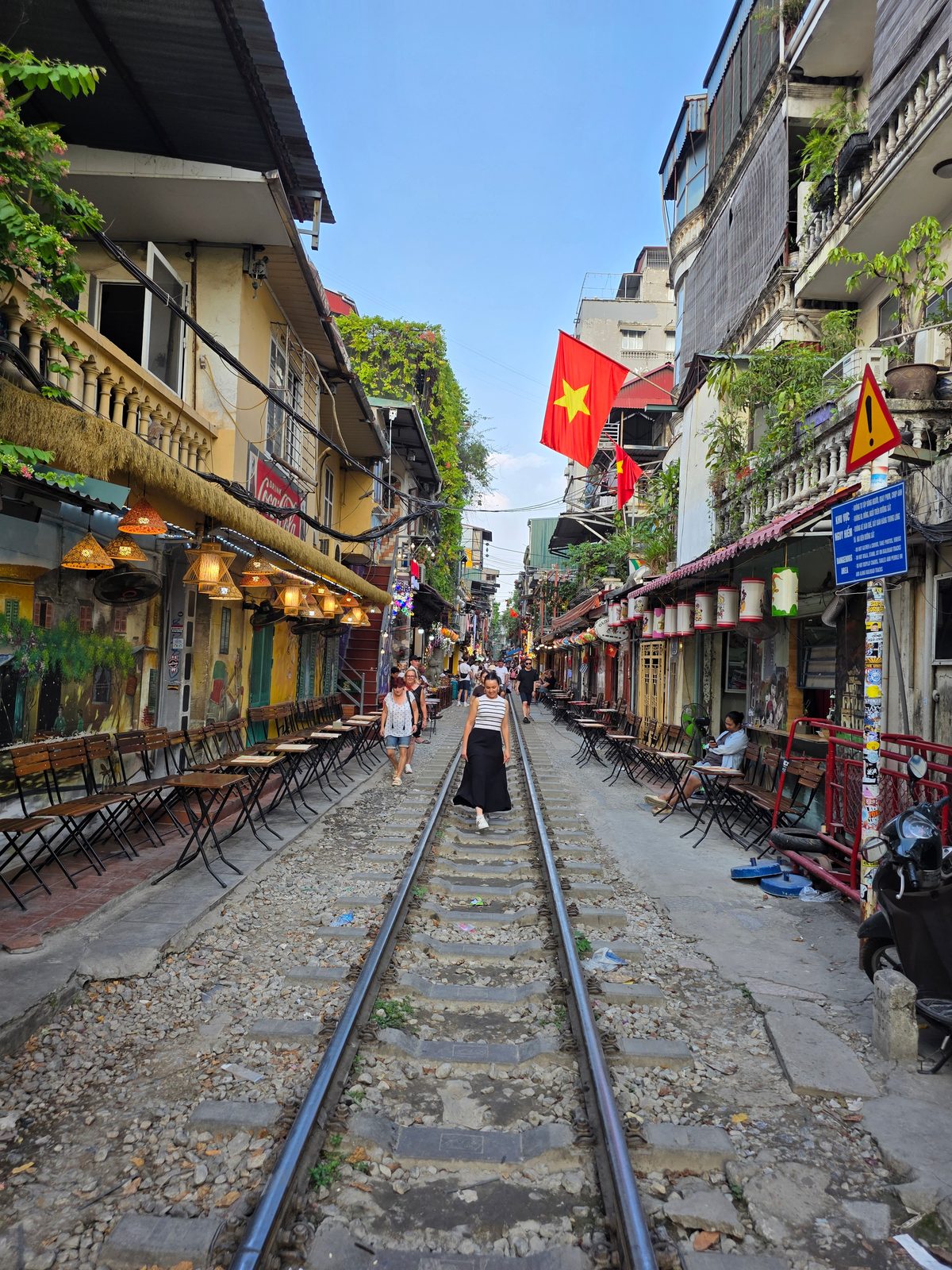
Five minutes later, the street is all ours.
Officially, the trackside cafés are banned, and since February 2026 fewer trains run. In practice, some cafés still welcome customers. We didn't see a single police officer, but access can be blocked on some days, mostly on weekends.
Schedules aren't posted anywhere: ask at the café, they're the ones who know. And when the siren sounds, back to the wall, never on the rails.
October 23 · 5 pm
A cathedral and a mango with salt
After the train, we walk down to St. Joseph's Cathedral. Two gray towers, blackened by the humidity, that look lifted straight out of a French town and dropped among the scooters. On the forecourt at sunset, it's a parade: young Hanoians dressed to the nines, some in period costume, taking turns for photo shoots in front of the façade.
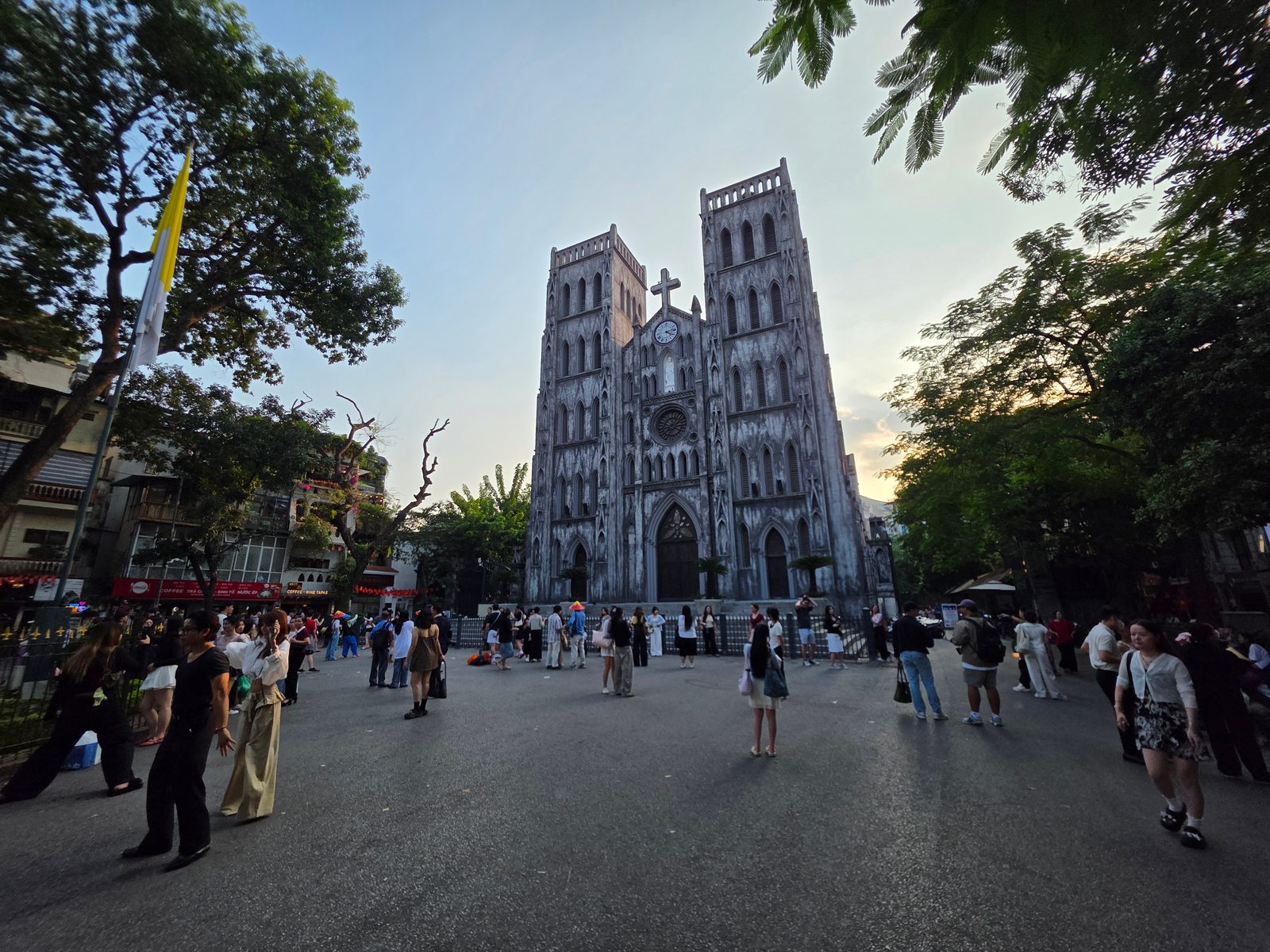
St. Joseph's Cathedral, its forecourt turned into an open-air photo studio.
Right next door, our first food stop: a plate of mango, served with salt. Yes, salt. The sweetness of the mango, the bite of the salt: it surprises you, then you go back for more. To balance things out, a plate of fries and some soy sauce, just to keep one foot on familiar ground.
On the way to the lake, a coffee shop catches our eye: Hương Mai, which mainly sells ground and flavored coffees. We try two, a classic and a lightly flavored one. Real Vietnamese coffee, strong, dense, very good.
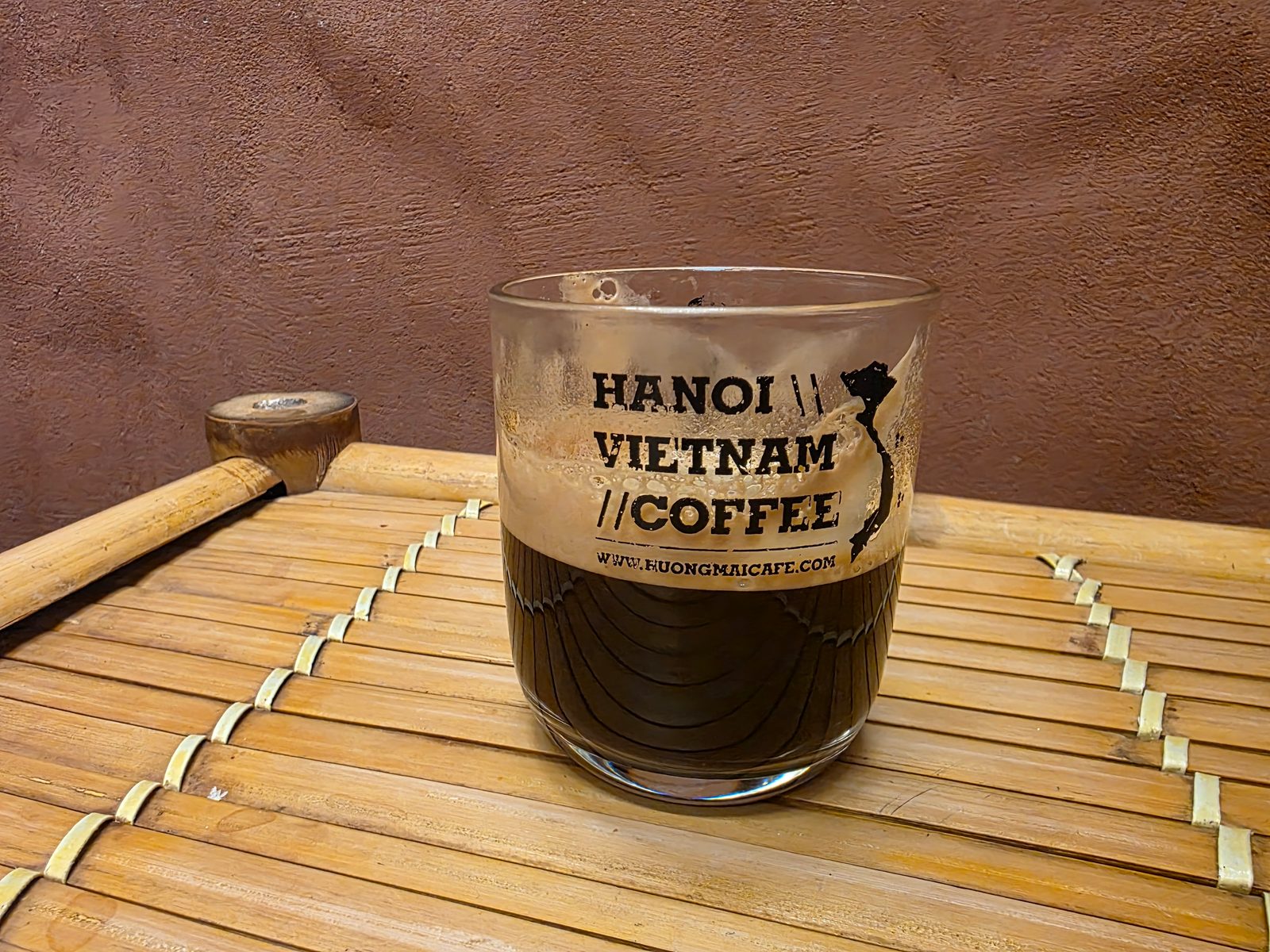
A coffee, with a map of the country printed on the glass, in case we'd forgotten where we were.
Hương Mai Café, Hanoi
Between the cathedral and the lake · Ground and flavored coffees, to drink in or take home by the bag
Coffee to take homeOctober 23 · evening
The Lake of the Returned Sword
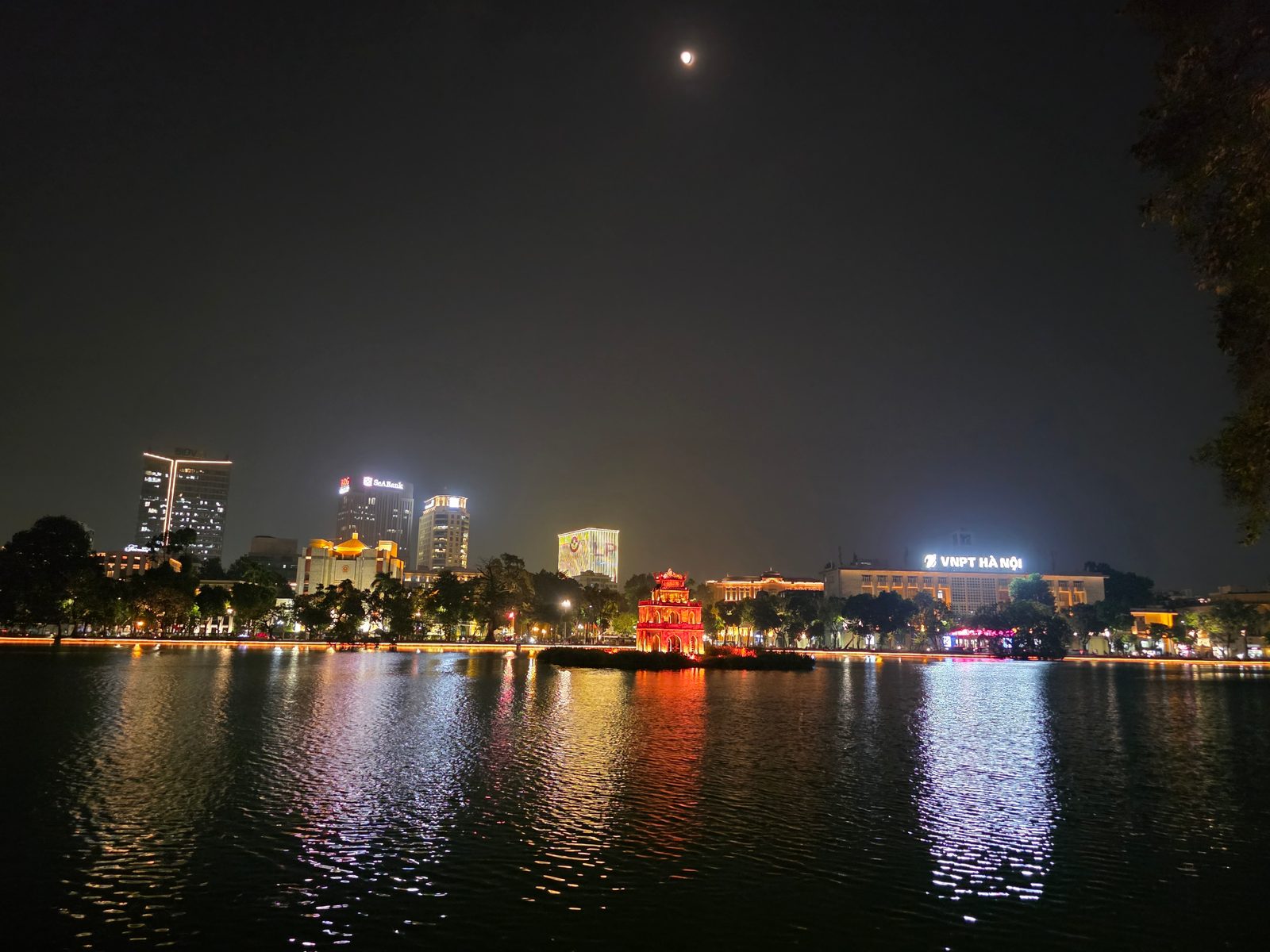
As night falls, we reach Hoàn Kiếm Lake. On Friday evenings, the streets around it close to traffic, and the whole of Hanoi comes out for a stroll. In the middle of the water, on its islet, the Turtle Tower lights up red, and the moon does the rest. Along the shore, giant letters spelling “Tôi ♥ Hà Nội” remind everyone, just in case, what the whole city thinks.
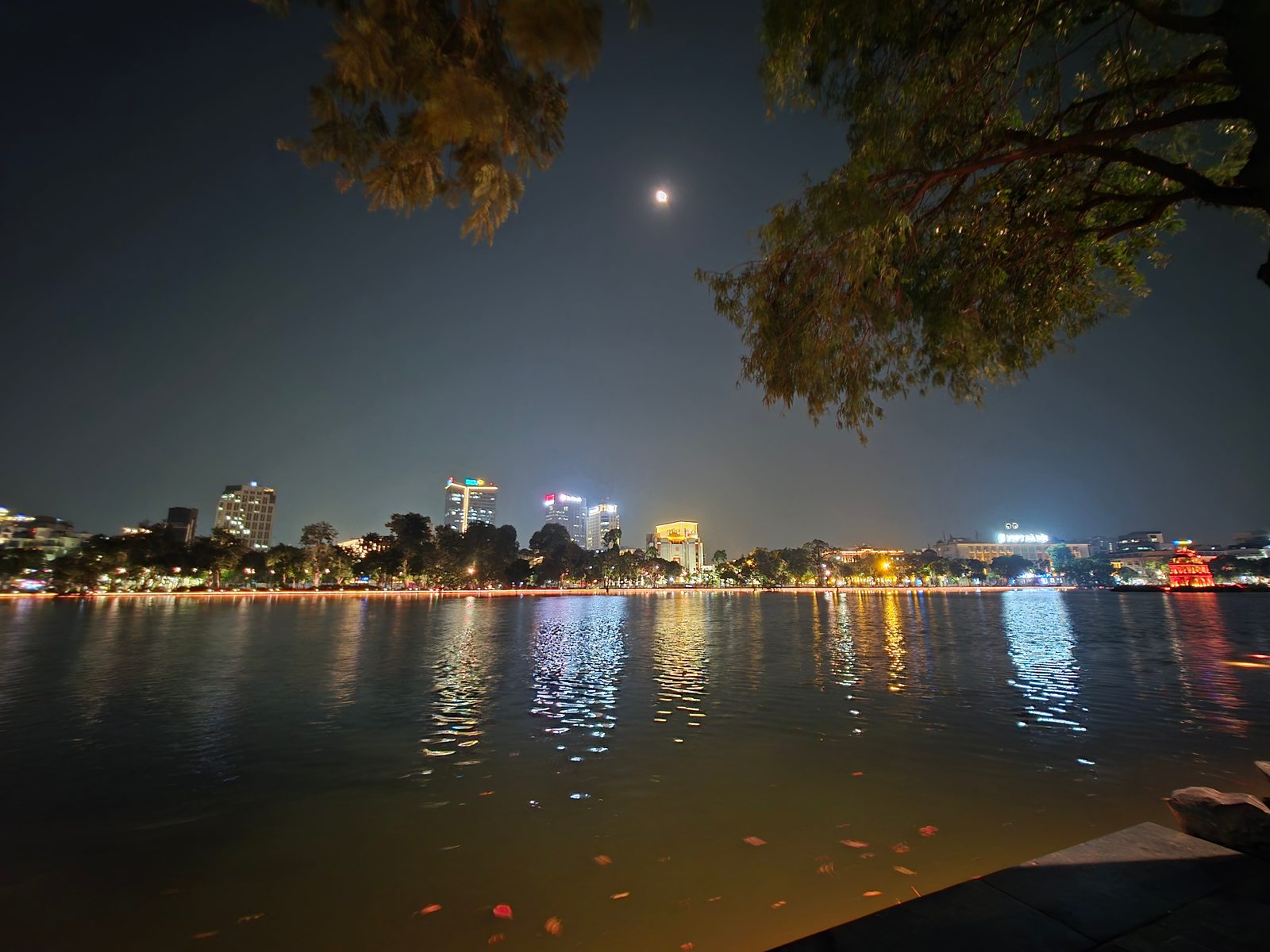
Hoàn Kiếm Lake under the moon. Far right in the background, the little Turtle Tower.
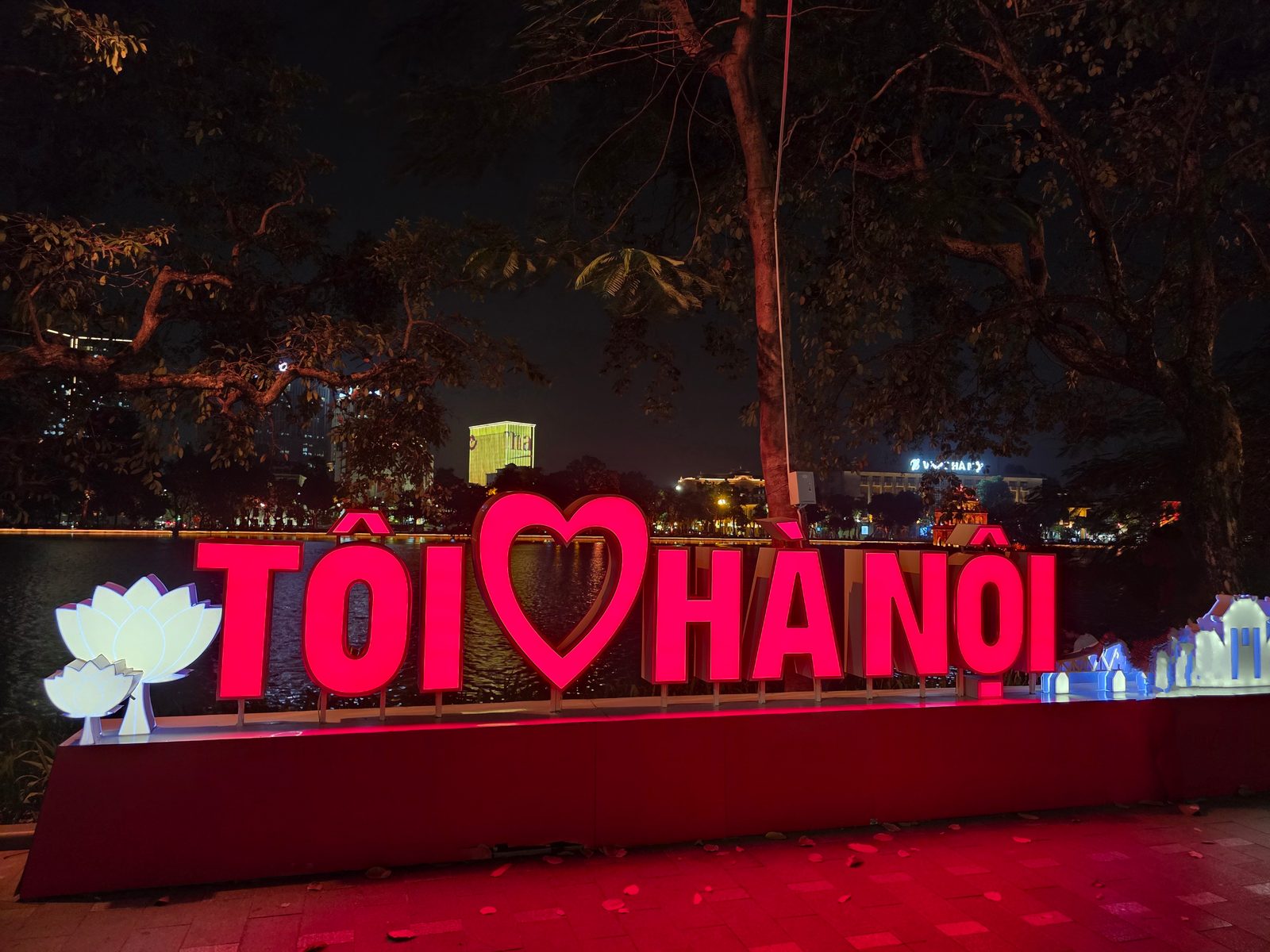
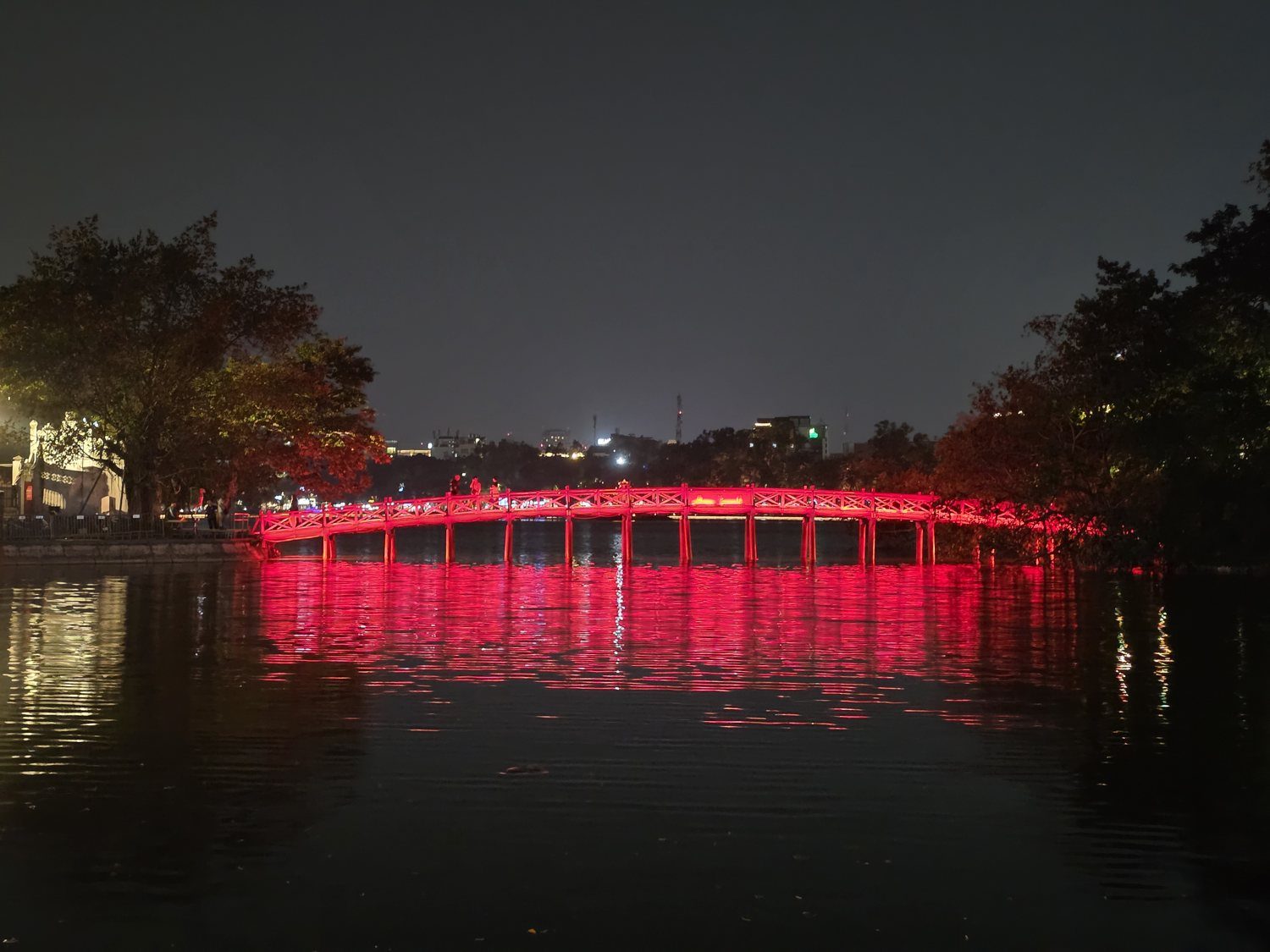
“Tôi yêu Hà Nội”: I love Hanoi. Message received. And in the distance, the red bridge waiting for us.
On the north side, a gateway with flame-topped pillars leads to the Thê Húc Bridge, all red wood, which crosses the water to Ngọc Sơn Temple, the Temple of the Jade Mountain, sitting on its little island. At night, the bridge glows like an ember.
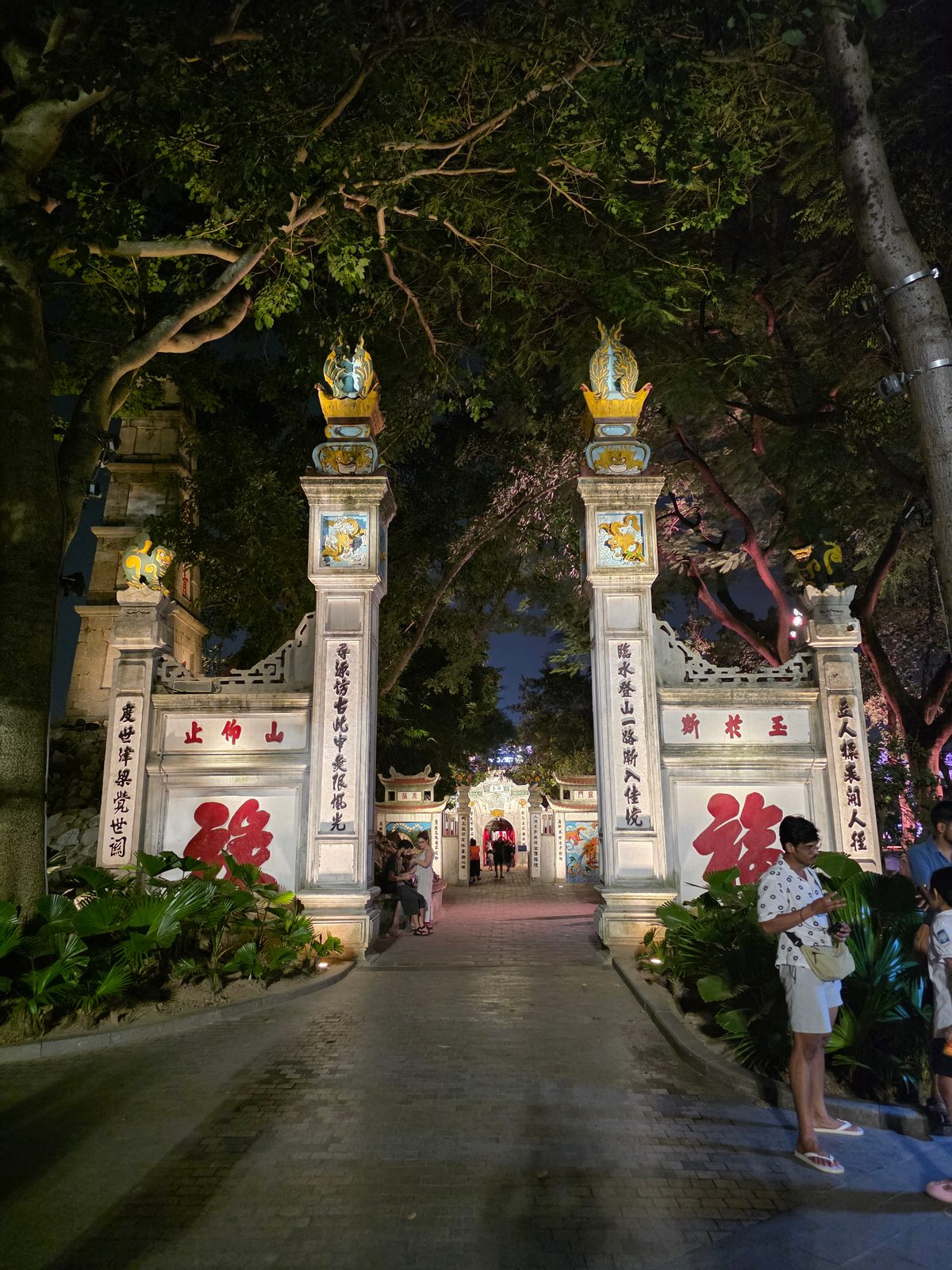
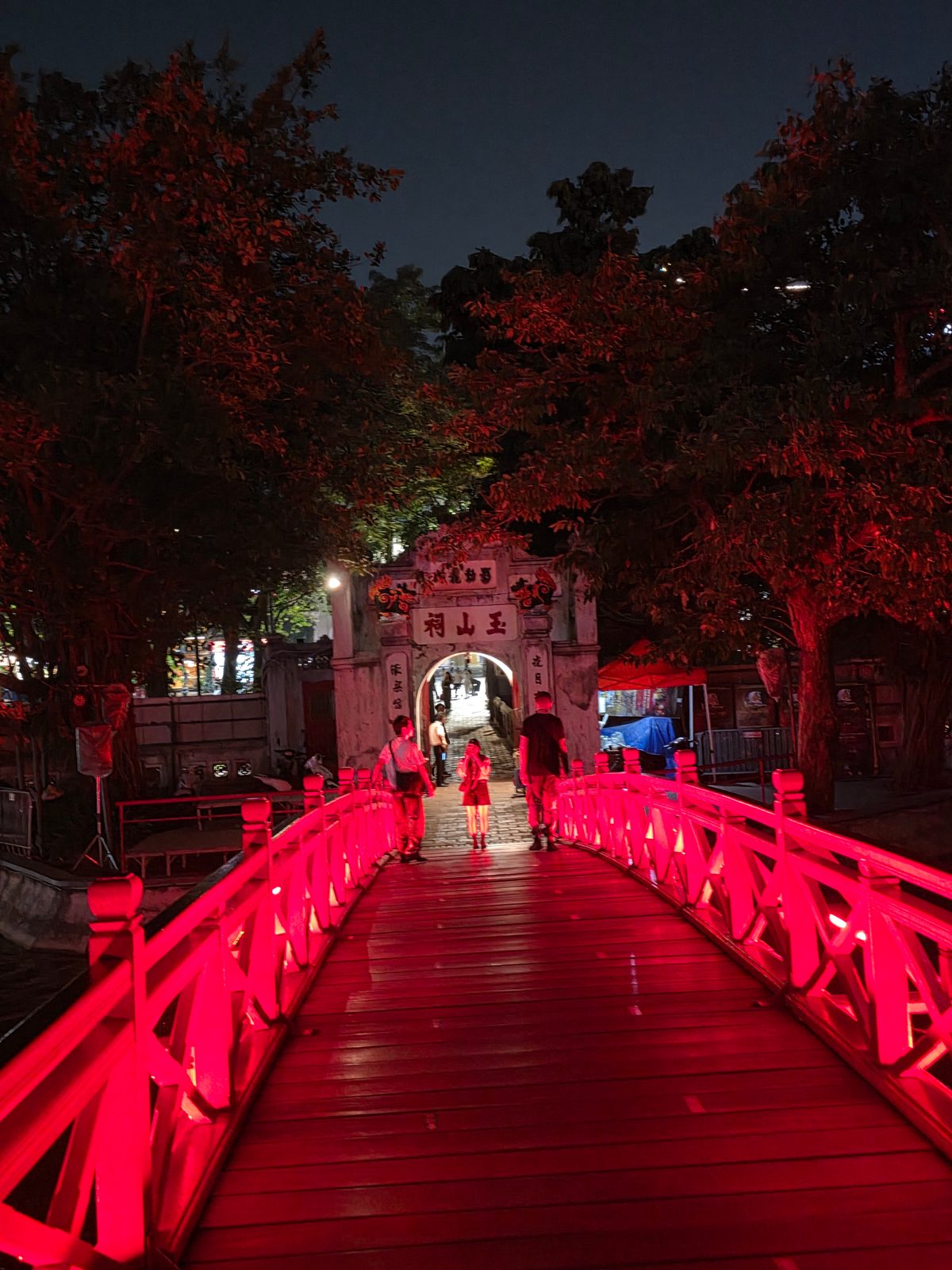
The gateway, then the red bridge. The temple waits on the other side.
We cross. At the end of the bridge, a red door, then the temple gate.
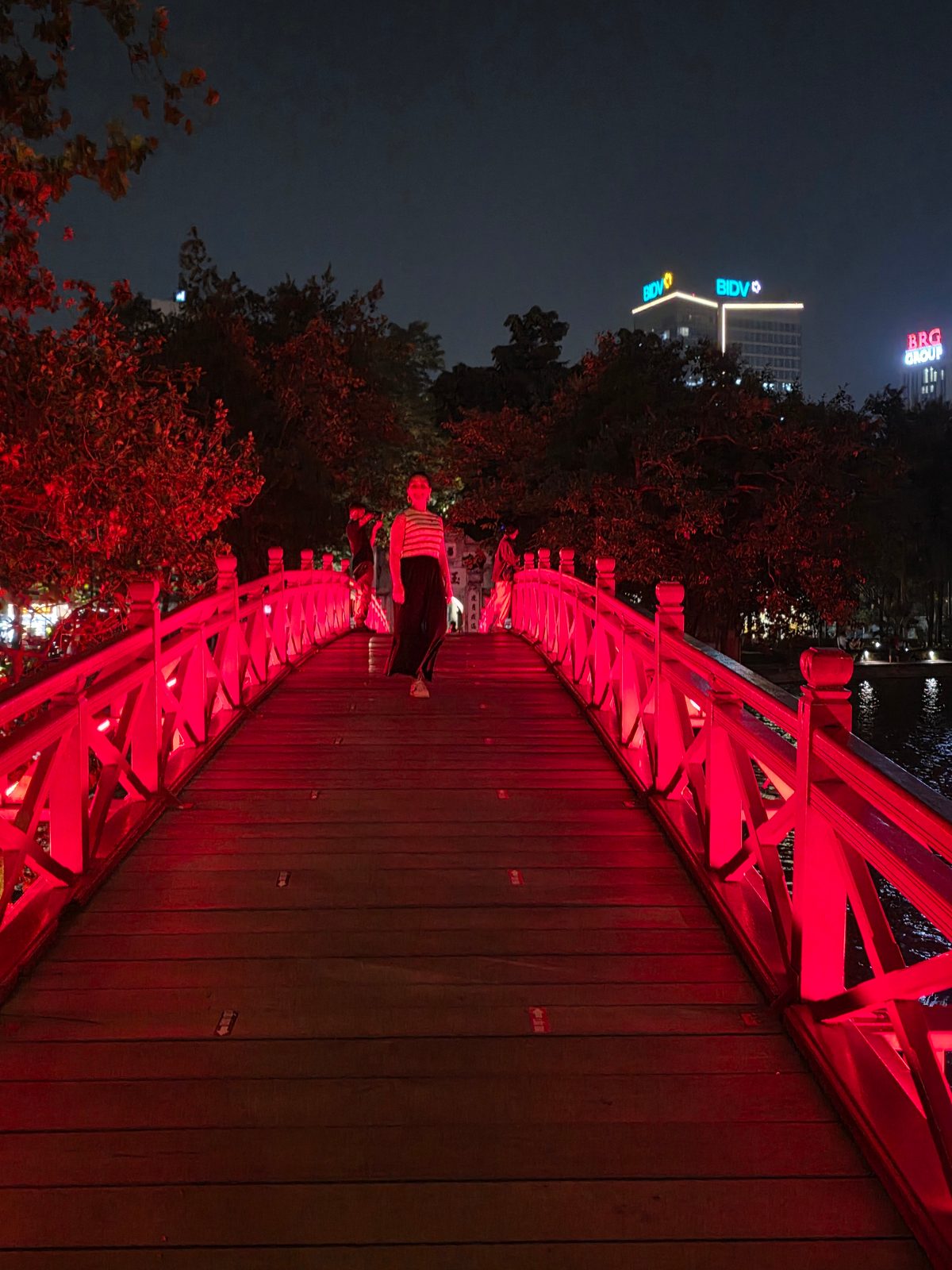
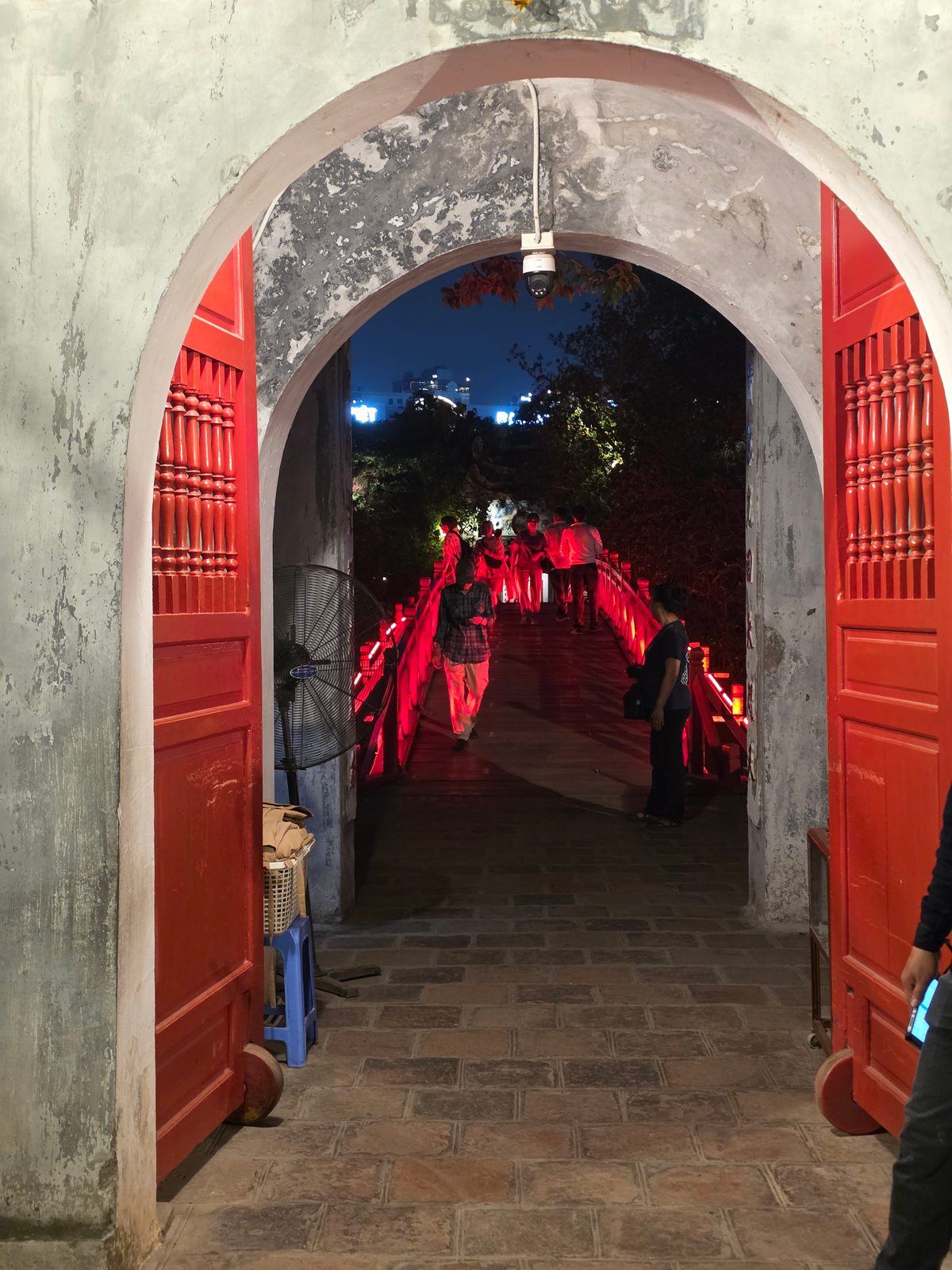
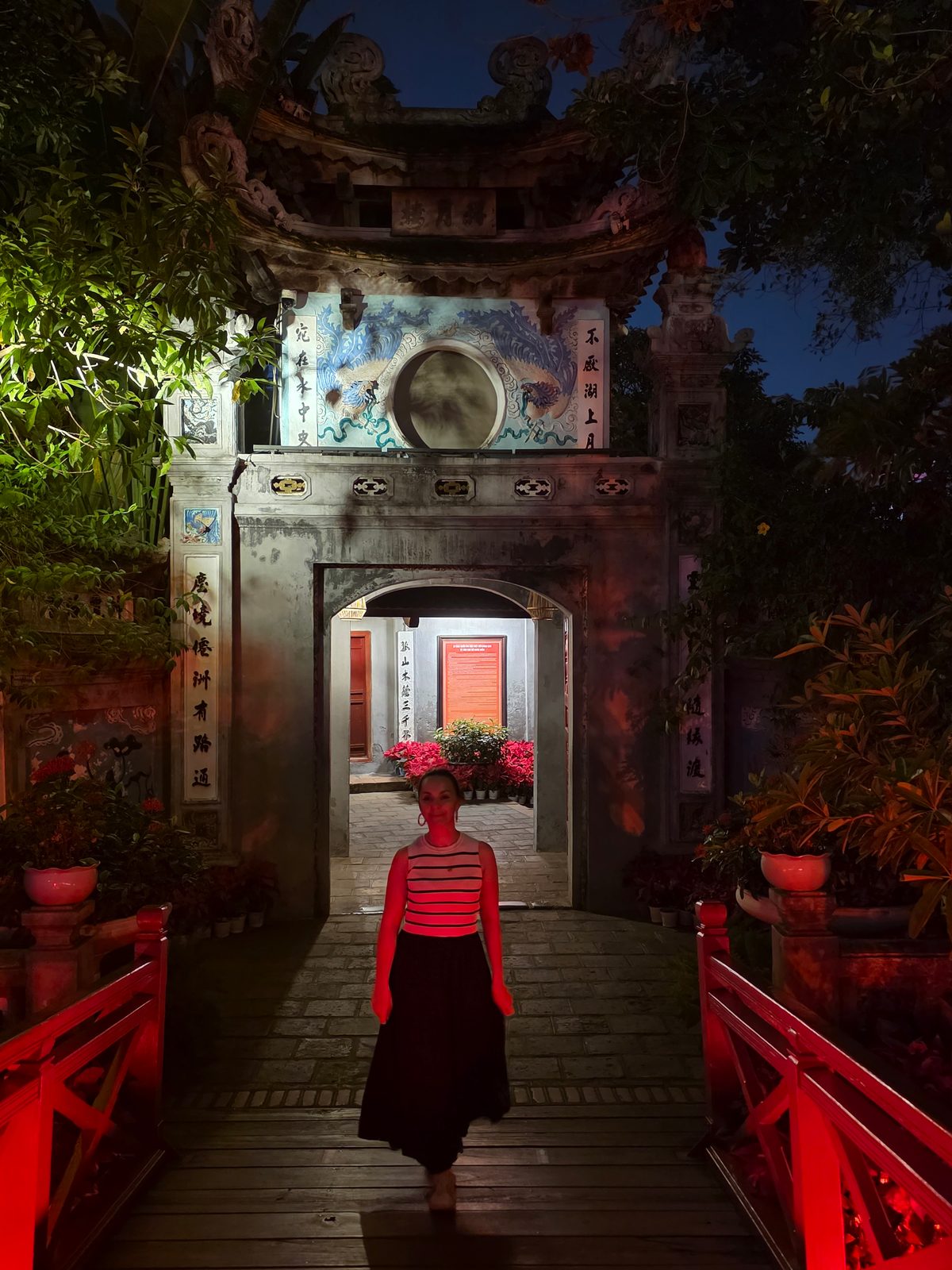
On the bridge, the red door, the phoenix gate.
On the island, the temple is still open: century-old bonsai, a large bronze incense burner, gilded lacquer panels, and a pavilion by the water.
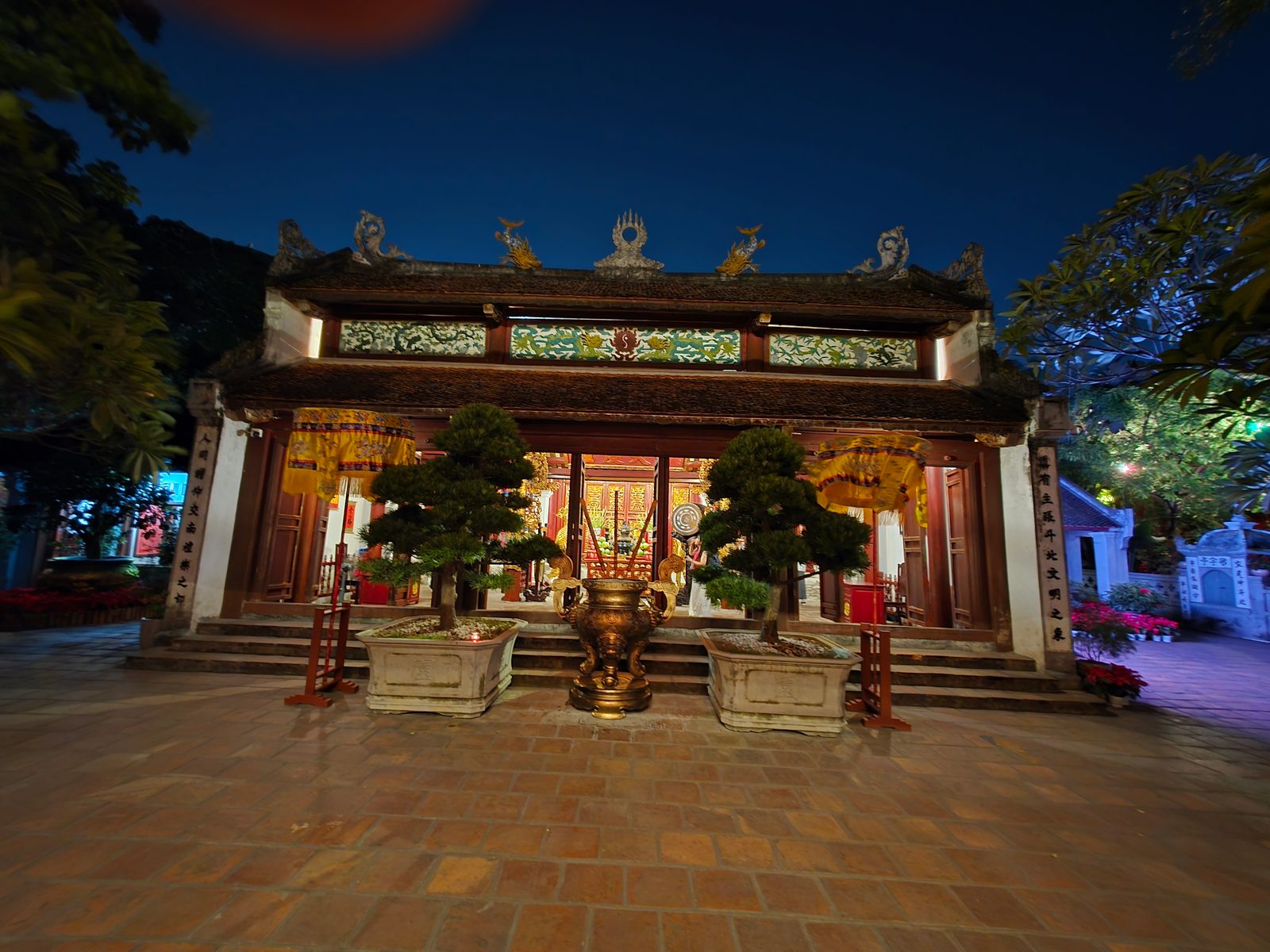
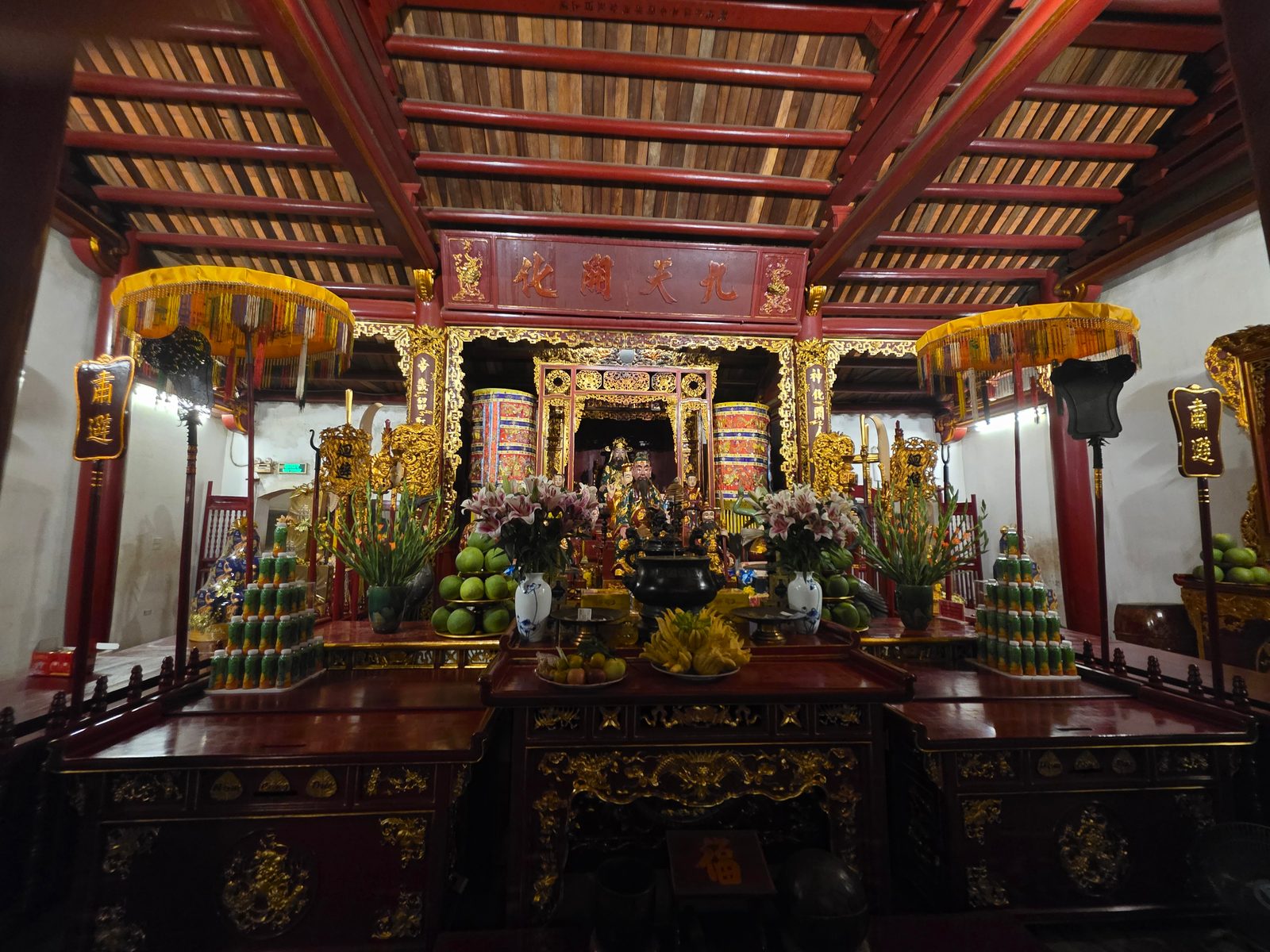
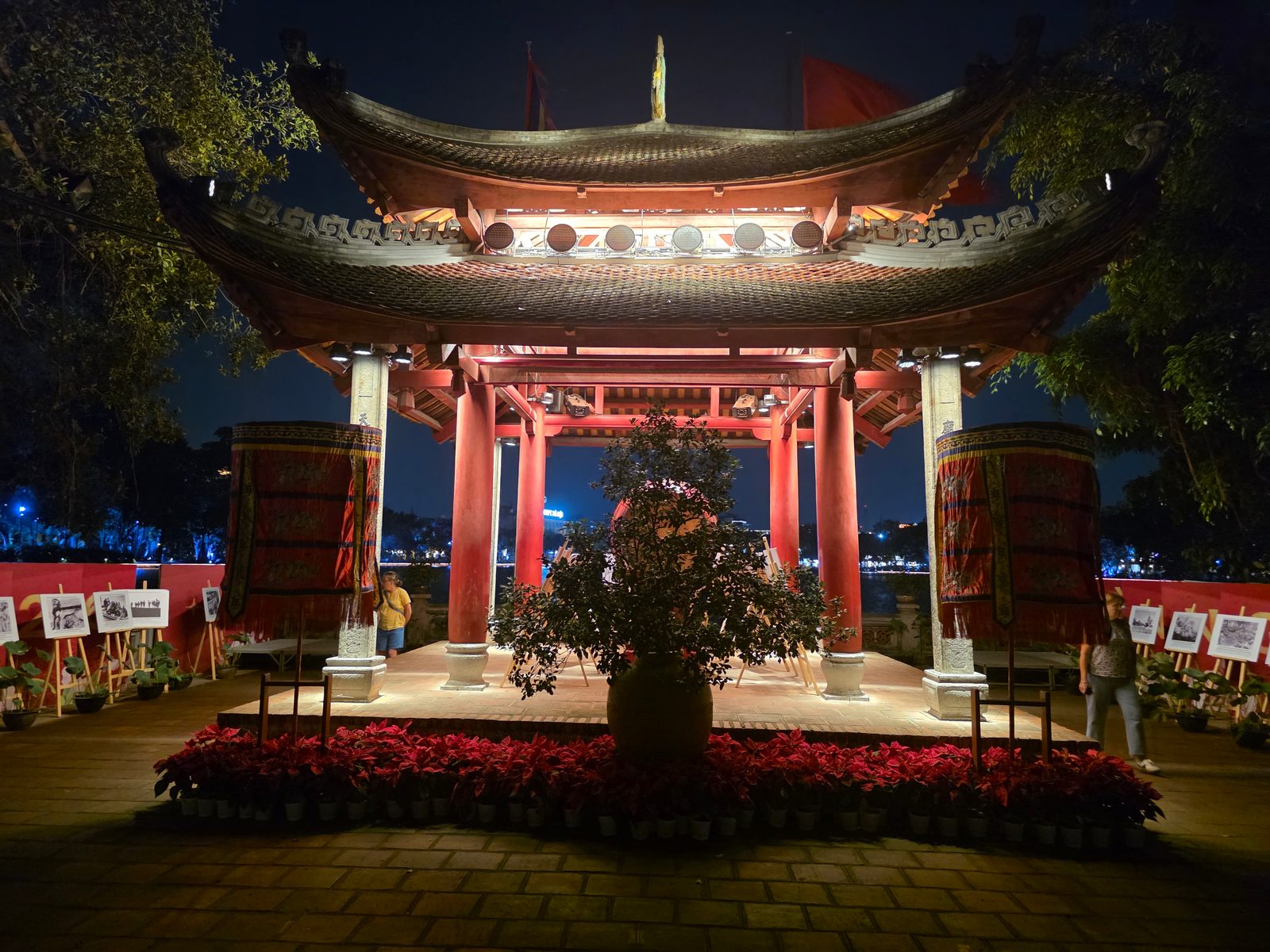
The sanctuary and its bonsai, the altar and its offerings, then the pavilion by the water.
And in one room, under glass, a surprise: two or three giant turtles, preserved, as long as a grown man. A big panel tells their story, and they're not there by chance.
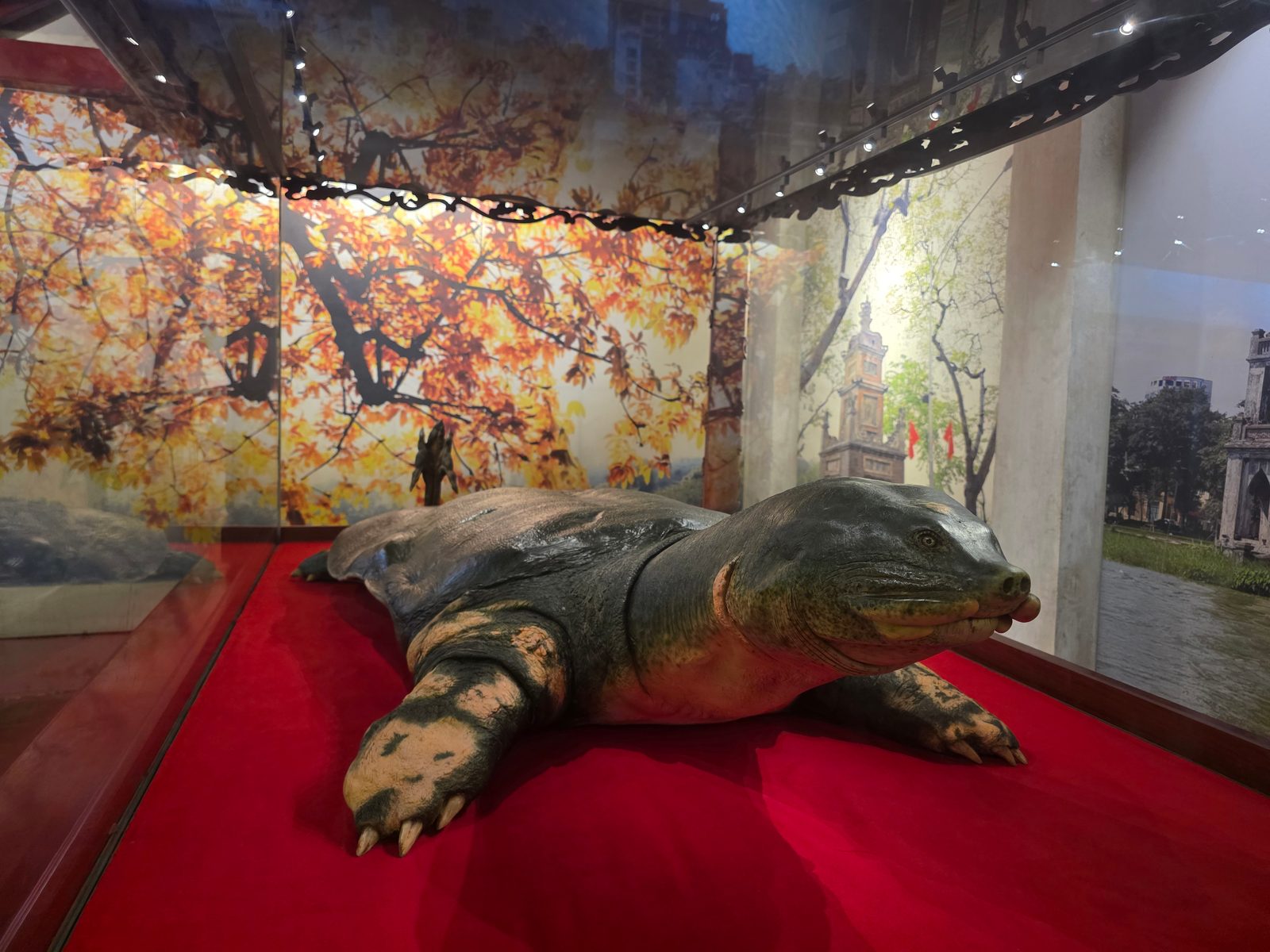
One of the lake's giant turtles, now safe behind glass. It's not alone in the room.
Hoàn Kiếm means “lake of the returned sword”. According to legend, Emperor Lê Lợi received a magic sword from the Golden Turtle God to drive out the invaders. Once victory was won, as he was boating on the lake, the turtle rose from the water to take the sword back and vanished with it. The lake really was home to giant turtles, of a species now on the brink of extinction. The last known one was found dead in January 2016, and the temple displays several, preserved.
A drink on the balcony, and a market we couldn't find
Back on the shore, we come out onto the big square facing the northern tip of the lake: old-style yellow and green façades, neon signs stacked up to the rooftops, and a never-ending ballet of scooters. The beating heart of Hanoi, night edition.
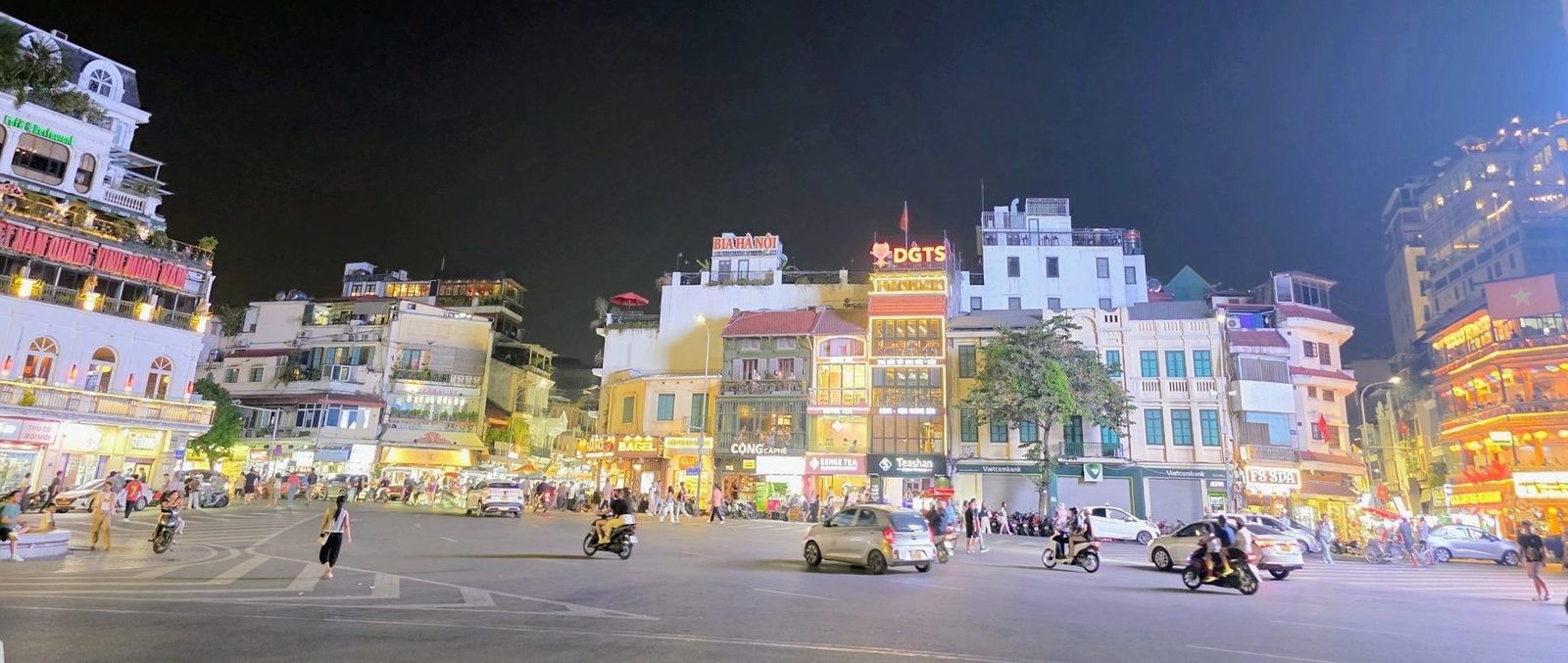
The big square at the northern tip of the lake. Here, the traffic never really stops.
We go up for a drink on the balcony of Hanoi Square Restaurant, a four-story house covered in lanterns of every color. Below, the big square facing the northern tip of the lake is teeming. Front-row seats over the anthill.
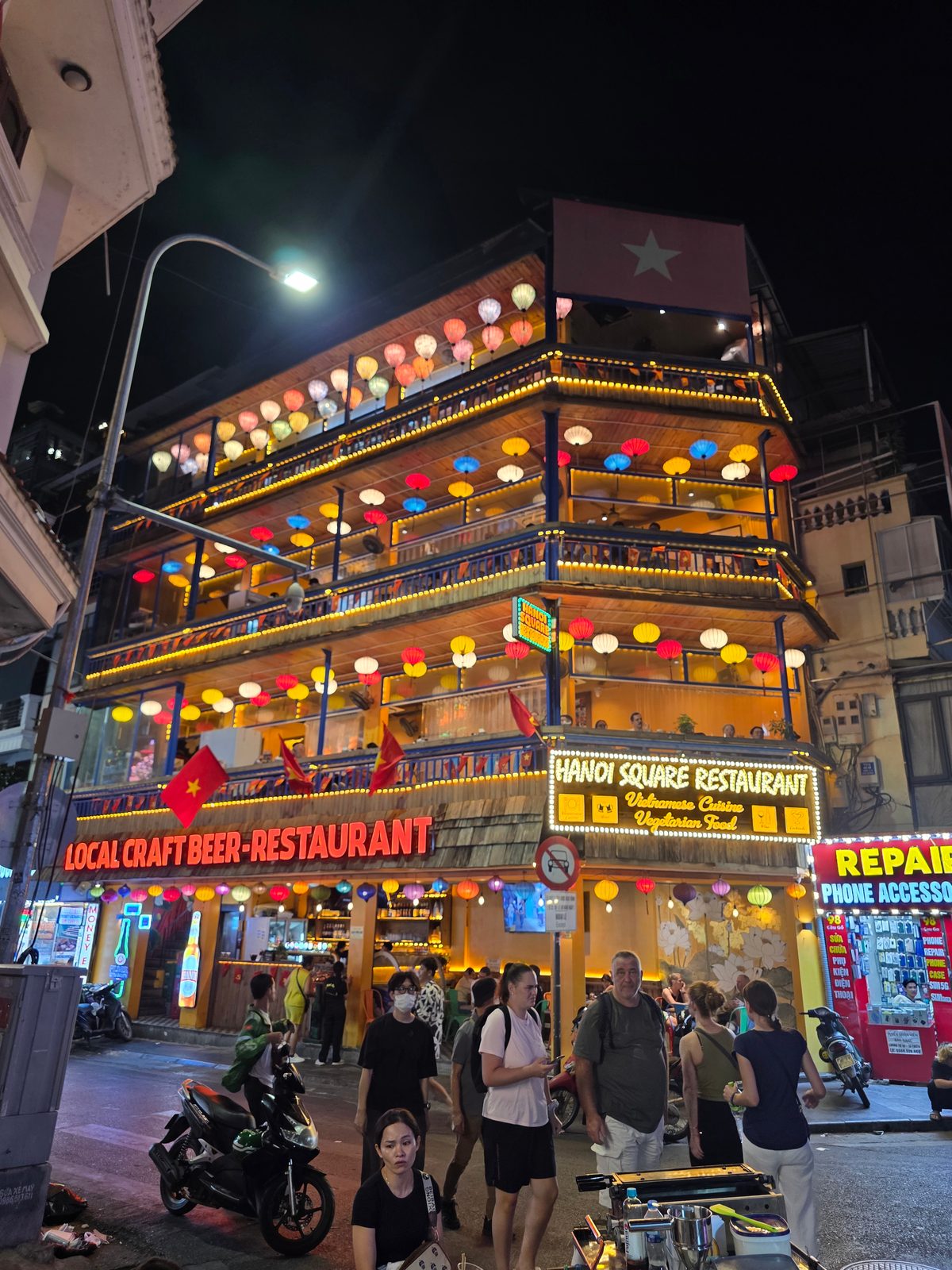
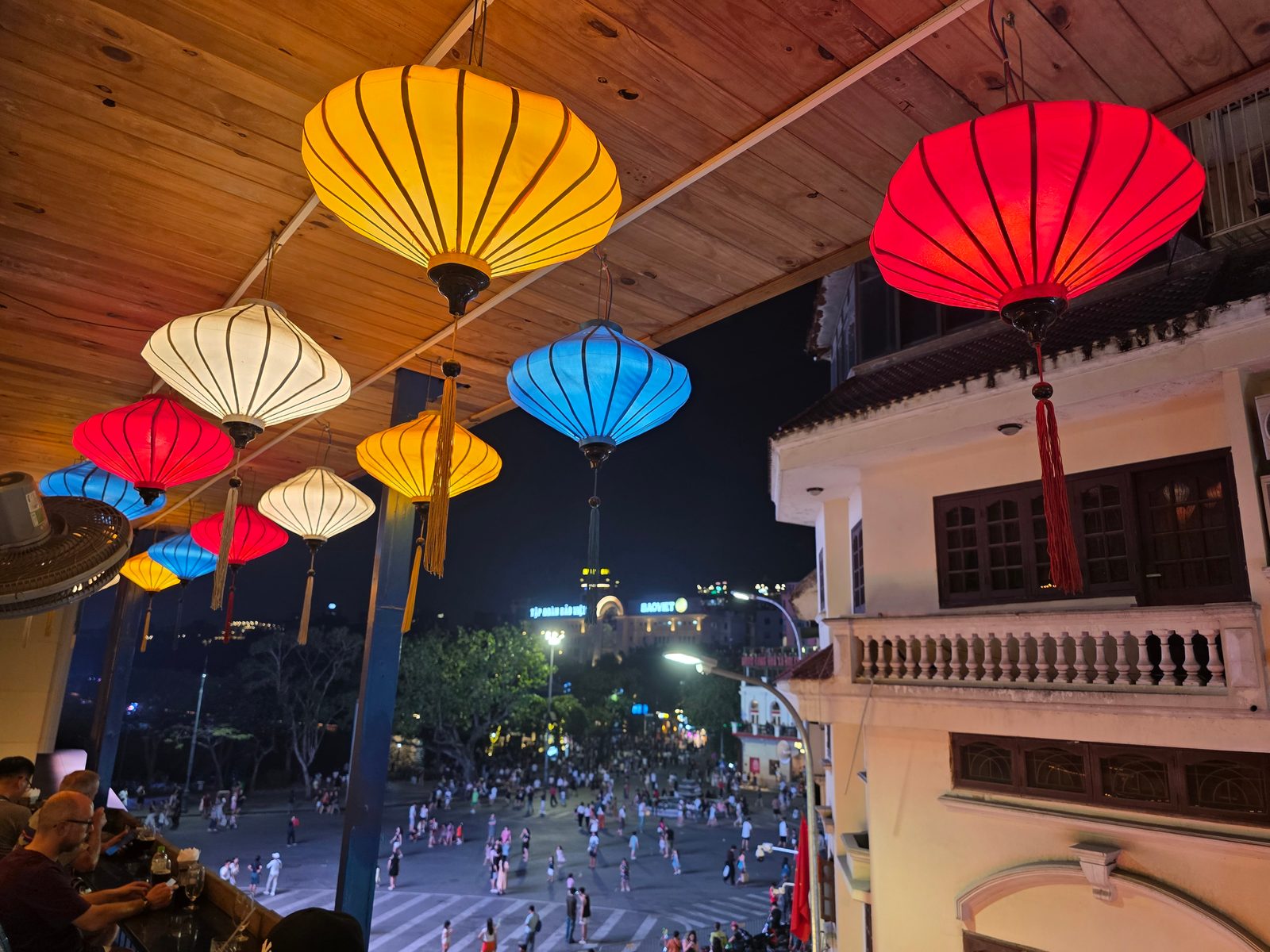
The lantern house, and the view from its balcony.
Hanoi Square Restaurant, Hanoi
North of Hoàn Kiếm Lake · Four-story house covered in lanterns · A drink on the balcony
View over the square and the lakeNext stop, the night market. We look for it along the lake. Nothing. It doesn't go around the water: it starts at the northern tip and runs up through the Old Quarter, street after street, all the way to the big Đồng Xuân covered market. A kilometer of stalls, smoke and music.
The Old Quarter night market only runs Friday to Sunday evenings. It doesn't follow the lake: take Hàng Đào Street from the northern tip and walk up to Đồng Xuân. And when it's time to pay, count the zeros again, same as everywhere else.
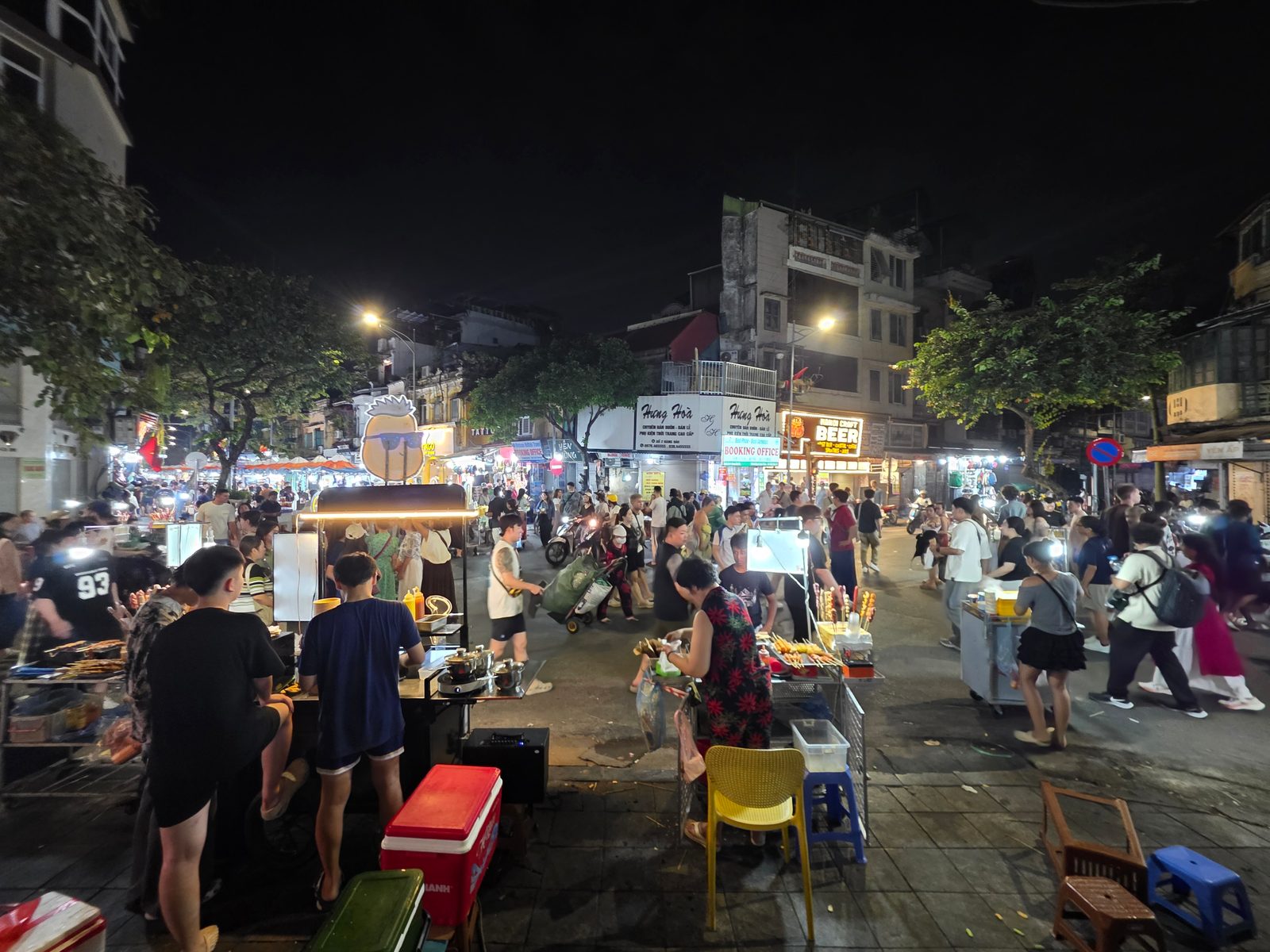
The night market, on the corner of Hàng Đào Street. Plastic stools mandatory.
First go at street food: skewers, one chicken, one shrimp. Well, “shrimp”… One bite and there's no doubt left: it's surimi, molded into the shape of a shrimp. Sold as surimi, it might have passed; sold as shrimp, it's a letdown. And the chicken is no better. Verdict, no appeal: we don't like it at all. Second go, at the stall with the potato in sunglasses: a baked potato smothered in beef sauce. No better, at least not for us. Good for the experience, but we won't be doing that again.
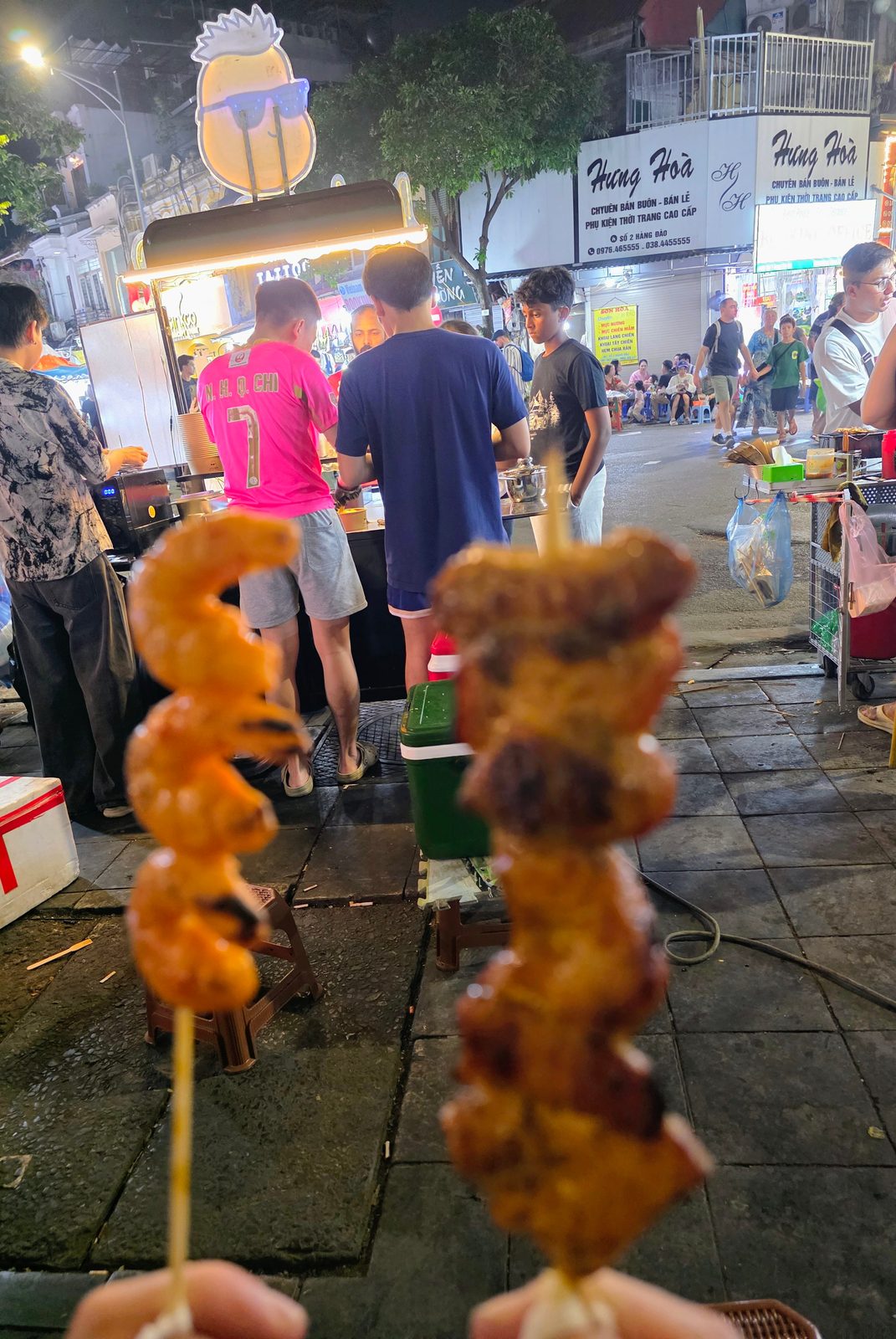
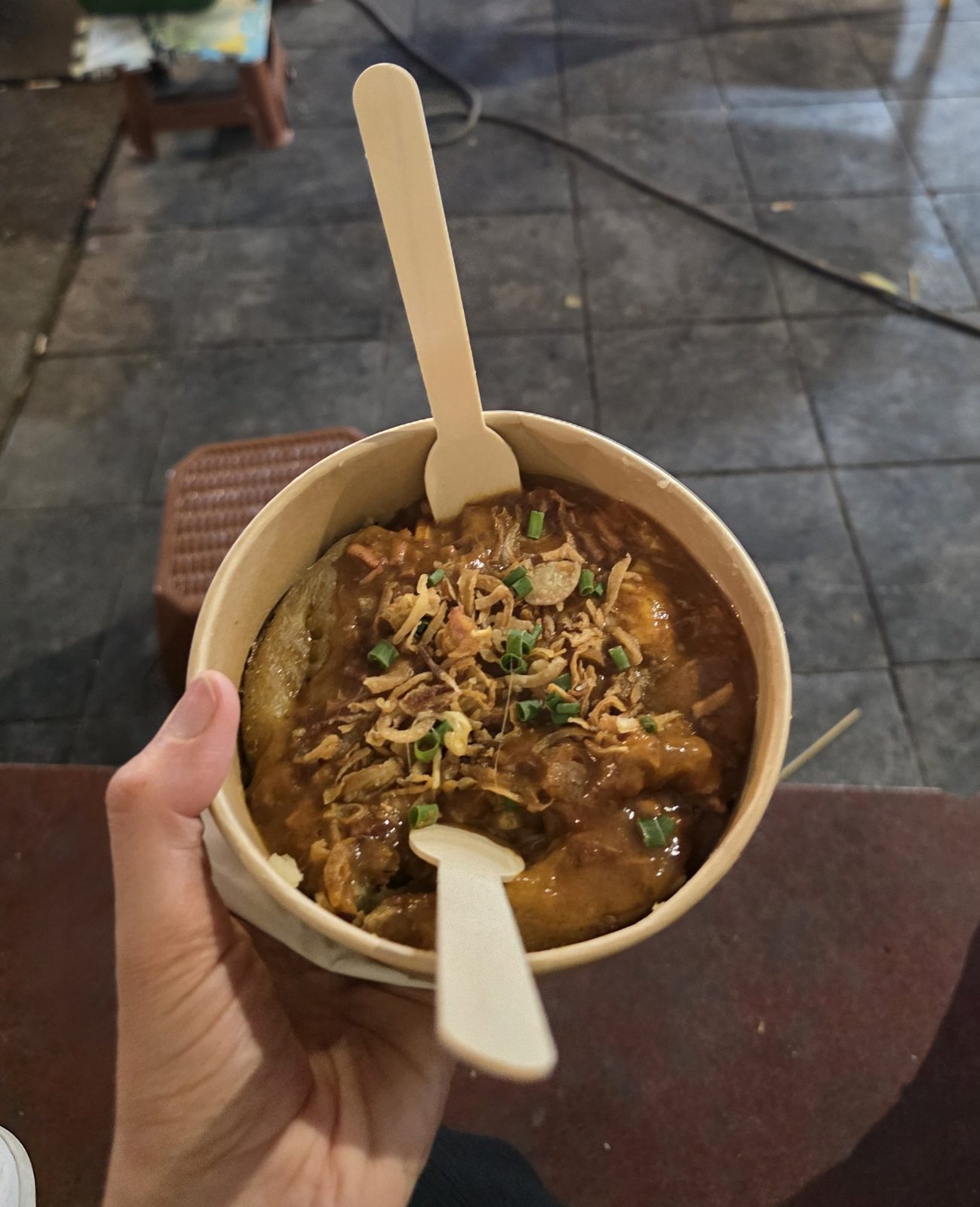
On the left, the “shrimp” that isn't one, and the chicken. On the right, the baked potato with beef sauce. They look great on camera, a lot less so on the plate.
Night market food: I don't recommend it. Neither the skewers nor the potato won us over. And watch out for “shrimp” skewers: ours were surimi. That's just my personal opinion, other travelers love it. But if, like us, you're mainly there to eat well, go for the atmosphere and save your appetite for a proper restaurant just around the corner.
We make up for it with dinner a few streets away, at Tết Restaurant on Lãn Ông Street: a little Old Quarter house, lanterns on the balcony, wood paneling and flowers at the door. Bowls of phở, chicken and beef, piping hot, fragrant, with all the herbs and the cilantro: exactly what we'd been dreaming of since the plane. Alongside, chicken spring rolls with their little dipping sauces, made with soy, herbs and a hint of chili. And to console ourselves for the market's fake shrimp, shrimp stir-fried with sesame, on a bed of salad. Real ones, this time. They were good, but coated in a sweet sauce, honey I think: not quite to my taste. Everything else, though, was excellent. Back at the hotel around midnight. Day one: approved.
Tết Restaurant, Hanoi
29 Lãn Ông Street, Old Quarter · Vietnamese cuisine, vegetarian dishes · Phở, chicken spring rolls, sesame shrimp
Favorite: the phở and the spring rolls