Two hours on a plane, and it's another country. After the alleys of Hanoi and the rice terraces of Sapa, Saigon (officially Ho Chi Minh City, but everyone still says Saigon) welcomes us with its wide avenues, colonial facades, glass towers and a much stickier heat. First impression, two hours in: more chic, classier than Hanoi. A little less chaos, just as many scooters.
October 30 · noon
Landing over the river
VietJet flight from Hanoi. On the approach, the Saigon River traces big brown loops between the neighborhoods, barges push upstream, and far in the distance, a spire towers over the city: Landmark 81, the tallest building in Vietnam. On the ground, the ride downtown is long: Saigon traffic sets the tone straight from the airport.
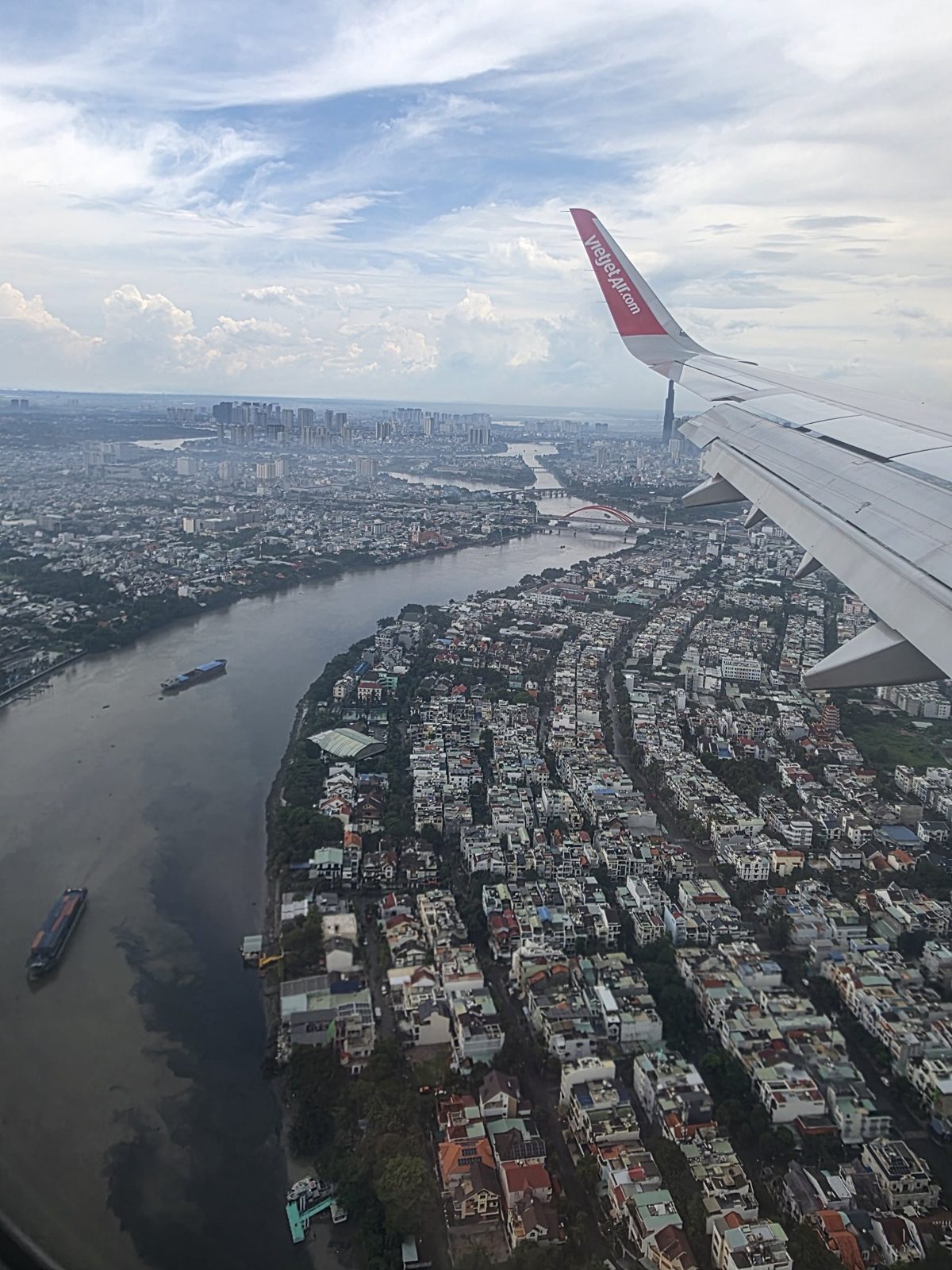
Welcome to Saigon: the river, the barges, and Landmark 81 in the distance.
Around 3 pm, we drop our bags at the Silverland Yen, in District 1. And nice surprise, we arrive just in time for afternoon tea, included in the price: little fritters, savory bites, cupcakes, tea, coffee, and fruits we'd never seen before. A big fruit with thin brown skin that peels like a lychee, translucent white flesh and a big shiny black pit: a longan, the lychee's cousin. And a sort of little pink bell, crunchy and juicy, that the waiter calls “rose apple”: the wax apple, known here as mận.
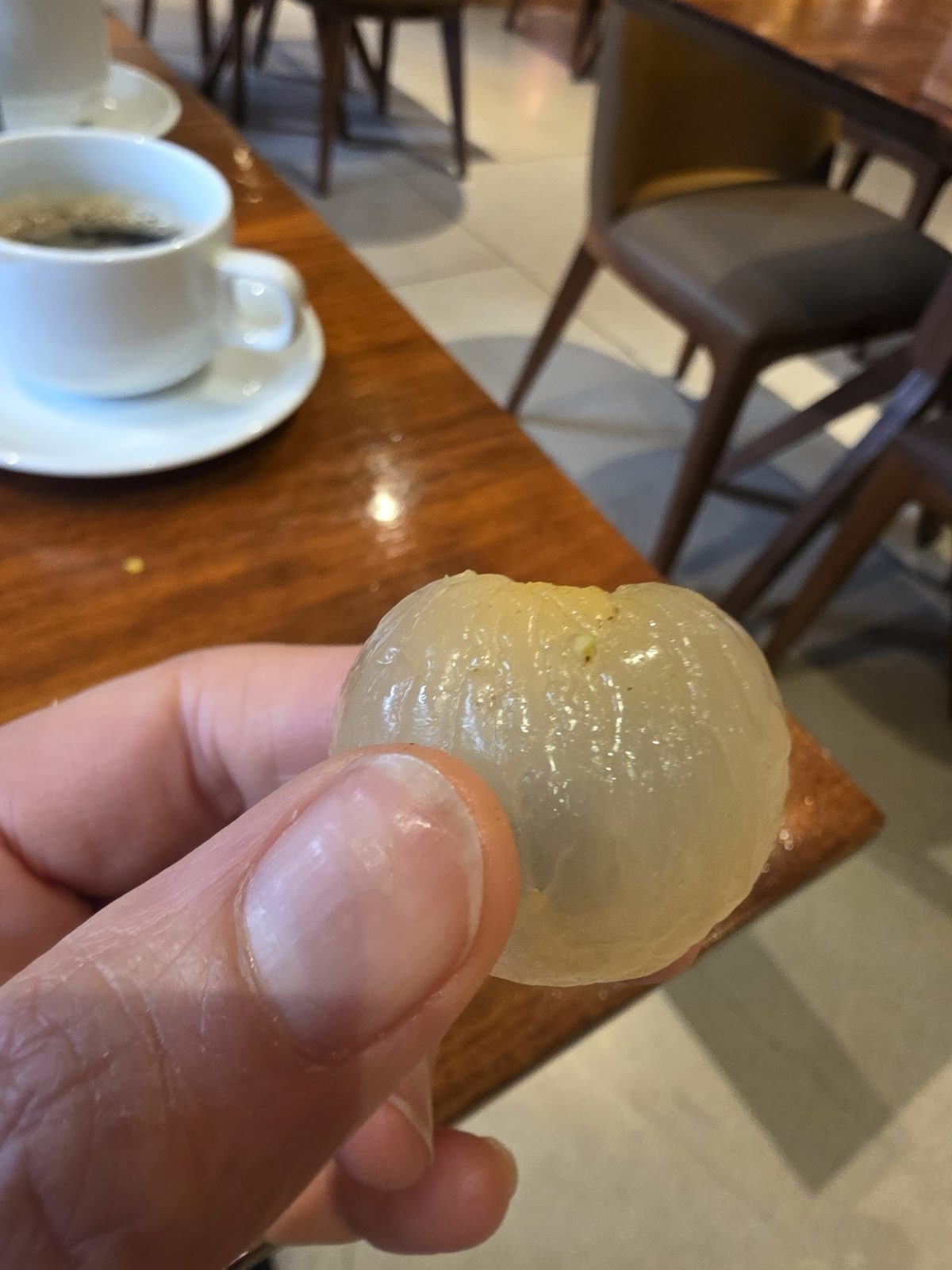
The longan, southern style: you peel it like a lychee and eat it like candy.
Silverland Yen, Saigon
District 1, steps from Bến Thành Market · Breakfast and afternoon tea included · Stores luggage during excursions
~€100 a nightAfternoon tea: a really good ideaPrice noted in October 2026; varies with the room, the season and the booking site.
October 30 · late afternoon
A cathedral under wraps, a post office that travels
First stop, Notre-Dame Cathedral. Well, what you can see of it: both bell towers are entirely wrapped in scaffolding. Only a bit of red brick peeks out on the side. Out front, the scooters circle the roundabout without even looking up.
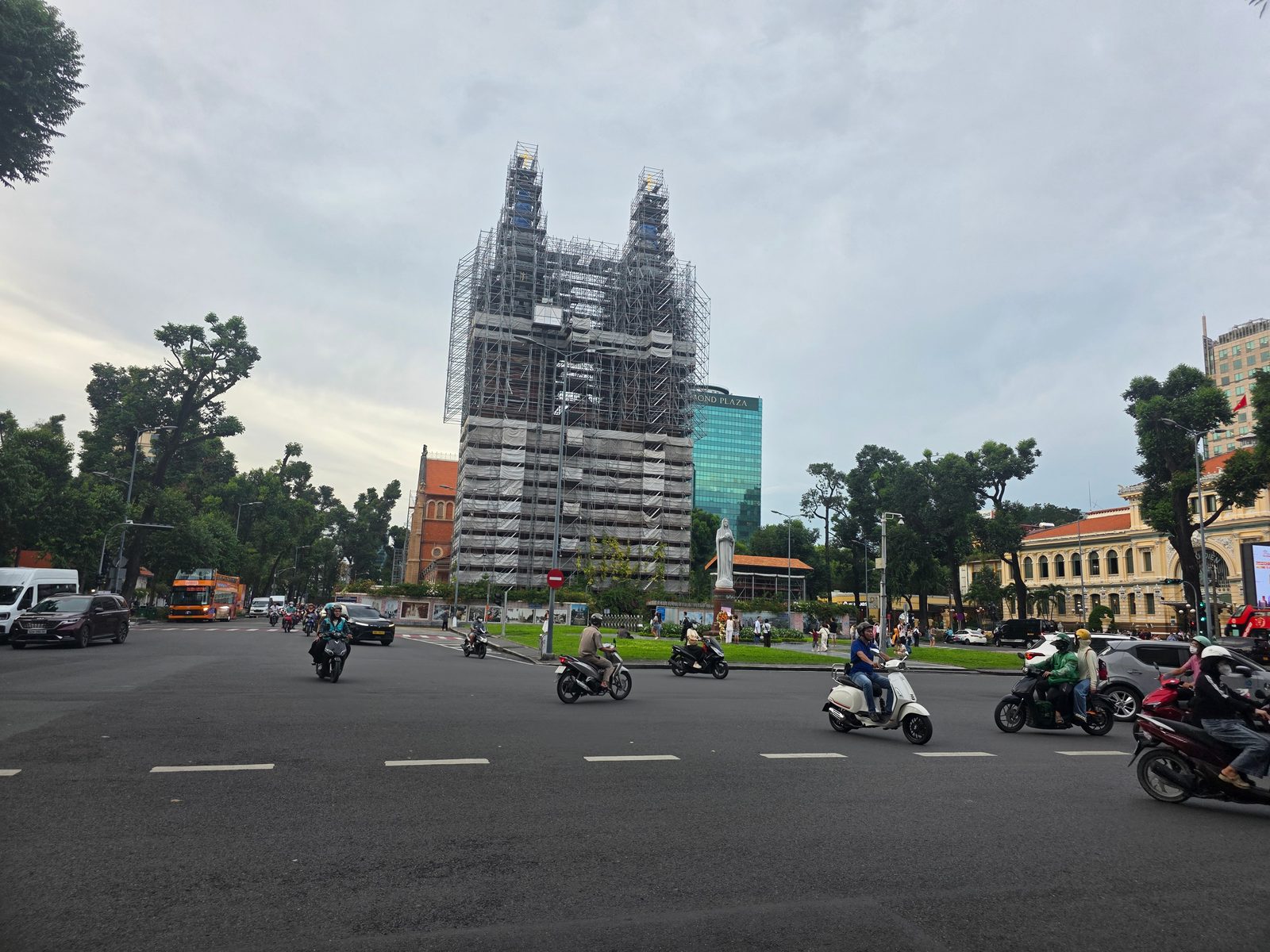
Notre-Dame Cathedral, gift-wrapped edition. In the foreground, the scooters. Always the scooters.
Restoration of the cathedral began in 2017, and no end date has been announced yet. Its two original crosses, eaten away by corrosion, were removed in 2023; new golden crosses were hoisted to the top of the bell towers in March 2026. The scaffolding, meanwhile, is still there.
Right next door, the Central Post Office is in great shape. A yellow and white facade, a big clock, and two dates engraved just below: 1886-1891, the years it was built. People often say it's the work of Gustave Eiffel. Not true: it was designed by the architect Alfred Foulhoux. But the legend dies hard, and it makes for great photos.
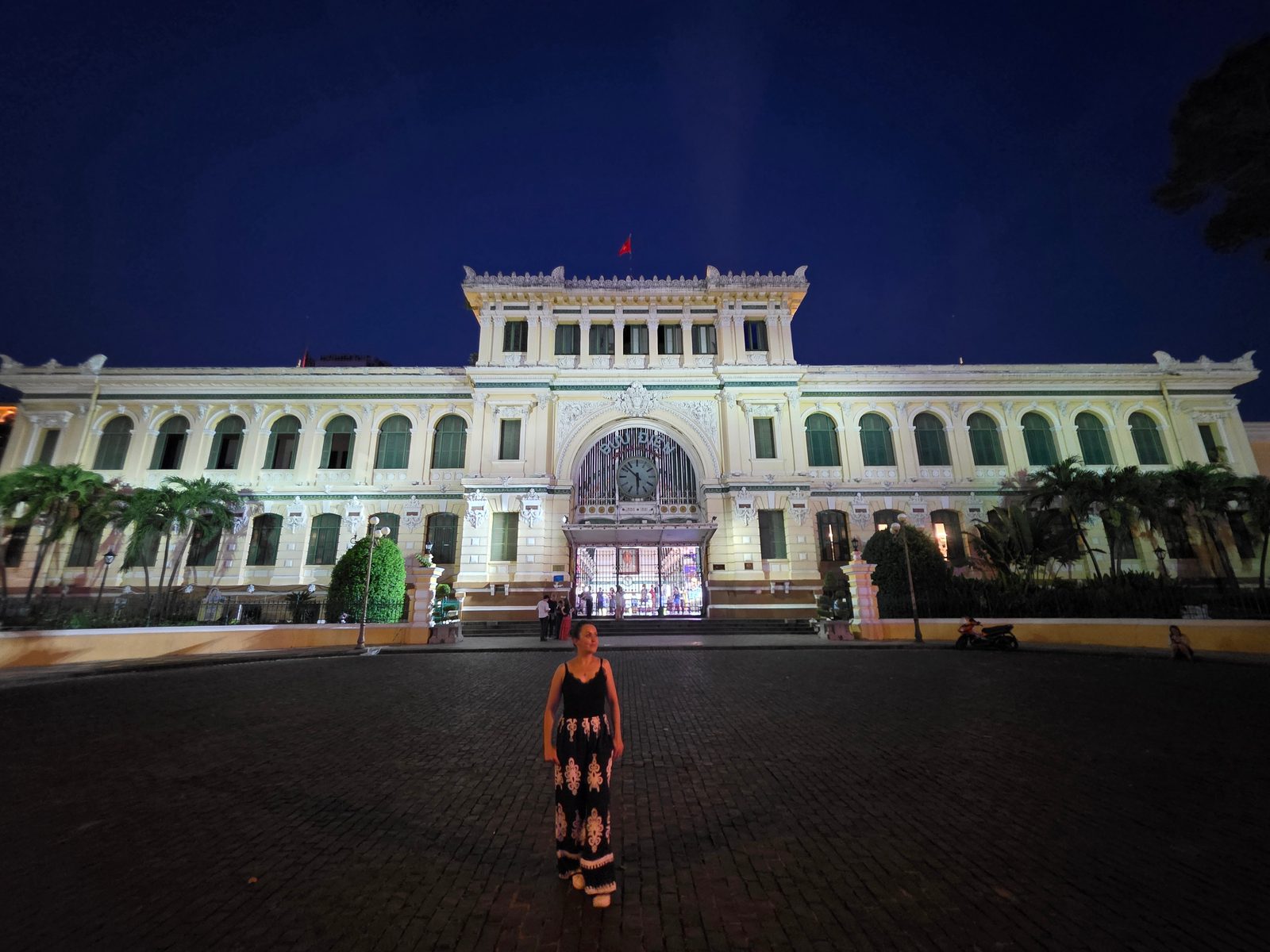
The whole Central Post Office. Pretty stylish, for a post office.
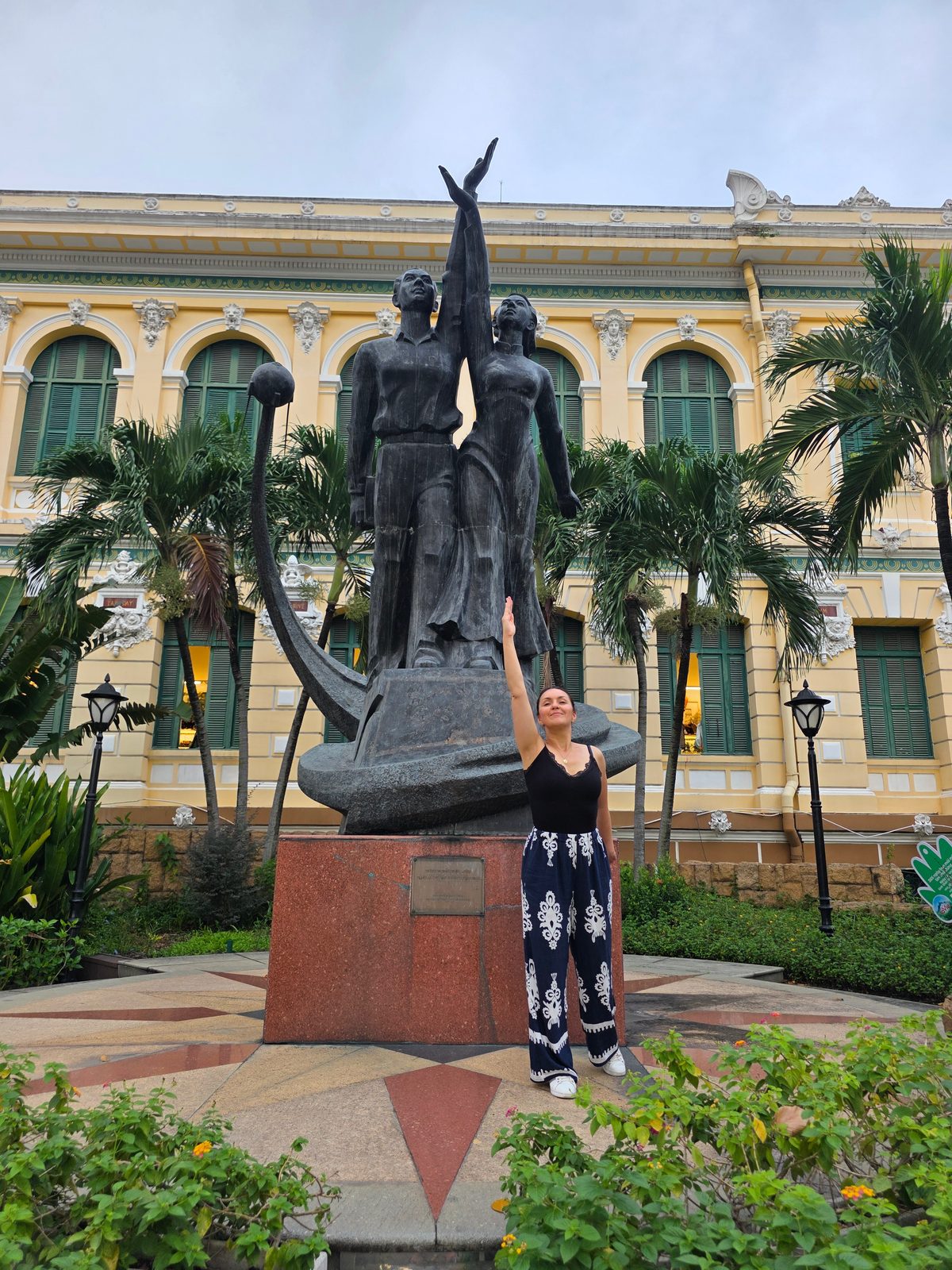
In the garden, a statue raising its arm. I did the same.
In the garden, a statue from the 1990s in a very socialist-realist style: a young man, a young woman in an áo dài, a satellite in orbit, and two arms reaching for the future. I couldn't resist.
Inside, it's more train station than post office: a huge vaulted hall, green and ocher, under a glass roof, with wooden counters all around. On the walls, two big old maps. One shows the “Telegraph lines of South Vietnam and Cambodia”, including the Mekong Delta, where we'll be sleeping tomorrow night. Below, old wooden phone booths, and clocks showing the time in the world's great capitals.
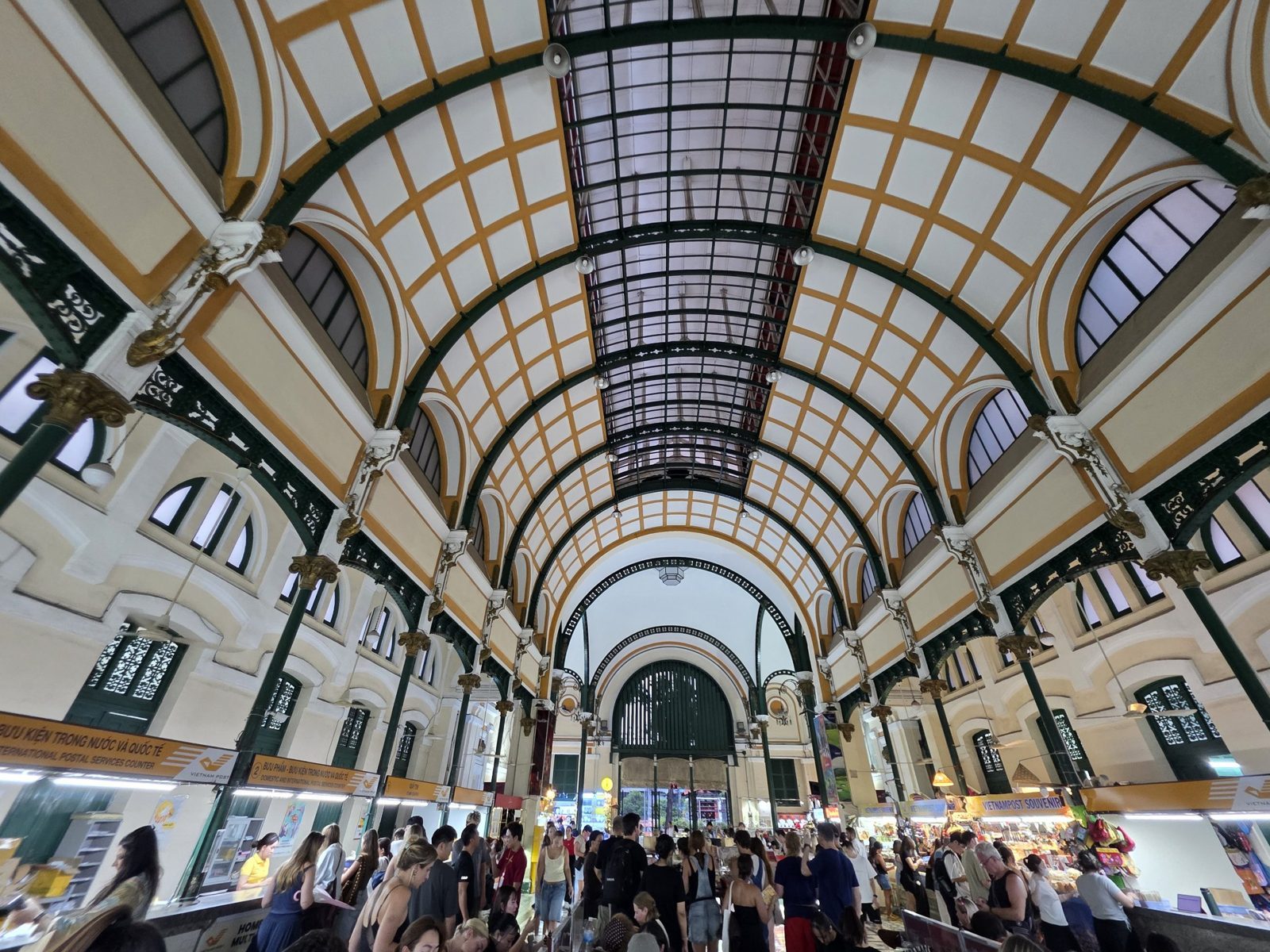
The post office hall. You half expect a train to pull in.
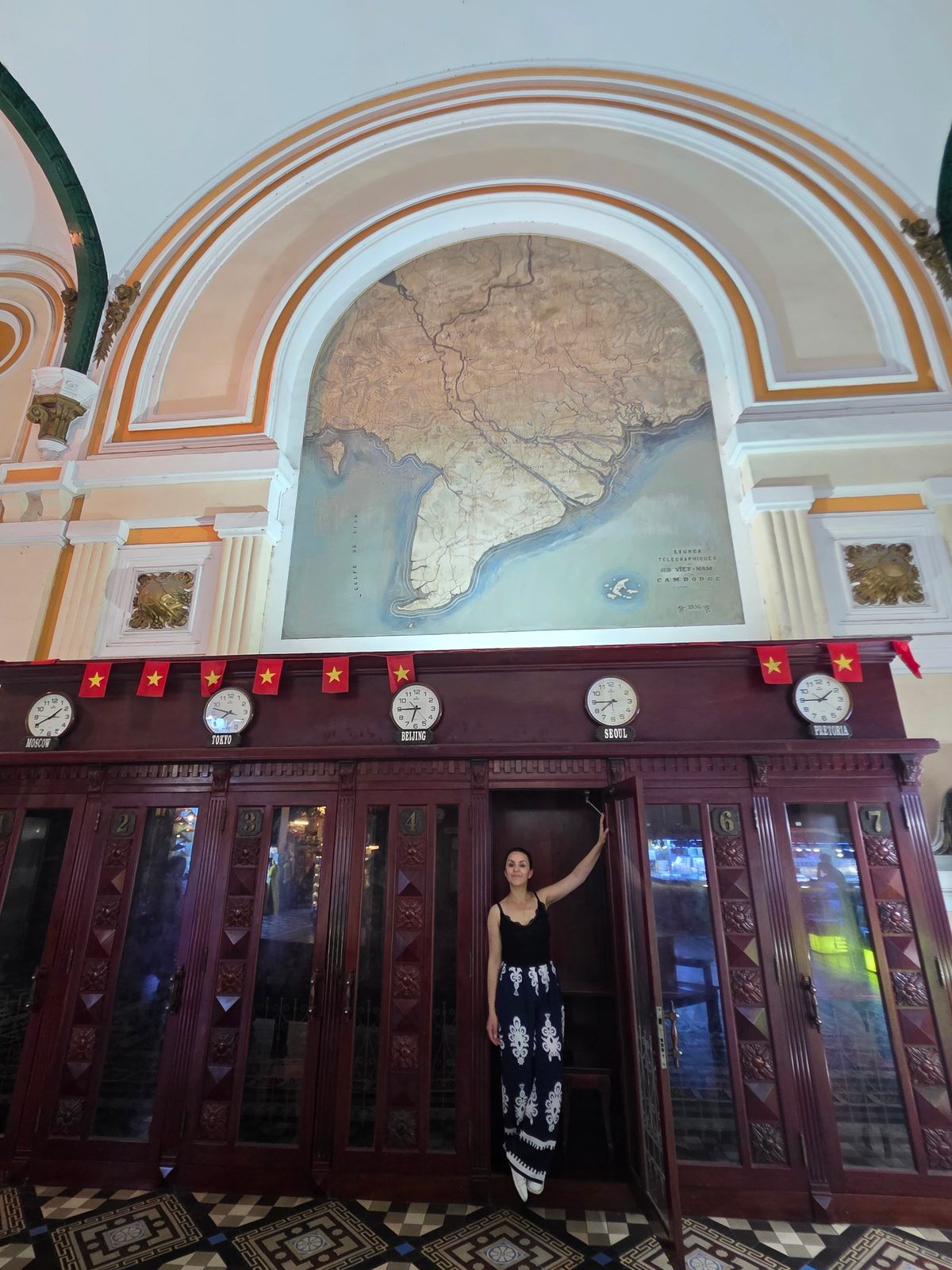
Under the map of the delta, the phone booths of yesteryear.
Leaving the post office, we walk up to City Hall, yellow and white under the floodlights, the red flag on top. In front of it, a big golden statue of Hồ Chí Minh waves to the crowd. After the post office statue, I'm starting to get into the habit: I wave back.
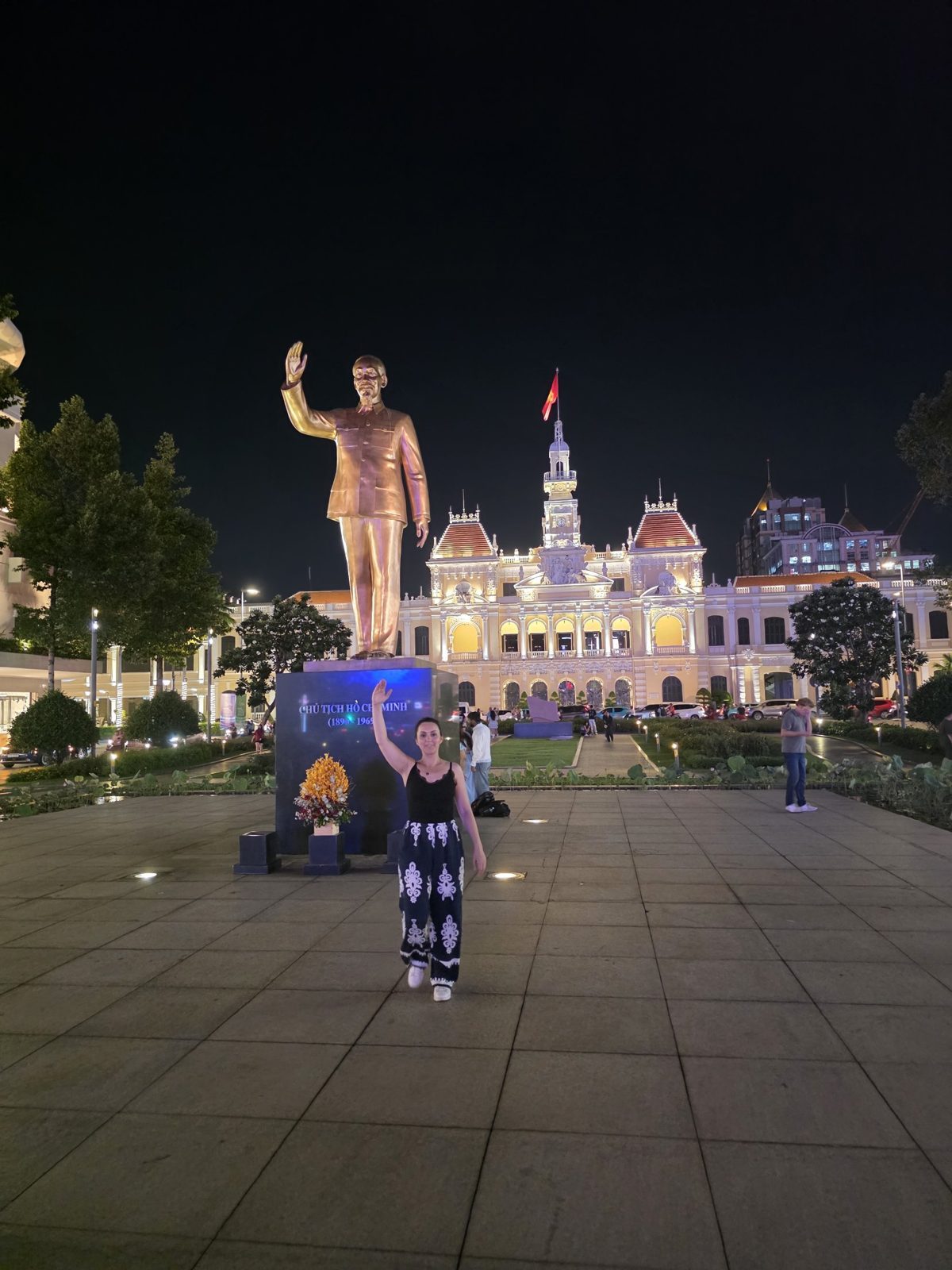
In Saigon, I do as the statues do.
October 30 · 6:30 pm
Saigon from above
For sunset, we head up to the Saigon Saigon Rooftop Bar, on top of the Caravelle hotel, facing the Opera House. We settle in for a drink, and the view is stunning. On one side, the roofs of the Opera House and the grand colonial hotels. On the other, the modern city lighting up: giant signs, glowing towers, and in the middle, a tower shaped like a lotus bud with a funny little balcony stuck on the side.
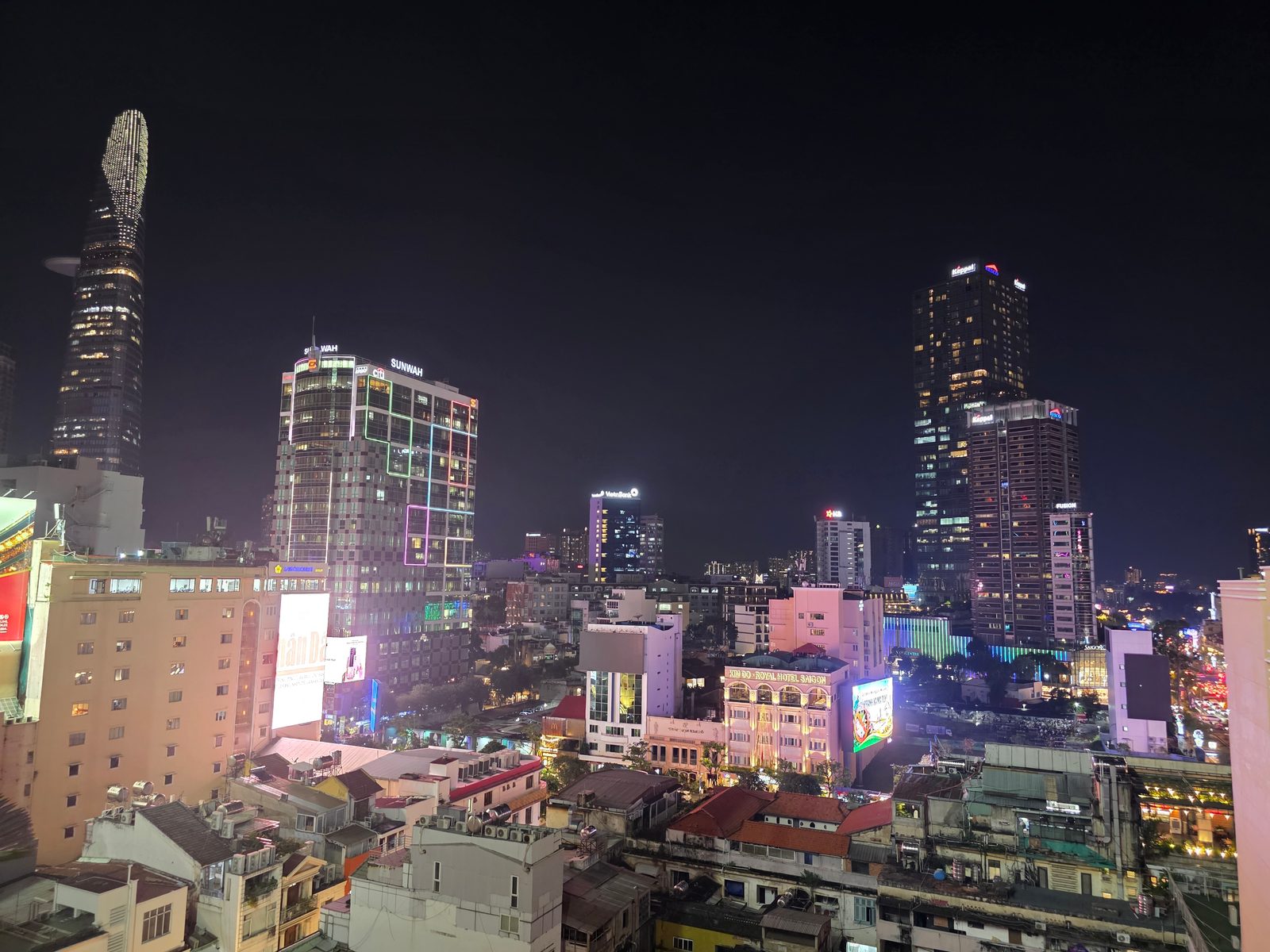
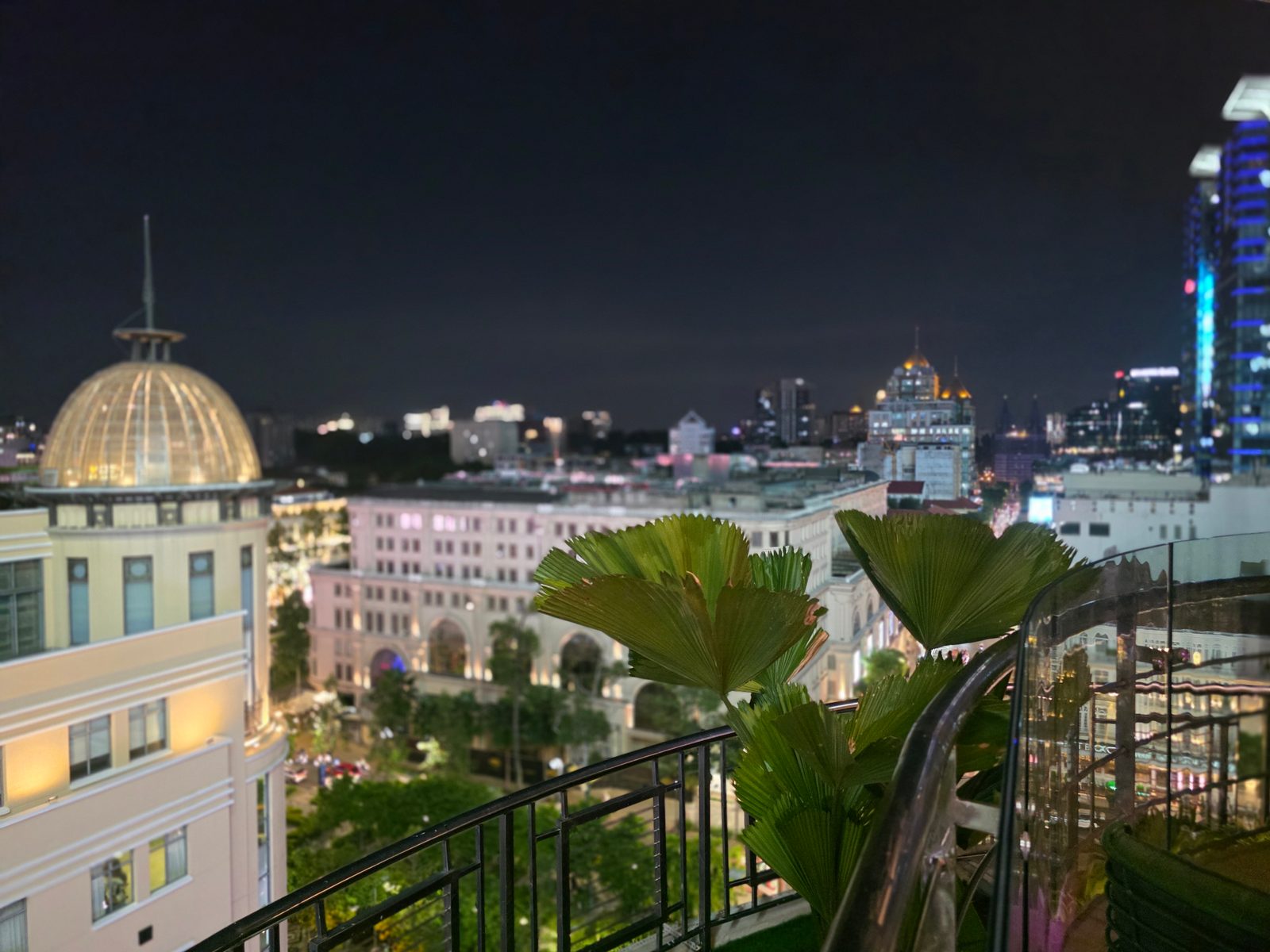
Saigon from the Caravelle's roof: the Bitexco on the left, and the domes of the colonial city.
The tower with the “little balcony” is the Bitexco Financial Tower: 262.5 meters (861 feet), 68 floors, designed by architect Carlos Zapata, inspired by the lotus bud, the national flower. The balcony? A helipad. It opened on October 31, 2010: the day after our visit, it turned 16.
October 30 · evening
Halloween on the Champs-Élysées
Coming down from the rooftop, we set off on foot across the city. First the illuminated Opera House, a little white and gold jewel planted in the middle of the traffic, with the Continental next to it, one of the oldest hotels in town.
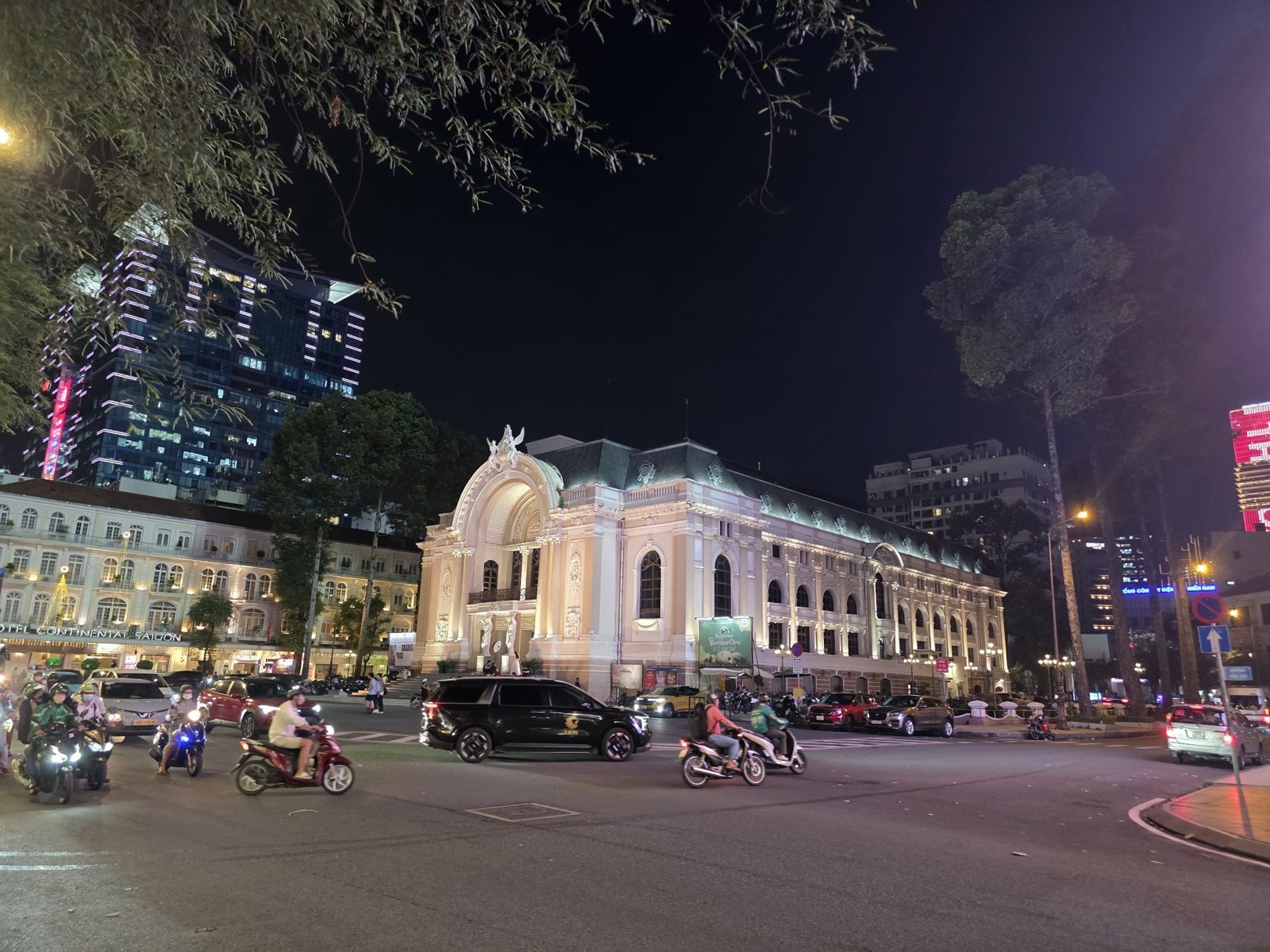
The Opera House, lit up like a wedding cake.
And then, surprise: the big pedestrian street Nguyễn Huệ, which runs from City Hall down to the river, is packed. It's Halloween. Everywhere, families, little girls in princess dresses, costumes on every corner, and some incredible characters: a giant insect in silver foil, a red harlequin with a ruff. Picture the Champs-Élysées on a big night out, only more tropical. Even at the rooftop bar, and in the casino of a big hotel where we went to take a peek, the hostesses had their costumes on.
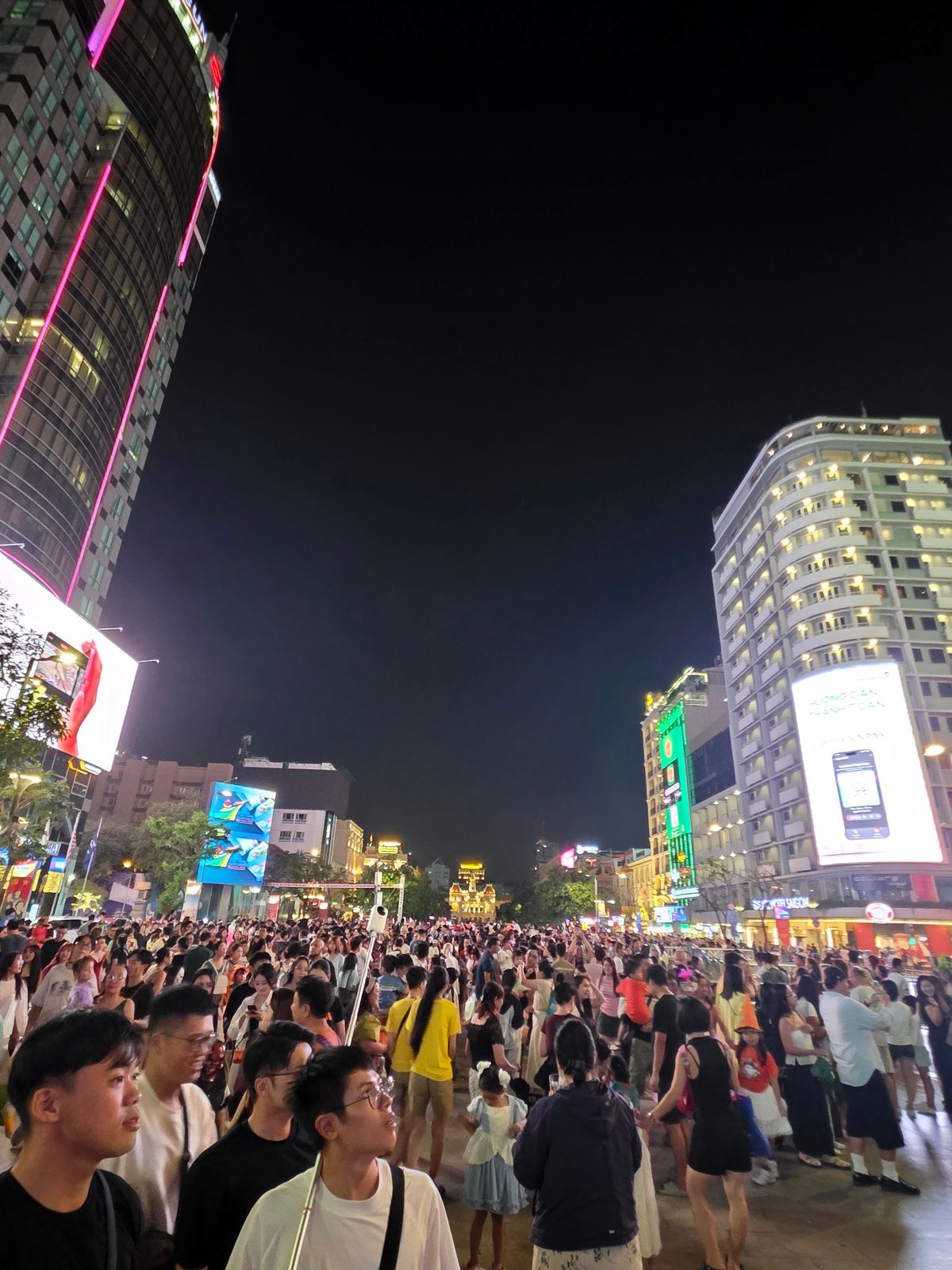
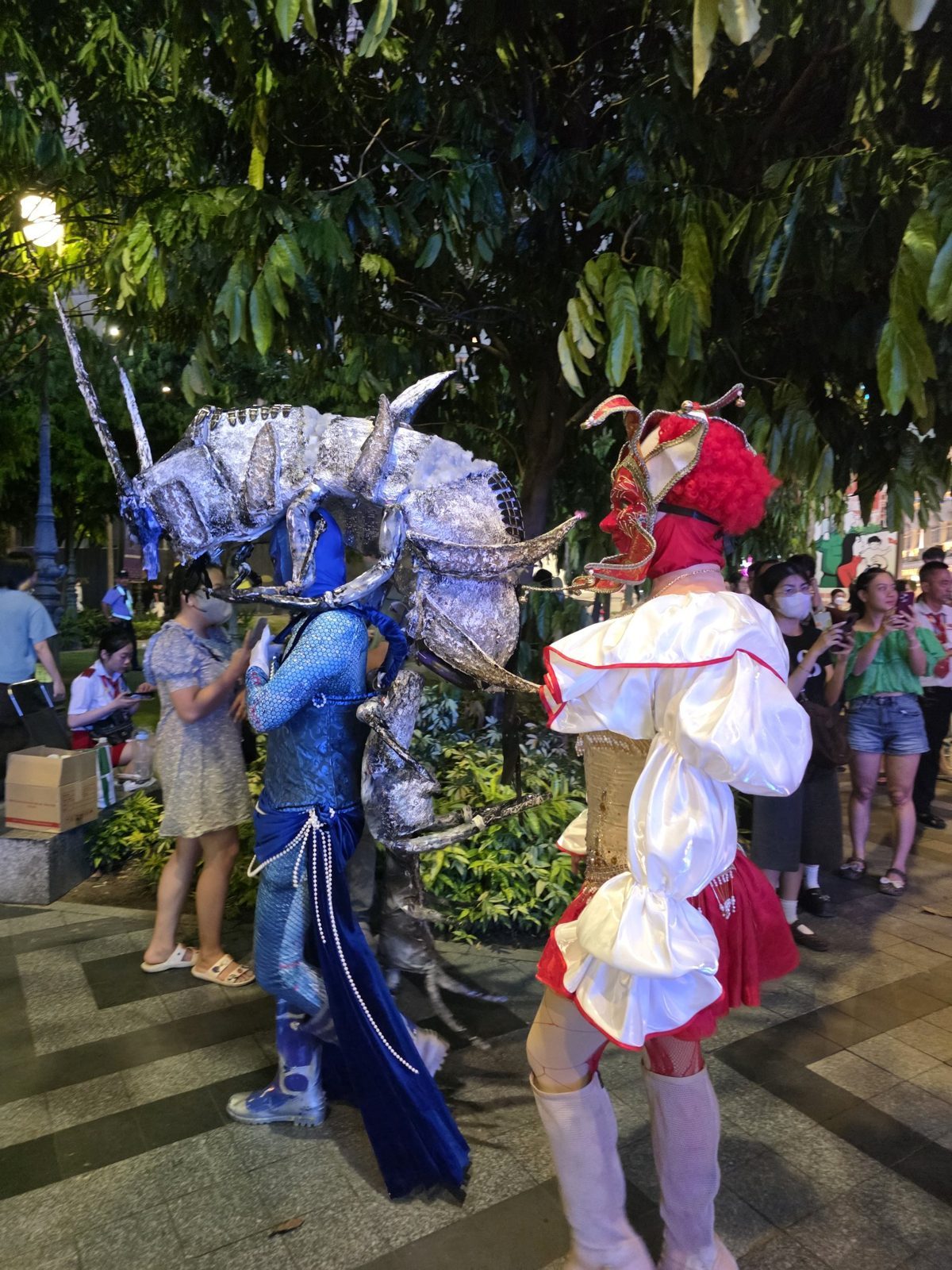
Nguyễn Huệ on Halloween night. And its residents for the evening.
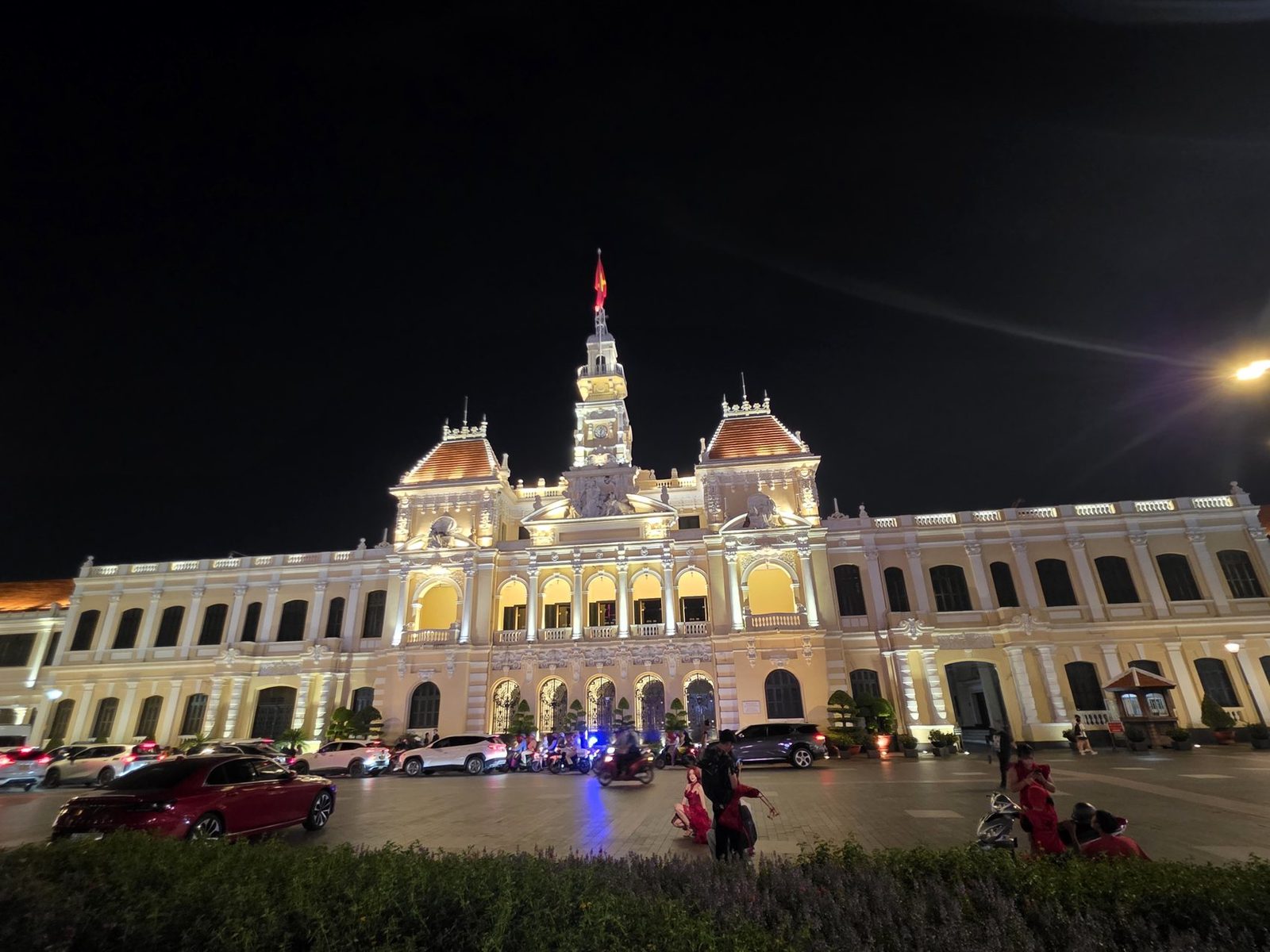
At the end of the street, City Hall has put on its evening wear.
We have dinner at Hoàng's Kitchen, on Lê Thánh Tôn Street, a name you see all over town: there are several in Saigon. A chain, then, and I was expecting something ordinary. Wrong: it was excellent, with a menu that goes on forever. A seafood mango salad, fresh, full of herbs, with a very good dressing. A coconut curry chicken soup, more Thai than Vietnamese, which we spiced up a bit with the herbs on the table: in two weeks, we've become hooked on Vietnamese herbs, and everything else tastes bland.
But the best part of the evening was our neighbors at the next tables. On the right, a young Brit on a business trip, who works in… flowerpots. And who tells us that, by his reckoning, 80 to 90% of the world's flowerpots come from Vietnam. I couldn't verify the figure, but I'll never look at my window boxes the same way again. On the left, three Egyptian friends, living in England, Ohio and Seattle, who meet up somewhere in the world every year. This year, it was Saigon.
They're the ones who recommended bò nướng lá lốt: ground beef wrapped in a lá lốt leaf, a cousin of the pepper plant, grilled over embers until charred, which you roll yourself in rice paper, with plastic gloves provided. We tried the rice paper, then gave up on the logistics and ate them as they were. Delicious anyway.
Hoàng's Kitchen, Saigon
122 Lê Thánh Tôn Street, Bến Thành area · Vietnamese cuisine and plant-based menu · Seafood mango salad, coconut-curry chicken soup, bò nướng lá lốt
Favorite: the bò lá lốtHuge choiceNext we walk past the grand hotels: the Majestic, all lit up, golden arcades and an ocean-liner facade, on the riverfront. A bit further on, on a square, the statue of General Trần Hưng Đạo, the national hero who drove back the Mongol invasions in the 13th century, points the way among the towers of the Hilton and the Bitexco. And all around, the endless stream of scooters, which never stops.
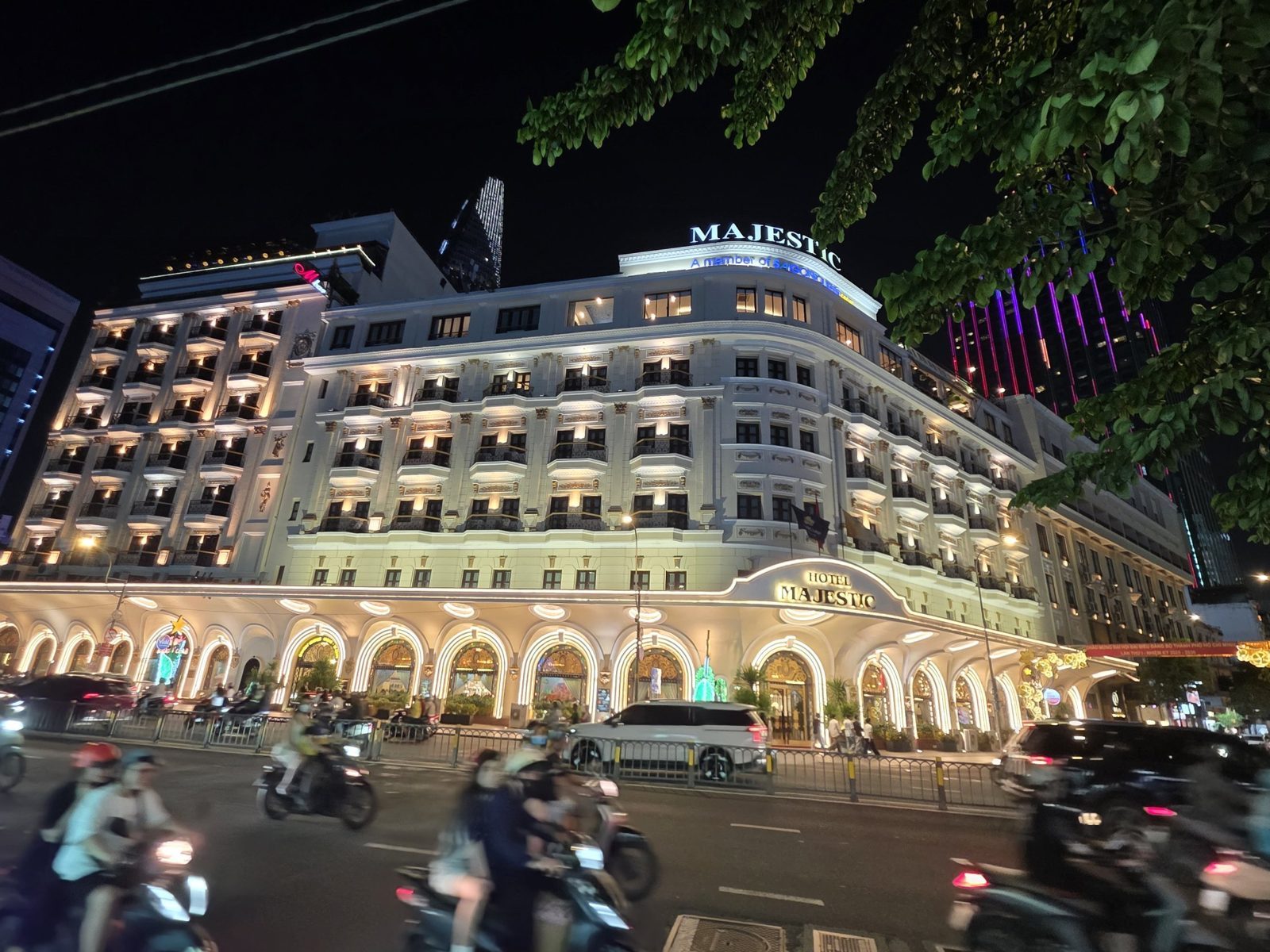
The Majestic, a riverside palace. The scooters don't stop to admire it.
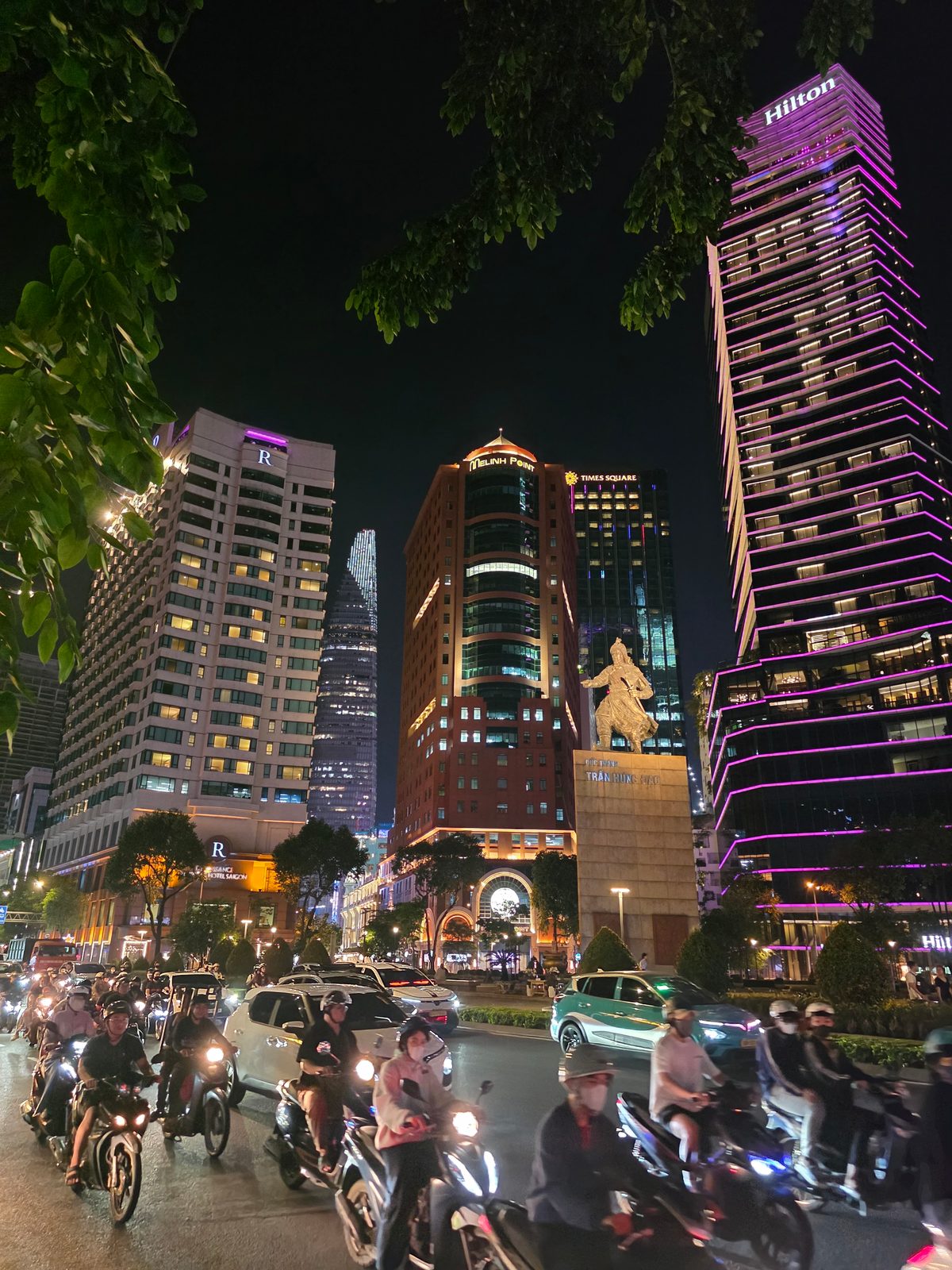
Trần Hưng Đạo, eight centuries of history, at the foot of the Hilton. And the scooters, as ever.
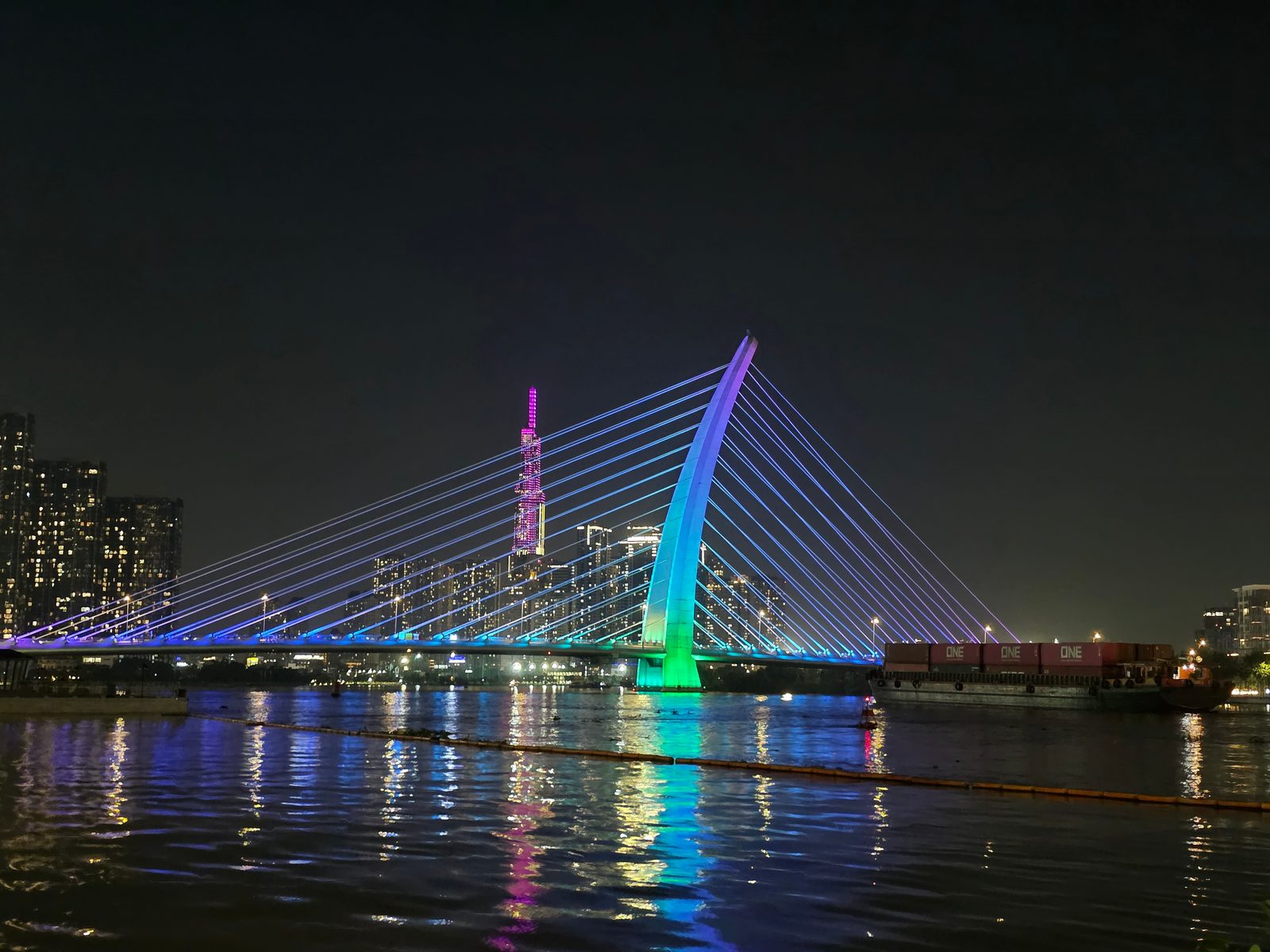
To finish, we head to the banks of the Saigon River. On the lawn, families picnic on mats. Across the water, the Thủ Thiêm 2 Bridge, with its big pylon curved like a sail, keeps changing color: blue, green, purple, pink. Right behind it, Landmark 81 glows pink. And a little further on, a huge arch under construction: the future footbridge that will soon link downtown to the other bank.
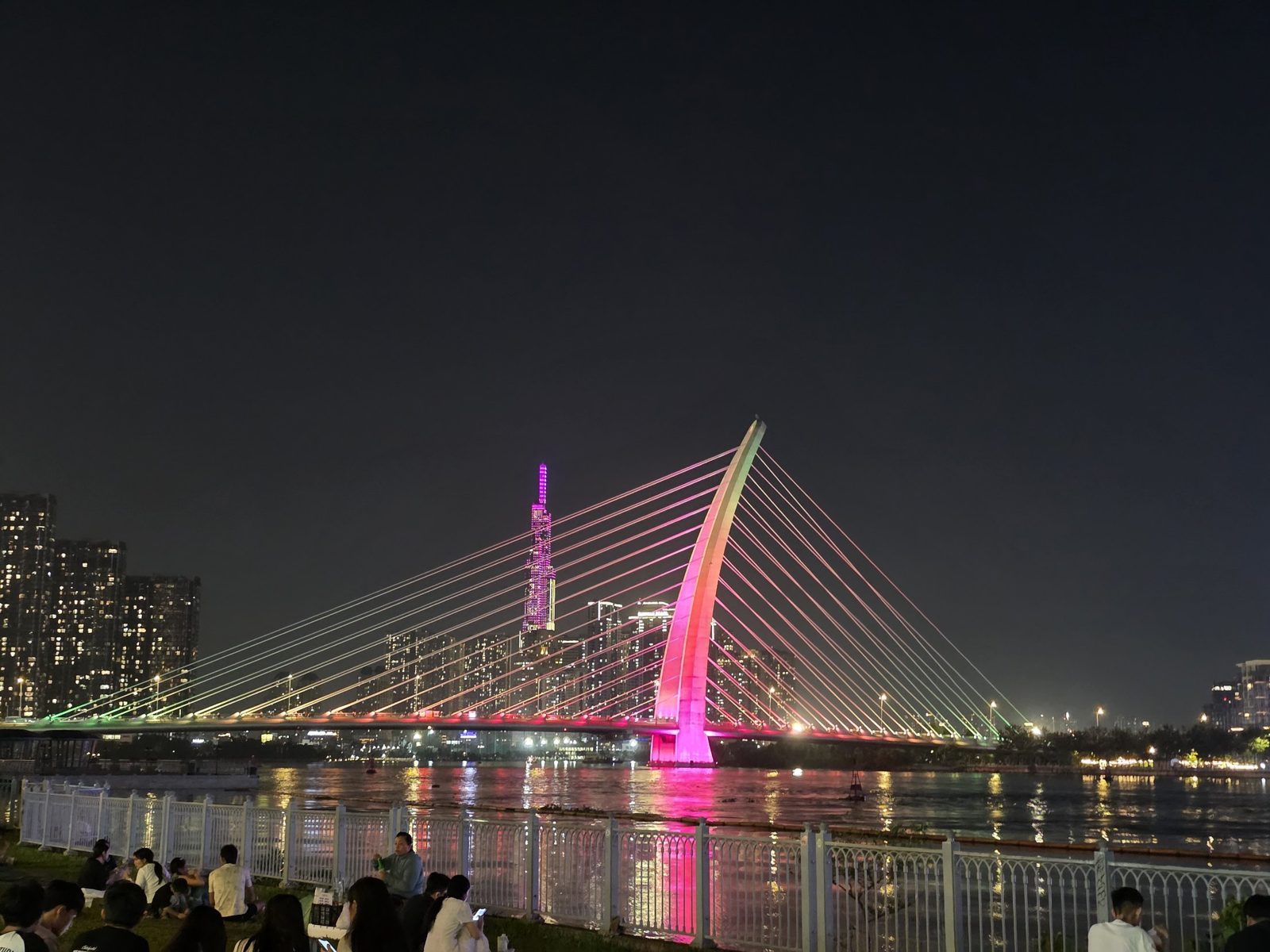
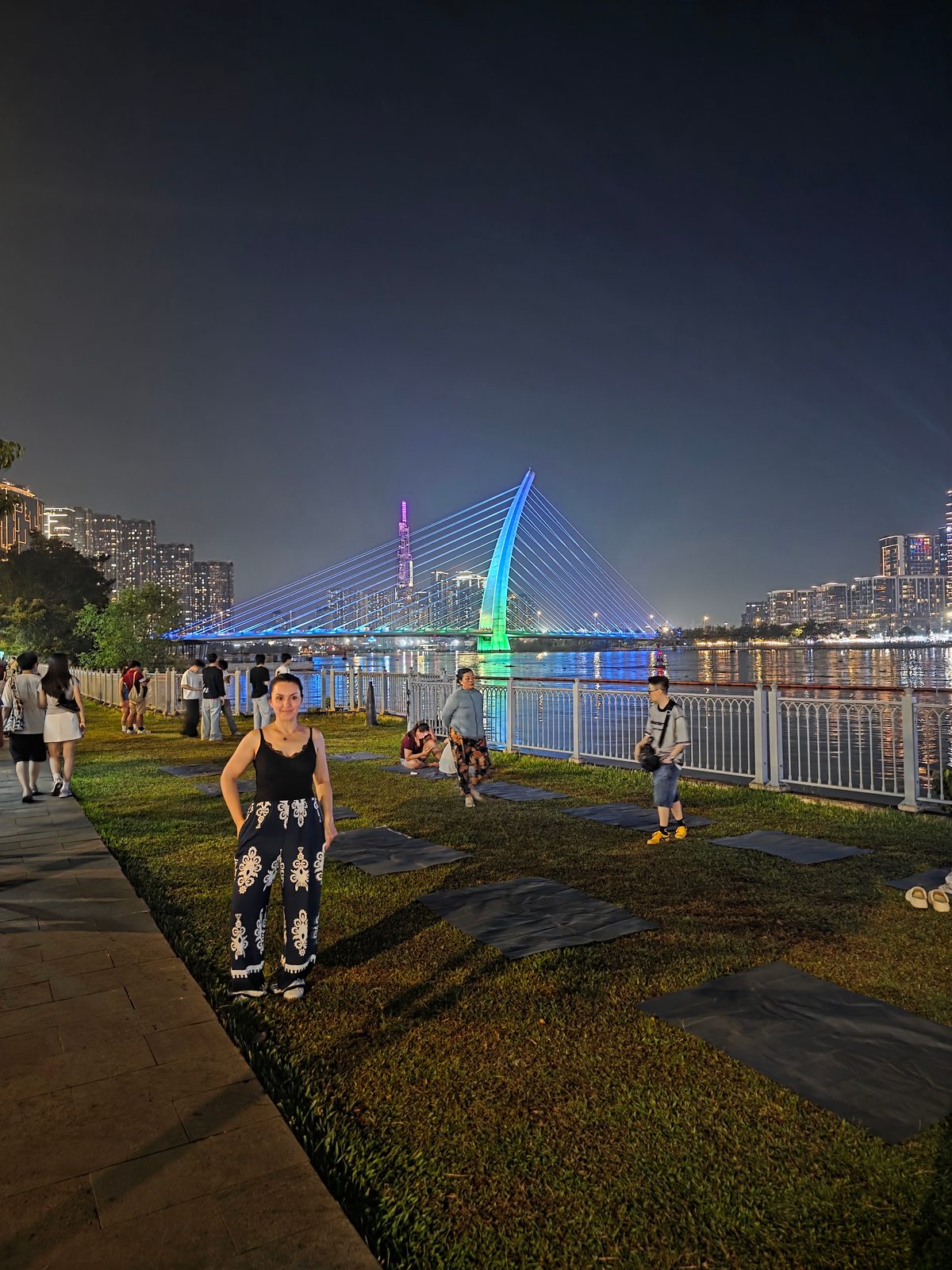
The same bridge, in pink this time. It just can't sit still.
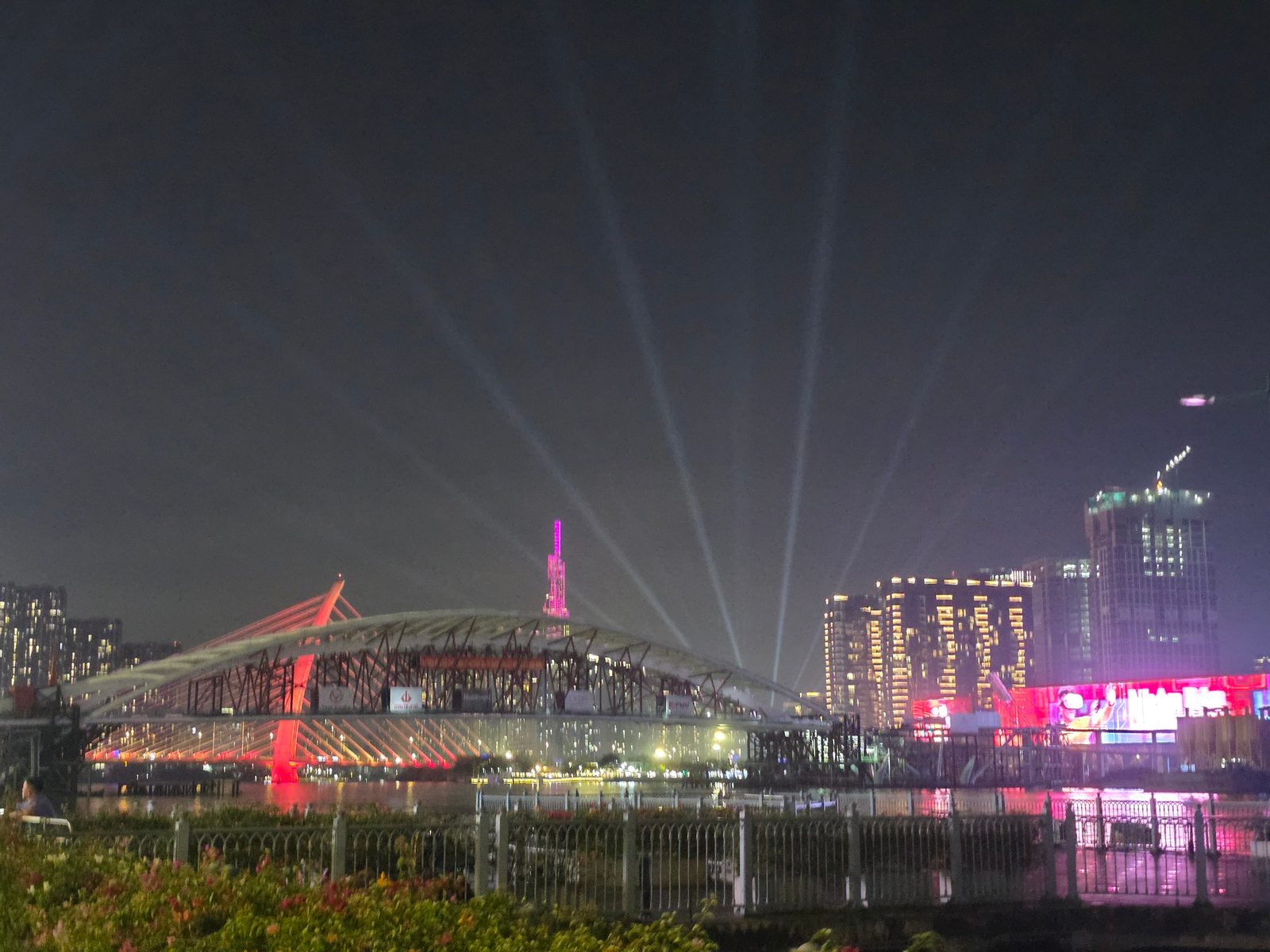
When the bridge puts on its light show.
The Thủ Thiêm 2 Bridge (also called the Ba Son Bridge) opened in April 2022. Its 113-meter (371-foot) pylon leans toward the Thủ Thiêm bank, the new business district across from downtown. Right next to it, the 720-meter (2,362-foot) pedestrian bridge between Bạch Đằng Quay and Thủ Thiêm Park received its last steel sections on October 21, 2026. Opening is planned before Tết 2027. We'll be back to walk across it.
October 31 · noon
Bến Thành, the art of haggling
Last morning in Saigon before the Mekong. First we wander down Lê Công Kiều Street, right behind the market, where antique dealers line up bronze Buddhas, dragons, turtles and unicorns. We were looking for a little souvenir that felt like Vietnam: we leave with a kỳ lân, the Vietnamese unicorn, perched on a seal base. Dragon's head, scaly body, plumed tail, and on the sides of the base, a phoenix, a dragon and a butterfly in relief. Here, the kỳ lân is a sacred animal, guardian of the home and bringer of luck. From now on, it'll be watching over my desk.
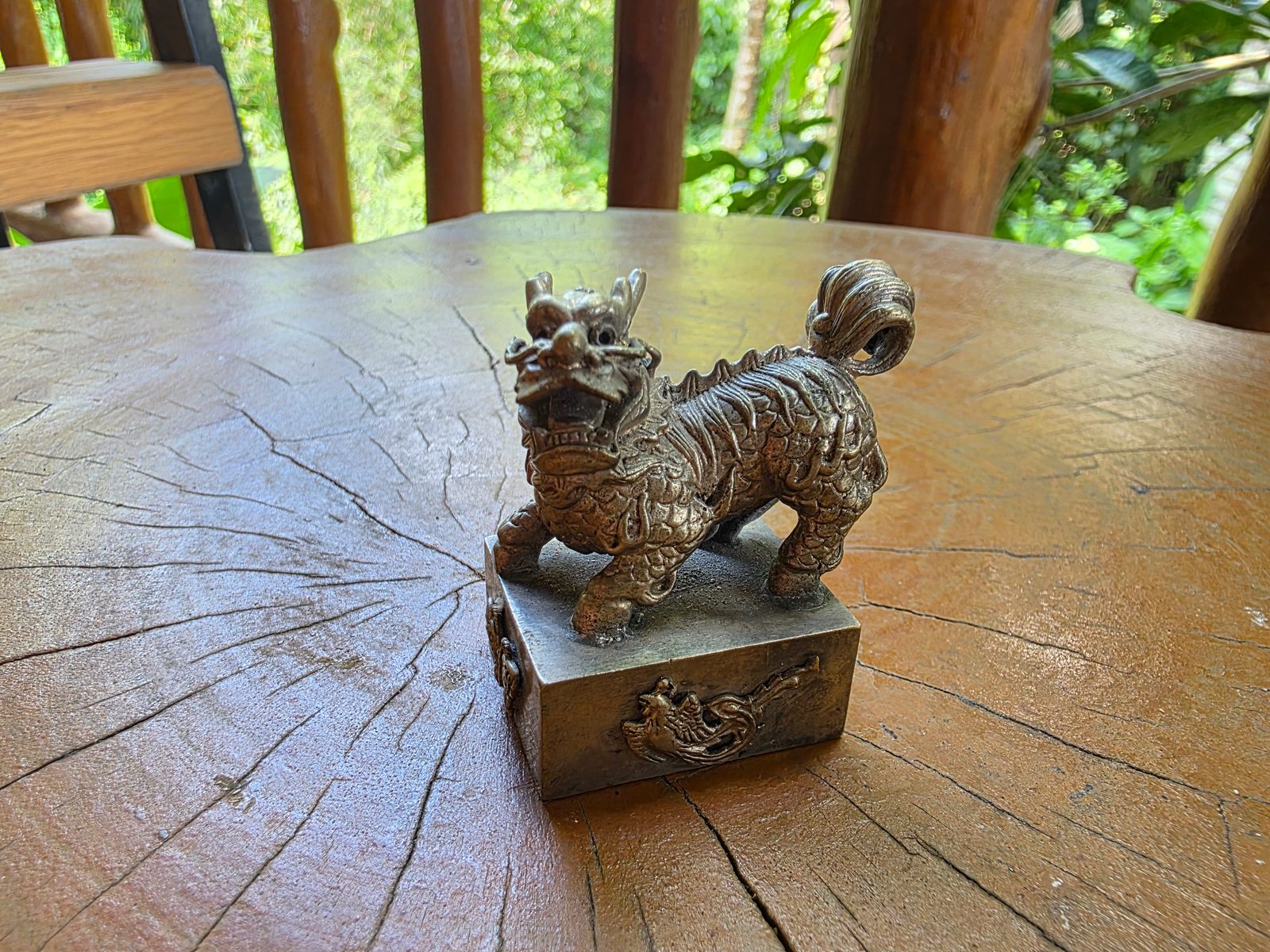
Our kỳ lân. Small, but full of character.
Then Bến Thành Market, the big covered market with the clock tower.
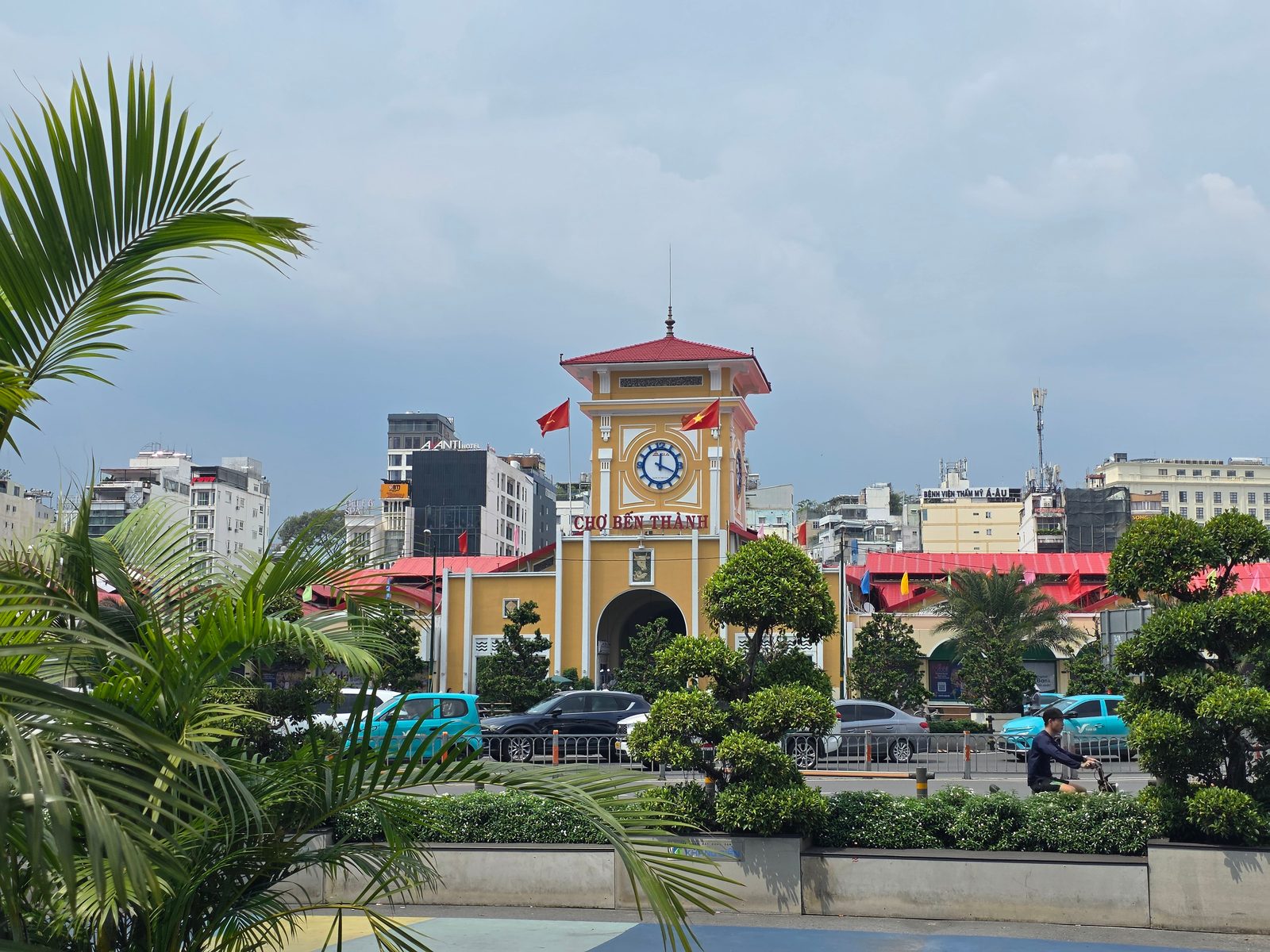
Bến Thành from a distance, before diving in.
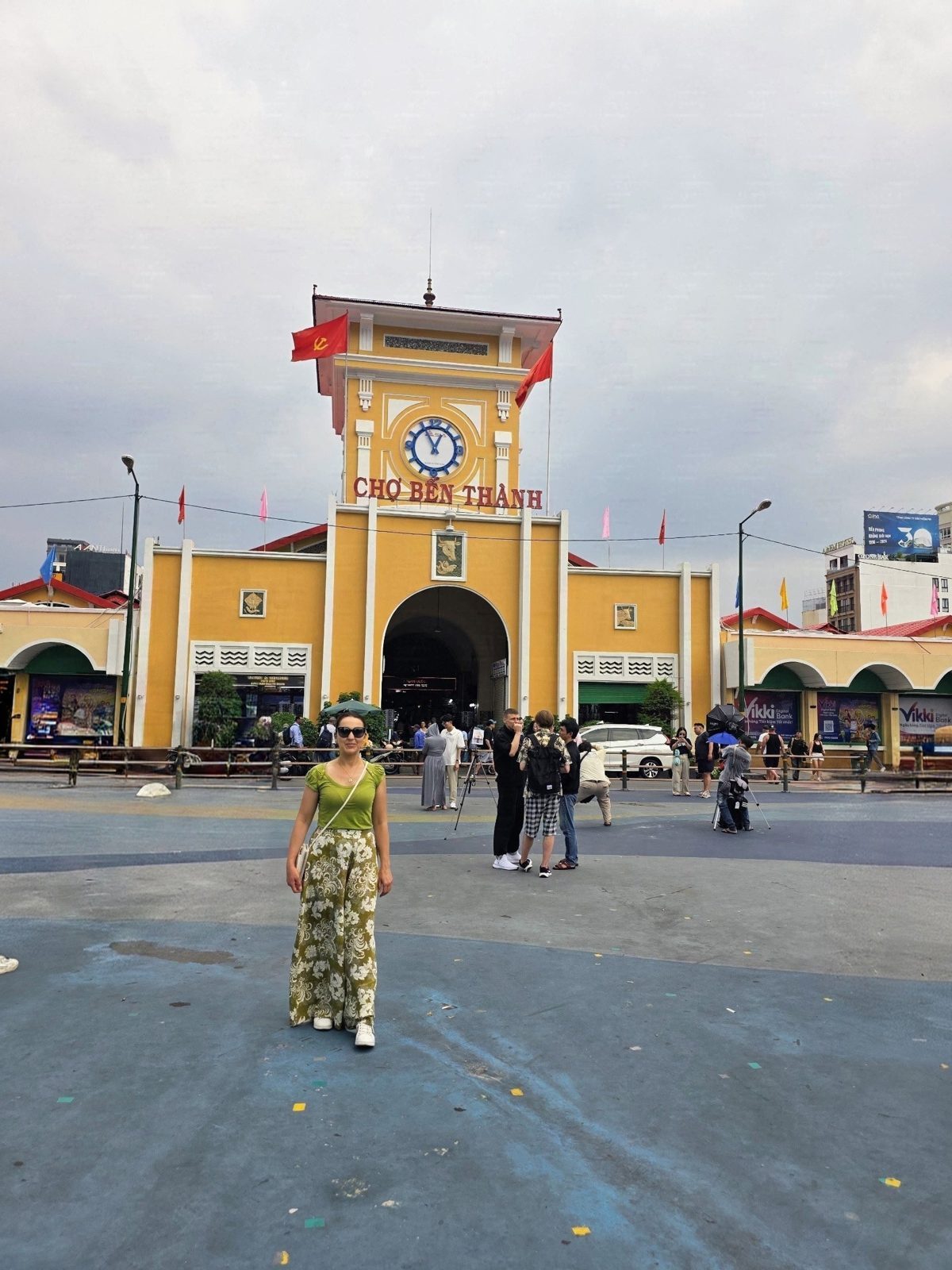
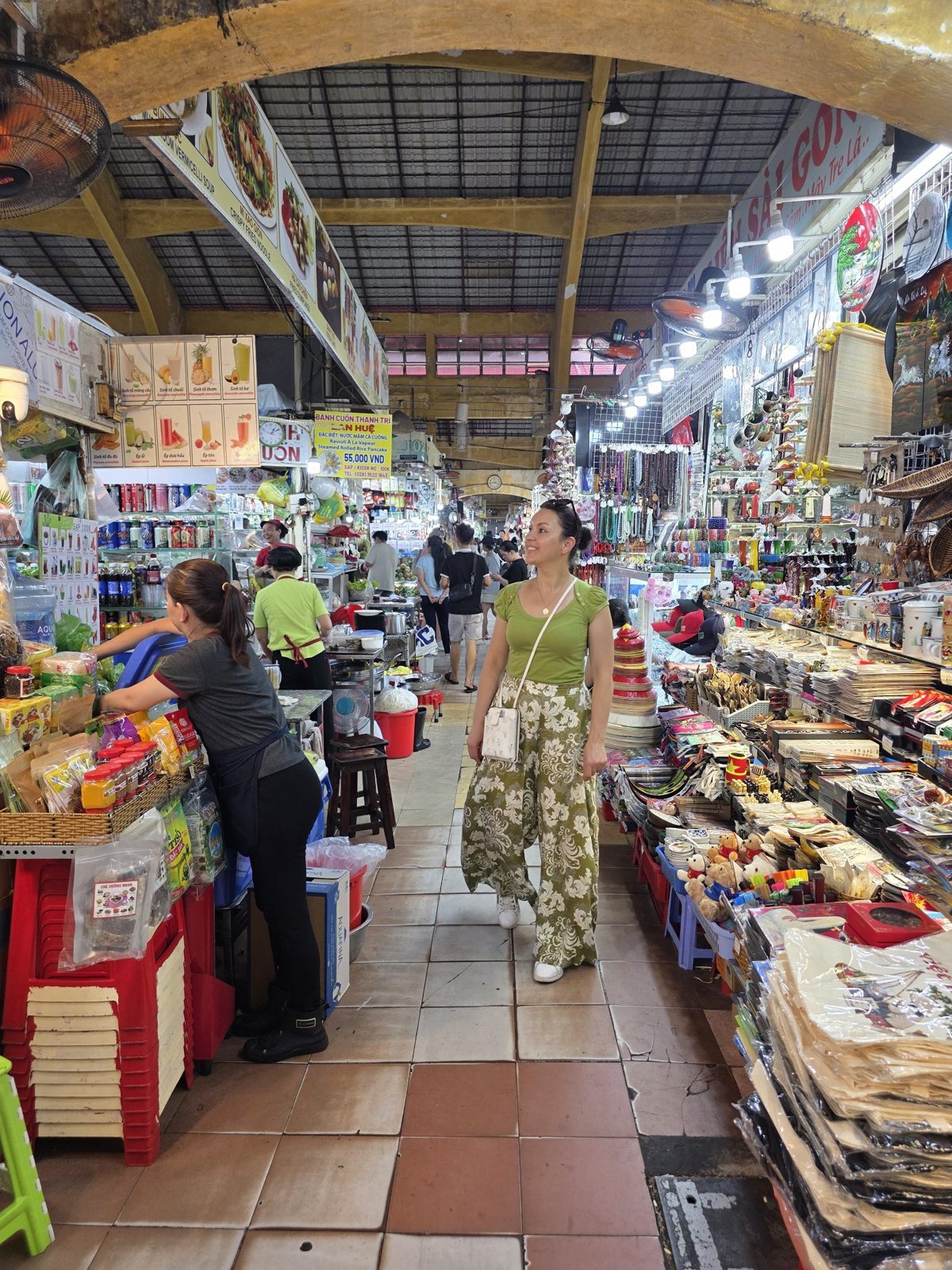
Chợ Bến Thành, its clock tower, and aisles where you don't know where to look.
Inside, narrow aisles of fabrics, hats, coffee and fruit. The fruit stalls are gorgeous, and so are the prices: 220,000 VND (~€7.60) for a kilo of mangosteens, imported from Thailand, hence the price. And in one corner, a heady smell, somewhere between onion and old cheese: durian, the “king of fruits”, often banned in hotels.
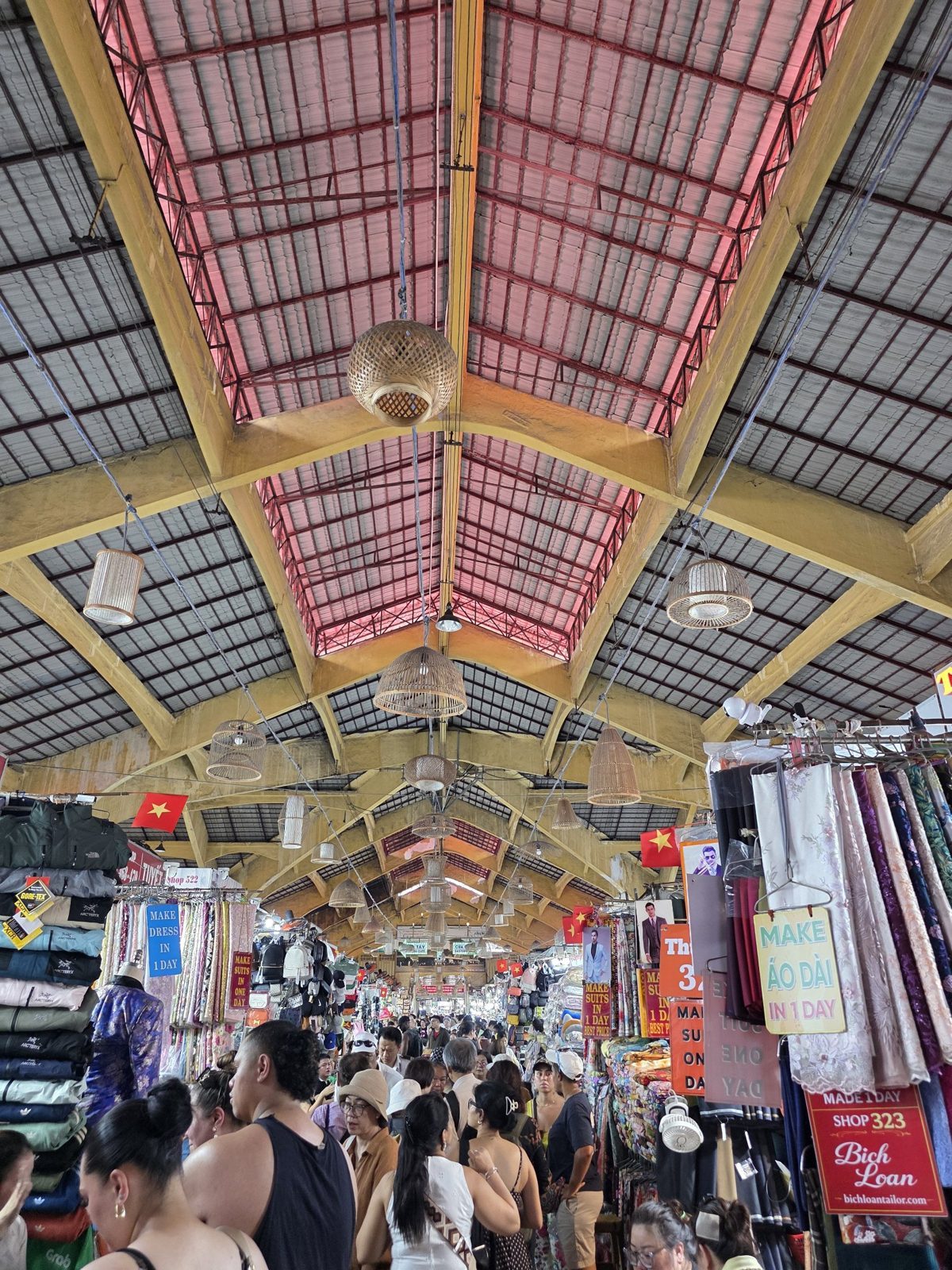
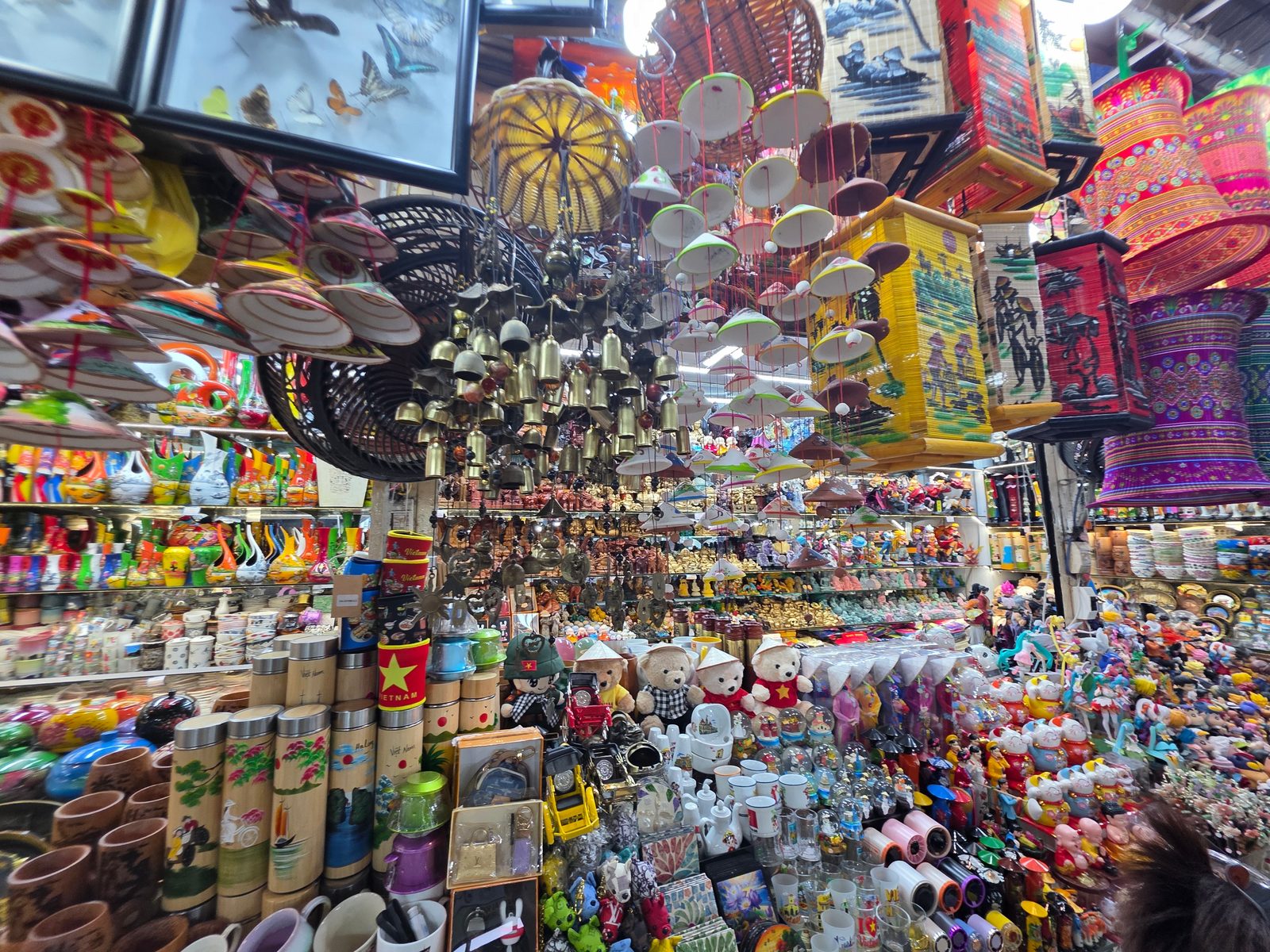
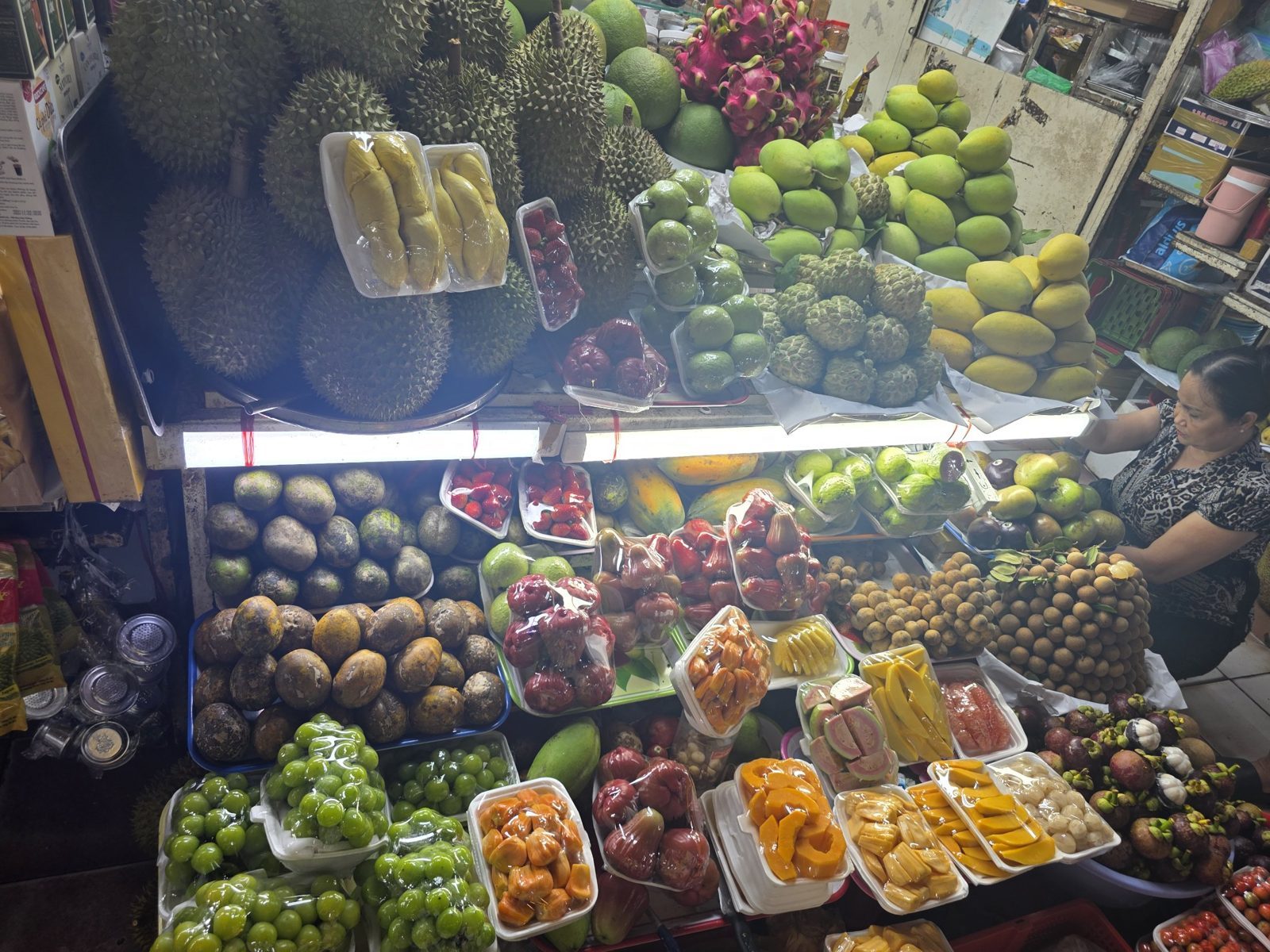
Under the rafters, souvenirs by the hundred and fruit by the mountain.
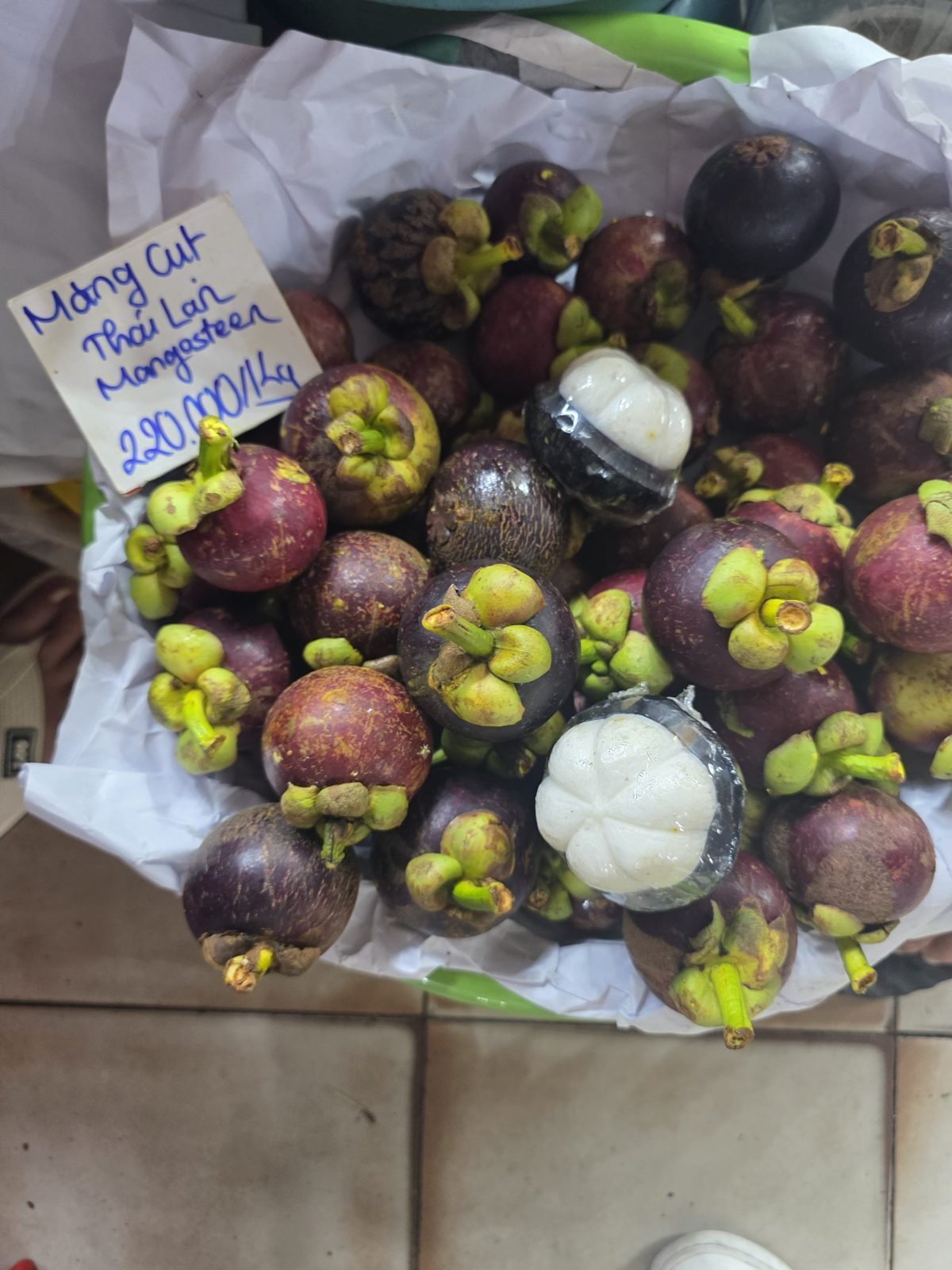
The mangosteen, “queen of fruits”. Thai, and the price tag shows it.
We leave with a pair of sunglasses. Asking price: 800,000 VND. Price paid: 250,000 VND (~€8.60). I won't say how long the discussion lasted.
Haggling at Bến Thành. It's Saigon's most touristy market, and starting prices reflect that. Open at around a third of the asking price, keep smiling, and don't hesitate to pretend to walk away: that's often when the right price shows up.
Just as we're leaving, the sky loses its temper. A tropical downpour, all at once, like someone emptying a bucket. We buy ponchos at the market exit, 10,000 VND (~€0.35) apiece, probably the best investment of the trip. We get back to the hotel with soaking feet, and vegetarian spring rolls to go under our arms for the road.
2 pm, a Grab is waiting. Heading south, to the Mekong Delta.